India-Japan clean energy, semiconductors talks: FM Sitharaman meets JBIC chief in Bangkok
Synopsis
Finance Minister Nirmala Sitharaman's Bangkok meeting with JBIC Governor Amakawa signals a significant deepening of India-Japan economic ties — spanning semiconductors, clean energy, Dholera investment opportunities, and a possible follow-on to the $600 million India-Japan Fund. With geopolitical supply chain realignment accelerating, this bilateral push carries weight well beyond a routine sideline meeting.
Key Takeaways
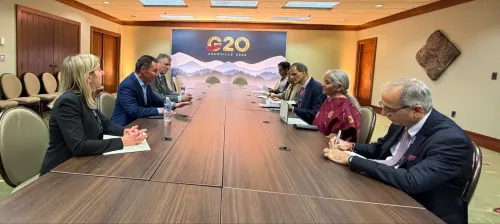
Finance Minister Nirmala Sitharaman met JBIC Governor Kazuhiko Amakawa in Bangkok on 16 October 2026 on the sidelines of the World Bank-IMF Annual Meetings .
Talks covered clean energy , semiconductors , critical minerals , electric mobility , and resilient supply chains .
The $600 million India-Japan Fund and Japanese participation in NIIF were highlighted as key cooperation vehicles.
JBIC expressed hope for a follow-on fund and flagged interest in semiconductor opportunities at Dholera and in AI and data centres .
Sitharaman encouraged Japanese data centre investment in Tier 2 and Tier 3 cities , specifically citing Visakhapatnam .
Sitharaman also called for faster IMF responses to middle-income countries facing balance-of-payments crises.
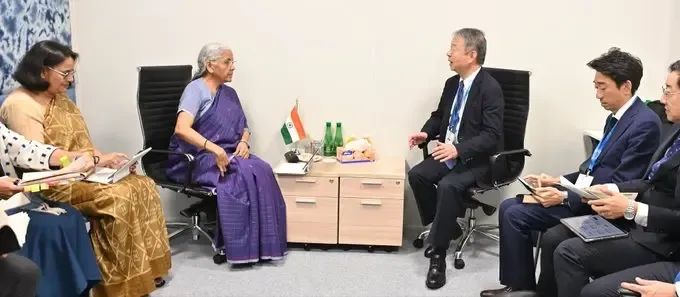
Finance Minister Nirmala Sitharaman on Friday, 16 October 2026, held talks with Japan Bank for International Cooperation (JBIC) Governor Kazuhiko Amakawa on the sidelines of the World Bank-IMF Annual Meetings in Bangkok, with both sides discussing expanded bilateral cooperation in clean energy, semiconductors, and critical minerals.
Key Areas of Discussion
According to the finance ministry, the discussions spanned a wide range of strategic sectors — including clean energy, energy transition, advanced manufacturing, semiconductors, critical minerals, electric mobility, and resilient supply chains. Notably, the talks specifically referenced the $600 million India-Japan Fund and Japanese participation in the National Investment and Infrastructure Fund (NIIF) as vehicles to deepen this cooperation.
JBIC's Growing India Footprint
Governor Amakawa highlighted what he described as the success of the India-Japan Fund, citing its investments in e-mobility and bioethanol, and expressed hope for a follow-on fund. He also noted JBIC's existing stake in the National Industrial Corridor Development Corporation (NICDC) and flagged growing Japanese interest in semiconductors — including opportunities at the Dholera special investment region — as well as in AI and data centres.
Sitharaman's Push for Tier 2 and Tier 3 Investment
Finance Minister Sitharaman used the meeting to encourage Japanese investment in data centres located in Tier 2 and Tier 3 cities, specifically citing Visakhapatnam as a destination, framing this as a means to support balanced urban growth across India. This aligns with the Centre's broader push to decentralise digital infrastructure beyond metropolitan hubs.
India's Broader Agenda at Bangkok Meetings
Earlier on the same day, Sitharaman delivered a keynote address on India's urban development programmes, under the theme 'Working Together to Make Cities Investable — Mobilising Private Capital for Urban and Water Infrastructure', at the World Bank-IMF sidelines. In a separate interaction with the Atlantic Council, she raised concerns about middle-income countries falling into acute balance-of-payments crises and the pace of IMF response. 'The response can't come years afterwards. They approach you in desperation for help and for nearly three or four years, no solution is given,' she said, adding: 'These kinds of things are getting corrected now.'
The India-Japan bilateral economic relationship has gained fresh momentum in recent years, with both governments identifying semiconductors and clean energy as strategic pillars of their partnership. The Bangkok talks come as India accelerates its semiconductor mission and seeks to diversify clean energy supply chains away from single-country dependencies.
Point of View
Not just an investment destination. The push to channel Japanese capital into Tier 2 and Tier 3 data centres is strategically smart — it decentralises digital infrastructure while giving Japan a wider geographic footprint. What remains to be seen is whether the $600 million fund's successor will be structured with stronger employment and transition-linked conditionalities, or remain primarily a returns-driven vehicle.
NationPress
16 Oct 2026
Frequently Asked Questions
What did FM Sitharaman discuss with the JBIC Governor in Bangkok?
Finance Minister Nirmala Sitharaman met JBIC Governor Kazuhiko Amakawa on 16 October 2026 in Bangkok to discuss expanding India-Japan cooperation in clean energy, energy transition, semiconductors, critical minerals, electric mobility, and resilient supply chains. The $600 million India-Japan Fund and Japanese participation in NIIF were specifically discussed.
What is the India-Japan Fund and why does it matter?
The India-Japan Fund is a $600 million bilateral investment vehicle that has already backed sectors such as e-mobility and bioethanol. JBIC Governor Amakawa highlighted its success and expressed hope for a follow-on fund, signalling continued Japanese financial commitment to India's economic transition.
What is India's interest in Japanese investment in Dholera?
Dholera, a special investment region in Gujarat, has been identified as a key site for India's semiconductor ecosystem. JBIC noted growing Japanese interest in semiconductor opportunities there, alongside interest in AI and data centres, aligning with India's broader chip mission.
Why did Sitharaman highlight Visakhapatnam for data centre investment?
Sitharaman encouraged Japanese investment in data centres in Tier 2 and Tier 3 cities, citing Visakhapatnam as a specific example. The push is aimed at supporting balanced urban growth and decentralising India's digital infrastructure beyond major metros.
What did Sitharaman say about the IMF and middle-income countries?
In an interaction with the Atlantic Council in Bangkok, Sitharaman raised concerns that middle-income countries falling into balance-of-payments crises are not receiving timely IMF assistance, sometimes waiting three to four years for solutions. She indicated that corrections to this process are now under way.