South Korea military drill 2025: Suicide drones, robots and KF-21 on show
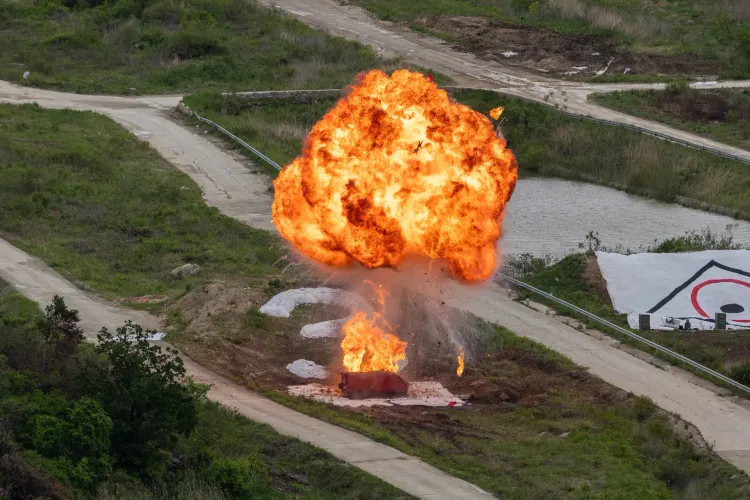
Synopsis
South Korea's biggest integrated live-fire drill of 2025 put AI-guided command systems, loitering 'suicide' drones, and multi-legged robots alongside the homegrown KF-21 jet — all within 25 km of the inter-Korean border. It is the first such exercise under President Lee Jae-myung, and a pointed signal to Pyongyang that Seoul's defence-industrial ambitions have teeth.
Key Takeaways
South Korea held its Combined Joint Live-Fire Exercise at Seungjin Fire Training Field, Pocheon on 29 May 2025 .
1,400 troops from 27 units and 457 pieces of equipment were deployed across all four military branches.
Homegrown assets on show included the KF-21 fighter jet, Chunmoo rocket system, K2 tanks, and K9A1 howitzers.
Unmanned systems — surveillance drones, 'suicide drones', and multi-legged robots — played a central role in both defensive and offensive phases.
An AI-driven command and control centre provided real-time strike recommendations during the exercise.
The drill was the first under President Lee Jae-myung and was attended by over 1,900 people , including 400 citizen observers .
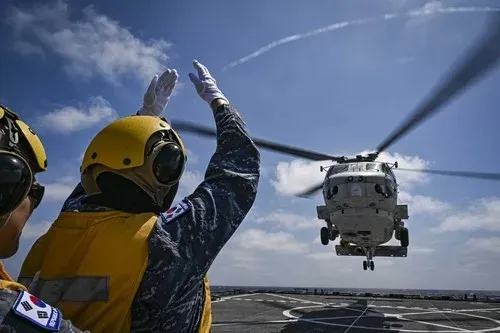
South Korea staged a large-scale integrated military firepower exercise on Thursday, 29 May 2025, deploying advanced homegrown assets — including suicide drones, multi-legged robots and the domestically developed KF-21 fighter jet — in a demonstration of ground and air combat capability at the Seungjin Fire Training Field in Pocheon, just 25 kilometres south of the inter-Korean border.
Scale and Assets on Display
The Combined Joint Live-Fire Exercise mobilised approximately 1,400 troops drawn from 27 units across all four military branches — the Army, Navy, Air Force, and Marine Corps — supported by 457 pieces of equipment. Ground systems on display included the Chunmoo multiple launch rocket system, K2 main battle tanks, and K9A1 self-propelled howitzers.
Unmanned systems, regarded as critical in contemporary warfare, featured prominently. Surveillance drones, loitering munitions commonly referred to as 'suicide drones', and multi-legged autonomous robots were all deployed during the exercise.
How the Drills Unfolded
The exercise was structured in two phases. In the first, troops operated under a simulated enemy attack scenario, using surveillance drones and satellite assets to gather intelligence on a simulated target. An artificial intelligence-driven command and control centre then generated strike recommendations, after which forces executed the defensive mission using a combination of manned platforms, unmanned vehicles, and aerial assets.
The second phase focused on offensive operations against a simulated mechanised enemy force, with assets deployed simultaneously from land and air. Notably, the exercise incorporated manned-unmanned teaming combat systems — a configuration increasingly central to modern military doctrine globally.
Political and Strategic Significance
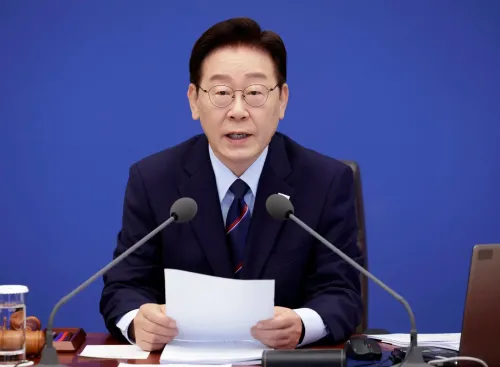
According to reports, this marked the first integrated live-fire exercise conducted under the administration of President Lee Jae-myung, lending it added political weight. The drill at Seungjin was the final public-facing run of the series; two similar exercises had been conducted the previous week.
The event was hosted by Defence Minister Ahn Gyu-back and attended by more than 1,900 people, including 400 citizen observers — a deliberate signal of transparency and public confidence in the country's defence posture.
Why It Matters
The exercise comes amid persistent tensions on the Korean Peninsula and growing global interest in drone and AI-integrated warfare, as evidenced by conflicts in Ukraine and the Middle East. South Korea's emphasis on homegrown platforms — particularly the KF-21 and the Chunmoo system — underscores its push for defence self-reliance and positions it as a credible arms exporter. This is the latest in a series of high-profile demonstrations Seoul has used to signal both domestic capability and deterrence to Pyongyang.
Point of View
It is advertising a doctrine. With the KF-21 programme still in its early operational phase and the global arms market watching, Seoul is simultaneously signalling to Pyongyang and pitching to buyers. The Lee Jae-myung administration, often perceived as more dialogue-oriented toward the North, has chosen a muscular opening statement — one that complicates easy narratives about its strategic direction.
NationPress
19 Sept 2026
Frequently Asked Questions
What is the Combined Joint Live-Fire Exercise held by South Korea?
It is an integrated military drill in which all branches of the South Korean armed forces — Army, Navy, Air Force, and Marine Corps — conduct live-fire operations together. The May 2025 edition at Seungjin Fire Training Field in Pocheon was the final public-facing run of the series and the first held under President Lee Jae-myung.
What weapons and systems were showcased in the drill?
The exercise featured the homegrown KF-21 fighter jet, Chunmoo multiple launch rocket system, K2 tanks, K9A1 self-propelled howitzers, surveillance drones, loitering 'suicide drones', multi-legged autonomous robots, and an AI-driven command and control system.
Where is Seungjin Fire Training Field and why is its location significant?
Seungjin Fire Training Field is located in Pocheon, approximately 25 kilometres south of the inter-Korean border. Its proximity to North Korea makes exercises held there a direct and visible demonstration of South Korea's defensive readiness.
What role did artificial intelligence play in the exercise?
An AI-driven command and control centre processed data collected by surveillance drones and satellite assets and generated real-time strike recommendations for commanders. This reflects a broader shift in South Korean military doctrine toward AI-integrated operations.
Why is this exercise significant under President Lee Jae-myung?
It is the first integrated live-fire drill staged under the Lee Jae-myung administration, according to reports, signalling that the new government intends to maintain a strong public defence posture despite Lee's historically more engagement-oriented stance toward North Korea.