Lee Jae Myung approval rating rises to 34.8% for first time in 10 weeks
Synopsis
After a ten-week freefall from 48.9 per cent to a low of 32.1 per cent mid-week, South Korean President Lee Jae Myung's approval climbed back to 34.8 per cent — driven almost entirely by a single Friday press conference in which he took positions on presidential term extension, indictment cancellations, and troop deployment. The rebound is real but fragile: negative assessments still stand at 63.4 per cent.
Key Takeaways
President Lee Jae Myung's approval rating rose 1 percentage point to 34.8 per cent last week — the first increase in 10 weeks .
The previous high was 48.9 per cent on 13 July 2026 ; the week's intra-week low was 32.1 per cent on Wednesday .
Negative assessments remain elevated at 63.4 per cent , up 0.1 percentage point .
Justice Minister nominee Kim Seung-won and Gender Equality Minister nominee Yong Hye-in both withdrew amid qualification controversies.
Largest age-group recovery was among voters in their 20s , up 5.4 percentage points to 24 per cent .
Survey by Realmeter for EKN newspaper covered 2,507 adults with a ±2 percentage point margin of error at 95 per cent confidence .
South Korean President Lee Jae Myung's approval rating climbed 1 percentage point to 34.8 per cent last week, marking the first upward movement in 10 weeks, according to a survey released by pollster Realmeter on Monday, 21 September 2026. The uptick follows a prolonged slide from a 48.9 per cent rating recorded on 13 July and is largely attributed to Lee's clarification of several contentious political issues at a press conference held on Friday.
What the Poll Found
The Realmeter survey, conducted among 2,507 adults nationwide from Monday to Friday last week, showed positive assessments of Lee's job performance rising to 34.8 per cent, while negative assessments edged up by 0.1 percentage point to 63.4 per cent. Commissioned by EKN newspaper, the survey carried a margin of error of 2 percentage points at a 95 per cent confidence level.
The weekly trajectory tells a telling story: Lee's rating stood at 32.9 per cent on Tuesday and dipped further to 32.1 per cent on Wednesday before recovering to 35.3 per cent on Thursday and 37.2 per cent on Friday — the day he addressed reporters on key policy matters.
What Drove the Earlier Decline
According to Realmeter, Lee's approval had been dragged down at the start of the week by controversies surrounding cabinet nominee vetting and the fallout from recent confirmation hearings. Specifically, the ratings were dented by questions over the qualifications of Justice Minister nominee Kim Seung-won and Gender Equality Minister nominee Yong Hye-in, both of whom subsequently withdrew from consideration.
The pollster noted that the approval rating 'continued to decline due to controversy over personnel vetting and the repercussions of the confirmation hearings' before the press conference reversed the trend.
Why the Press Conference Turned Things Around
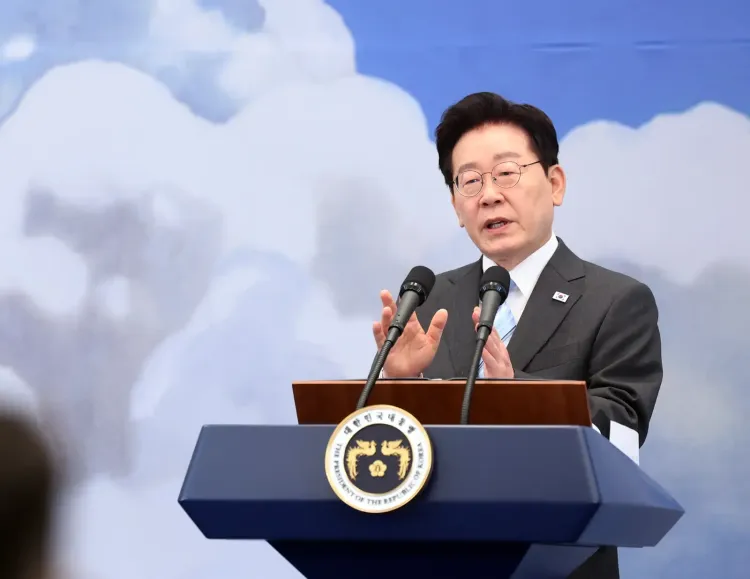
Lee's Friday press conference appears to have stabilised sentiment by addressing three politically sensitive topics: the possibility of a presidential term extension, the cancellation of indictments, and troop deployment policy. Realmeter noted that Lee 'reaffirmed his commitment to reforming state affairs,' which resonated with a portion of the electorate that had grown uncertain about his direction.
Notably, this is the first sign of positive momentum since a steady ten-week descent — a period that coincided with sustained institutional controversy and questions about personnel decisions at the highest levels of government.
Age Group Breakdown
The recovery was sharpest among voters in their 20s, who registered a 5.4 percentage-point increase, pushing support within that cohort to 24 per cent. Those in their 60s saw a 2.9 percentage-point rise to 38.3 per cent, while support among those in their 30s grew by 2.8 percentage points to 29.8 per cent.
However, not all age groups swung positive. Support fell by 2.3 percentage points among those in their 40s to 38.9 per cent and by 1.9 percentage points among those in their 50s to 40.7 per cent, suggesting the press conference had uneven persuasive impact across generations.
What to Watch Next
With negative assessments still dominating at 63.4 per cent, Lee faces a steep challenge to consolidate the modest rebound. How the government handles pending cabinet appointments and whether the tone set at Friday's press conference translates into policy action will likely determine whether this week's uptick is a turning point or a brief respite.
Point of View
And with negative assessments at 63.4 per cent, the floor looks far more solid than any ceiling. The bifurcated age-group response — the under-30s bouncing while the 40s and 50s slipped — suggests the press conference played to a base rather than broadening support. The withdrawal of two cabinet nominees is an accountability marker that mainstream coverage has treated as a footnote; for a presidency already struggling on legitimacy, it compounds the structural challenge ahead.
NationPress
21 Sept 2026
Frequently Asked Questions
Why did South Korean President Lee Jae Myung's approval rating rise last week?
Lee Jae Myung's approval rating rose by 1 percentage point to 34.8 per cent after he clarified his positions on contentious political issues — including presidential term extension, indictment cancellations, and troop deployment — at a Friday press conference. Realmeter noted that this shift reversed a decline driven by cabinet vetting controversies earlier in the week.
How long had Lee Jae Myung's approval rating been falling before this increase?
Lee's approval had been declining for 10 consecutive weeks before last week's uptick. His rating had stood at 48.9 per cent on 13 July 2026 before entering a sustained slide.
Who were the cabinet nominees that withdrew amid controversy?
Justice Minister nominee Kim Seung-won and Gender Equality Minister nominee Yong Hye-in both withdrew from consideration following questions about their qualifications. Their confirmation hearings contributed to the drag on Lee's ratings earlier in the week.
Which age group showed the biggest swing in support for President Lee?
Voters in their 20s recorded the largest increase, rising 5.4 percentage points to 24 per cent. By contrast, support among those in their 40s and 50s fell by 2.3 and 1.9 percentage points respectively.
What is the current negative assessment of President Lee Jae Myung?
According to the Realmeter poll, 63.4 per cent of respondents gave negative assessments of Lee's job performance last week — up 0.1 percentage point from the previous week, even as positive ratings rose. The survey covered 2,507 adults with a margin of error of ±2 percentage points at 95 per cent confidence.