SpaceX Starship 15th flight test: spacecraft caught by tower arms for 1st time
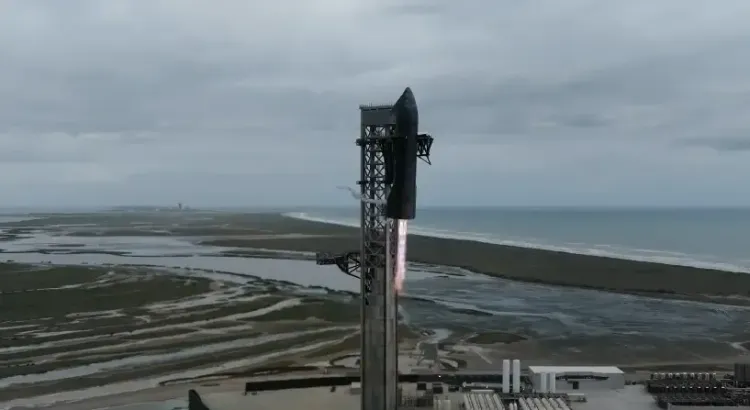
Synopsis
SpaceX's Starship has done what no rocket has done before — returned from orbit and been physically caught by its own launch tower. The 15th flight test, culminating in that tower-arm catch after 22.5 hours in space and a deployment of 26 Starlink V3 satellites, marks a turning point in reusable rocketry and edges Starship closer to its role as NASA's lunar lander.
Key Takeaways
SpaceX Starship completed its 15th flight test on 15 November 2026 from Starbase, Texas .
The launch tower's mechanical arms caught the returning Starship spacecraft — the first time this had ever been achieved.
The mission lasted approximately 22.5 hours , with the spacecraft landing back at 3:20 p.m.
Central Time on Saturday.
Starship deployed 26 Starlink V3 satellites during its orbital phase.
The Super Heavy booster was diverted from its planned tower-catch and made an offshore splashdown in the Gulf of Mexico .
Starship is central to NASA's Artemis lunar programme as the contracted crewed lander.
SpaceX's Starship spacecraft completed its 15th flight test on 15 November 2026, achieving a historic milestone when the launch tower's mechanical arms successfully caught the returning spacecraft — the first time a Starship vehicle had ever been retrieved this way. The mission launched from SpaceX's Starbase facility in Boca Chica, Texas, and concluded approximately 22.5 hours later.
Key Developments
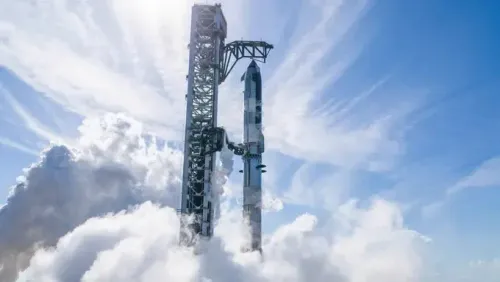
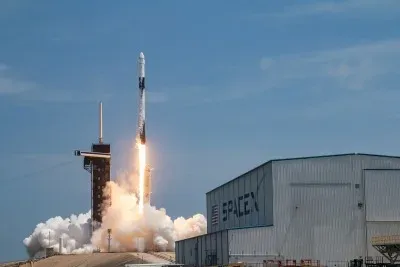
The giant rocket lifted off from Starbase on Friday afternoon. After completing its mission objectives in orbit, the spacecraft returned to the launch site at around 3:20 p.m. Central Time on Saturday, where the tower's mechanical arms — nicknamed 'Mechazilla' by SpaceX enthusiasts — executed the catch successfully.
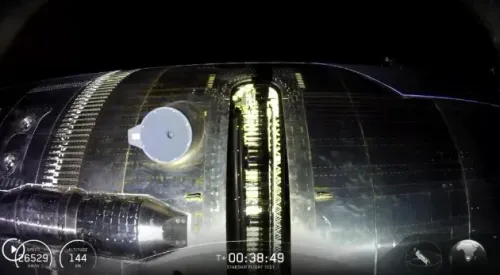
During descent, Starship reignited one of its Raptor sea-level engines to perform a deorbit burn, left Earth orbit, and began its re-entry trajectory. It executed a final swoop manoeuvre over the Gulf of Mexico before approaching the launch site. After emerging through cloud cover, the spacecraft ignited three Raptor engines to execute its landing flip manoeuvre, slowing descent sufficiently for the tower arms to make the catch.
Booster Diversion and Splashdown
The mission was originally designed to attempt the first-ever simultaneous catch of both the Super Heavy booster and the Starship spacecraft in a single flight. However, after stage separation, the booster was diverted from its planned return trajectory and made an offshore splashdown in the Gulf of Mexico, according to reports. The spacecraft catch alone nonetheless represents a significant engineering achievement for the programme.
Payload: Starlink V3 Satellites Deployed
Once in orbit, Starship deployed 26 Starlink V3 satellites — the same number deployed during the previous 14th flight test on 28 September, when Starship reached orbit for the first time. Following payload deployment, the spacecraft entered a prolonged coast phase lasting more than 20 hours before the SpaceX flight control team initiated return procedures.
What This Means for Starship's Future
SpaceX's Starship system — comprising the Starship upper stage and the Super Heavy booster — is designed as a fully reusable transportation architecture capable of carrying crew and cargo to Earth orbit, the Moon, Mars, and beyond. Catching the spacecraft mid-descent eliminates the need for expendable hardware, a core requirement for the economic viability of deep-space missions. This milestone notably advances NASA's Artemis programme, which has contracted Starship as the crewed lunar lander for future Moon missions. With the booster catch yet to be replicated in a combined single-flight scenario, SpaceX is expected to target that objective in upcoming test flights.
Point of View
And that benchmark remains unmet. The programme is progressing rapidly — from explosion-on-pad to orbital flight to tower catch in roughly two years — yet each test also surfaces the next layer of complexity. For NASA's Artemis timeline, already under pressure, Starship's pace of iteration is both reassuring and a reminder that the gap between a hardware milestone and a crewed mission is still substantial.
NationPress
15 Nov 2026
Frequently Asked Questions
What happened during SpaceX's Starship 15th flight test?
Starship's 15th flight test launched from Starbase, Texas on Friday and lasted approximately 22.5 hours. The spacecraft deployed 26 Starlink V3 satellites in orbit and was then caught by the launch tower's mechanical arms upon its return — a first in spaceflight history.
What does it mean for Starship to be 'caught' by the launch tower?
Rather than landing on legs, Starship descended toward the tower and was physically gripped mid-air by large mechanical arms mounted on the launch structure. This approach is designed to enable rapid reuse of the spacecraft without the need for separate landing infrastructure or expendable hardware.
Why was the Super Heavy booster not caught during this flight?
The mission was designed to attempt a simultaneous catch of both the Super Heavy booster and the Starship spacecraft in a single flight. However, after stage separation, the booster was diverted from its planned return trajectory and conducted an offshore splashdown in the Gulf of Mexico.
What satellites did Starship deploy on this mission?
Starship deployed 26 Starlink V3 satellites during its orbital phase. The same number of Starlink V3 satellites had also been deployed during the previous 14th flight test on 28 September.
Why does the Starship programme matter beyond SpaceX?
Starship is contracted by NASA as the crewed lunar lander for the Artemis programme, which aims to return astronauts to the Moon. Its fully reusable design is also central to long-term plans for missions to Mars, making its development milestones significant for both commercial and national space programmes.