Taiwan's NSB flags 9,000 divisive posts after Xi-Trump Beijing meet
Synopsis
Taiwan's spy chief told lawmakers that nearly 100 coordinated account groups flooded social media with over 9,000 divisive posts the moment Trump left Beijing — all pushing the CCP line that reunification means peace and that US backing is unreliable. The scale and timing point to a deliberate influence operation, not organic sentiment.
Key Takeaways
Taiwan's NSB identified nearly 100 suspicious account groups sharing over 9,000 divisive posts after the Trump-Xi Beijing summit .
Posts pushed CCP narratives : reunification brings peace; US support for Taiwan is unreliable.
Accounts lacked normal social connections and posted at fixed intervals — classic coordinated inauthentic behaviour.
NSB Director-General Tsai Ming-yen briefed President William Lai on 17 May and alerted multiple agencies to issue clarifications.
The US State Department reaffirmed no change in Washington's Taiwan policy or arms sales to Taipei.
Xi Jinping told Trump the Taiwan question is 'the most important issue in China-US relations' and warned of potential conflict if mishandled.
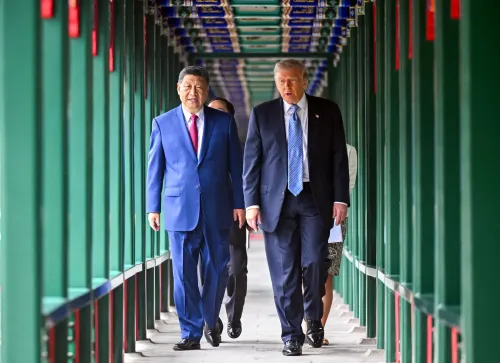
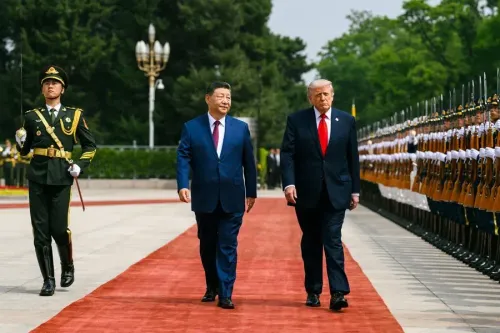
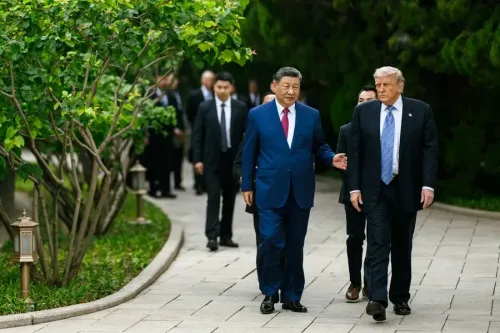
Taiwan's National Security Bureau (NSB) Director-General Tsai Ming-yen has revealed that the agency identified nearly 100 suspicious account groups that collectively shared over 9,000 divisive messages on social media following the summit between US President Donald Trump and Chinese President Xi Jinping in Beijing earlier this month. Tsai made the disclosure on Tuesday, 26 May at a session of the legislature's Foreign Affairs and National Defence Committee in Taipei.
Nature of the Influence Operation
According to Tsai, the suspicious accounts bore hallmarks of coordinated inauthentic behaviour — they lacked normal friend connections or mutual followers and published posts at fixed intervals, closely mirroring narratives pushed by Chinese Communist Party (CCP) state media. The dominant themes, he said, were that reunification with mainland China would bring peace to Taiwan, and that Washington's security commitment to Taipei could no longer be trusted.
After detecting the posts, the NSB alerted several government agencies to issue public clarifications and formally briefed Taiwanese President William Lai on 17 May. Tsai described this as part of the bureau's broader counter-cognitive-warfare mandate.
US Policy Reaffirmation and Trump's Remarks
Tsai noted that the US Department of State subsequently clarified that Washington's policy on Taiwan — including arms sales to Taipei — remained unchanged. He said the statement helped counter social media claims that the US would abandon Taiwan in a crisis.
Trump, speaking to Fox News after concluding his State Visit to China, said he wants both sides to de-escalate. When asked whether Taiwanese people should feel more or less secure following his meeting with Xi, Trump replied: 'Neutral. This has been going on for years,' adding that US policy on Taiwan had not changed. He also said: 'I'm not looking to have somebody go independent. And, you know, we're supposed to travel 9,500 miles to fight a war. I'm not looking for that. I want them to cool down. I want China to cool down.'
Xi Jinping's Position at the Summit
During the Beijing talks, Xi Jinping described the Taiwan question as 'the most important issue in China-US relations.' A statement from the Chinese Ministry of Foreign Affairs quoted Xi as warning that if the issue is mishandled, 'the two countries will have clashes and even conflicts, putting the entire relationship in great jeopardy.' Xi also characterised 'Taiwan independence' and cross-strait peace as 'irreconcilable as fire and water,' and called on the US side to 'exercise extra caution' in handling the matter.
The Broader Context
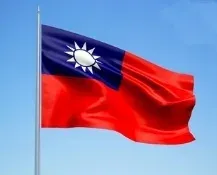
China maintains that Taiwan is an integral part of its territory and has not ruled out the use of force to achieve reunification. Taiwan, backed by strong domestic public support, continues to assert its sovereignty and has consistently responded to Chinese military incursions. This is not the first time Taipei has documented coordinated information operations tied to major diplomatic events — the NSB has flagged similar patterns around previous high-profile US-China interactions.
The episode underscores how geopolitical summits increasingly have a parallel battlespace: the information environment, where state-linked accounts attempt to shape public perception before official narratives can be countered.
Point of View
000 posts from nearly 100 coordinated groups within days of the summit — suggests the CCP's information apparatus was pre-positioned, not reactive. What is notable is the dual target: Taiwanese public confidence in sovereignty and Taiwanese trust in the US security umbrella, both struck simultaneously. Trump's 'neutral' framing, however well-intentioned as de-escalation rhetoric, handed the influence operation a ready-made ambiguity to exploit. Taipei's rapid counter — briefing the president within days and pushing agencies to issue clarifications — shows a maturing institutional response, but the asymmetry remains: seeding doubt is far cheaper than dispelling it.
NationPress
19 Sept 2026
Frequently Asked Questions
What did Taiwan's NSB find after the Trump-Xi Beijing summit?
Taiwan's National Security Bureau identified nearly 100 suspicious account groups that shared over 9,000 divisive social media posts following the Trump-Xi summit in Beijing. The accounts exhibited coordinated behaviour — no normal social connections, fixed posting times — and amplified CCP narratives questioning US support for Taiwan.
What narratives did the suspicious accounts push?
The posts primarily pushed two themes: that reunification with mainland China would bring peace to Taiwan, and that the United States could not be relied upon to defend Taiwan in a crisis. NSB Director-General Tsai Ming-yen described this as part of the CCP's broader cognitive warfare strategy.
How did the Taiwanese government respond to the disinformation campaign?
The NSB alerted multiple government agencies to issue public clarifications and briefed President William Lai on 17 May. The US State Department also reaffirmed that Washington's Taiwan policy and arms sales to Taipei remain unchanged, which Tsai said helped counter the false narratives.
What did Trump say about Taiwan after his Beijing visit?
Speaking to Fox News after his State Visit to China, Trump described his position on Taiwan as 'neutral,' saying the situation 'has been going on for years.' He added that he was not seeking Taiwanese independence and wanted both China and Taiwan to 'cool down,' while reiterating that US policy on Taiwan had not changed.
What was Xi Jinping's message to Trump on Taiwan?
Xi Jinping told Trump that the Taiwan question is 'the most important issue in China-US relations,' warning that mishandling it could lead to clashes or even conflict. He called 'Taiwan independence' and cross-strait peace irreconcilable and urged the US to exercise extra caution on the issue.