Will Tarique Rahman's Leadership Change Bangladesh's Stance on Pakistan?
Synopsis
As Tarique Rahman prepares to lead Bangladesh, how will his policies reshape the nation's relationship with Pakistan? This pivotal moment comes after Muhammad Yunus has improved ties, but concerns linger about security and national sovereignty. Will Rahman's 'Bangladesh first' approach steer the country towards stability?
Key Takeaways
Tarique Rahman emphasizes a 'Bangladesh first' policy to prevent external interference.
Relations with Pakistan are under scrutiny following Yunus's tenure.
Public sentiment strongly opposes a return to the pre-1971 era.
Rahman's leadership may reshape foreign relations with India and Pakistan.
Security concerns remain paramount as military ties between Pakistan and Bangladesh are explored.
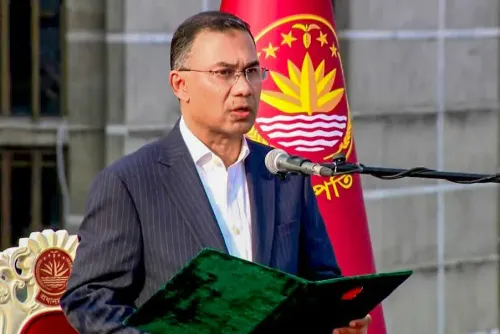
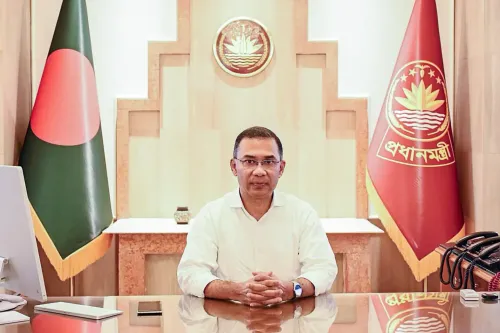
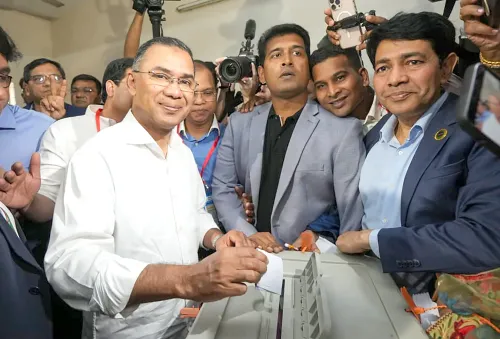
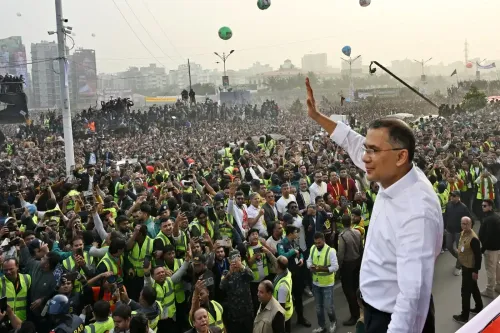
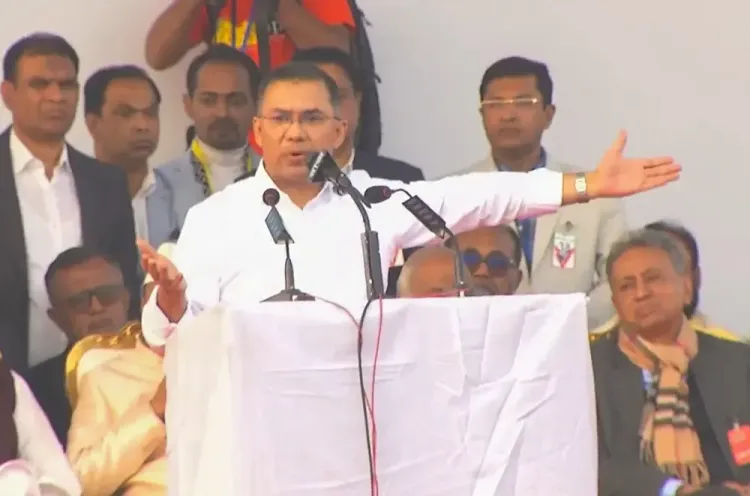
New Delhi, Feb 14 (NationPress) As Tarique Rahman prepares to assume the role of Prime Minister of Bangladesh, the focus shifts to his approach towards Pakistan.
Since Muhammad Yunus took the reins of the interim government in Bangladesh, relations between Dhaka and Islamabad have noticeably improved.
Yunus has faced criticism for conceding too much to Pakistan.
He relaxed visa regulations and granted Pakistan unrestricted access to the maritime territories of Bangladesh, a move that security agencies warn could be exploited by terrorists.
The Bangladesh Nationalist Party (BNP) held power from 2001 to 2007.
Back then, the Indian government and BNP maintained a relationship characterized by fluctuating dynamics.
India frequently accused the prior Bangladesh administration of permitting terrorist activities on its soil.
However, this time around, the situation may differ as Jamaat-e-Islami is not aligned with the BNP as it was in the past.
Officials assert that while it is unrealistic to expect the BNP to completely sever ties with Pakistan, Tarique Rahman will be mindful of the necessity for strong relations with India.
He is likely to maintain standard relations with Pakistan but is expected to prevent the Inter Services Intelligence (ISI) from using Bangladesh as a haven, unlike during Yunus's leadership, as noted by an official.
Another official remarked that for the time being, Pakistan would adopt a wait-and-see strategy, refraining from exerting too much pressure as Tarique Rahman settles into his role.
Tarique Rahman's primary challenge is to restore stability to his violence-plagued nation, which will be his immediate focus, according to the official.
New Delhi, in contrast, would not oppose cordial ties between Dhaka and Islamabad.
However, it would remain cautious if Tarique Rahman emulates Yunus's approach of giving too much leeway to Pakistan.
In recent months, numerous high-profile visits by Pakistan Army and ISI officials have occurred.
During these visits, Pakistan has sought to strengthen military relations.
An official from the Intelligence Bureau expressed concern that these visits aimed to establish bases potentially directed at targeting India.
Abhinav Pandya, the founder of the 'Usanas Foundation' think tank and a Cornell University public affairs graduate, suggests that the BNP has never completely abandoned its Islamic roots.
“Nevertheless, this time it seems likely to adopt a more pragmatic approach. Throughout his campaign, he has emphasized a nation-first policy, which is a positive indication,” he noted.
It is evident that he intends to prevent external interference in Bangladesh's matters, Pandya added.
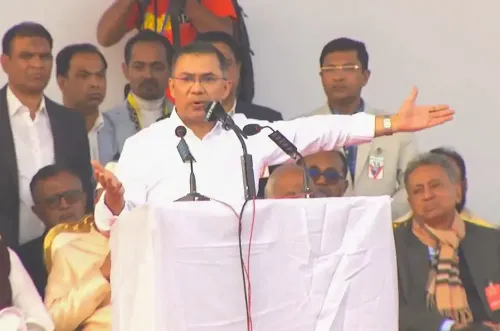
“His slogan, ‘not Dilli, not Pindi... Bangladesh first’, clearly reflects his intent, and he will not permit Pakistan to meddle excessively,” he elaborated.
Tarique Rahman has even criticized the pro-Pakistan Jamaat for siding with Islamabad during the 1971 conflict, he stated.
He accused Jamaat-e-Islami of attempting to deceive the populace with hollow promises.
“This indicates a notable shift, and Tarique Rahman is committed to adhering to his nation-first policy. This marks an improved direction for his foreign relations,” Pandya commented.
Additionally, Tarique Rahman has successfully tapped into the sentiments of the Bangladeshi people.
A significant portion of the populace is opposed to a return to the pre-1971 era.
They recognize that granting Pakistan too much freedom in Bangladesh could lead to a revival of that historical period, according to observers.
Following Yunus's ascent, the Jamaat gained significant influence.
With the ISI, the Jamaat plotted to revert the nation back to pre-1971 conditions.
The citizens were visibly displeased and understood the implications of voting for the Jamaat.
An official conveyed that the public's message was unmistakable: they do not wish for Pakistan to dictate in Bangladesh.
This is something Tarique Rahman is acutely aware of, the official concluded.
Point of View
Particularly in relation to Pakistan. The challenge will be balancing diplomatic relations while addressing the concerns of the populace wary of past alliances. His commitment to a 'Bangladesh first' policy may resonate with citizens seeking stability and sovereignty.
NationPress
22 Sept 2026
Frequently Asked Questions
What is the significance of Tarique Rahman's leadership?
Tarique Rahman's leadership could redefine Bangladesh's foreign relations, especially with Pakistan, as he aims to prioritize national interests and stability.
How have Bangladesh-Pakistan relations changed recently?
Relations have improved under Muhammad Yunus, but concerns about security and national sovereignty persist, especially with recent military ties.
What was the impact of Muhammad Yunus's policies?
Yunus's policies have been criticized for granting too much access to Pakistan, raising security concerns among Bangladeshi authorities.
What is the public sentiment regarding ties with Pakistan?
Many Bangladeshis are apprehensive about a return to pre-1971 conditions and wish to limit Pakistan's influence in their country.
What challenges does Tarique Rahman face?
Rahman must navigate complex foreign relations while addressing domestic stability and public sentiment regarding past alliances.