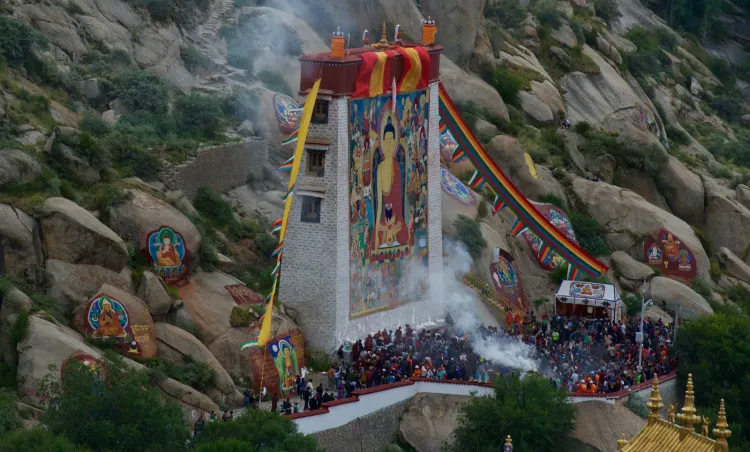
Tibet Buddha site in Drakgo turned into racetrack amid cultural erasure
Synopsis
A site in Tibet's Drakgo County that once held a towering public Buddha statue — removed in December 2021 — has been converted into a horse-racing field. The Bitter Winter report frames it as part of a systematic pattern: remove, replace, overwrite. A monastery school was razed, a forty-foot Guru Rinpoche statue was destroyed on orders, and monks who resisted were detained.
Key Takeaways
A Buddha statue near Ganden Rabten Namgyal Ling Monastery in Drakgo County, Tibet , was removed in December 2021 without official explanation.
The statue's grounds have since been converted into a horse-racing field , according to Bitter Winter .
The statue was relocated inside the monastery's Dukhang , restricting public access and altering its devotional function.
The nearby Ganden Nangten School was closed and demolished; two new buildings of undisclosed purpose were erected in its place.
In November 2021 , monks were reportedly ordered to destroy a forty-foot gold and silver Guru Rinpoche statue ; those who resisted were detained.
The report describes the pattern as one of deliberate cultural replacement — 'They build.
A sacred site in Drakgo County, Tibet, that once housed a towering Buddha statue has been converted into a horse-racing field, according to a report by Italy-based religious freedom publication Bitter Winter. The transformation, which follows the statue's removal in December 2021, is being described as part of a broader, systematic effort to overwrite Tibetan religious and cultural identity in the region.
What Happened at the Site
The Buddha statue once stood prominently near Ganden Rabten Namgyal Ling Monastery in Drakgo County, part of the Garze Tibetan Autonomous Prefecture in China's Sichuan Province. Visible for miles, it served as a public landmark and devotional site for local Tibetans. Chinese authorities removed the statue in December 2021 without providing any official explanation, according to the report. The removal was carried out under tight restrictions, and witnesses reportedly faced serious risks even in documenting the event.
The statue was not destroyed but relocated inside the monastery's Dukhang — the assembly hall — where access is limited to monks and a small number of lay visitors. As the Bitter Winter report noted, 'The statue survives, but its visibility, its function, and its meaning have been radically altered.' The previously vacant grounds have since been converted into a racetrack.
A Pattern of Replacement, Not Just Removal
The Drakgo site is not an isolated case, according to the report. Around the same period, Ganden Nangten School, which had served the local monastic community, was shut down by Chinese authorities and subsequently razed. Two large new buildings were erected in its place, though their purpose has not been disclosed. The report characterised the closure as a signal that 'Tibetan religious education is to be replaced, not repaired.'
In November 2021, monks at the monastery were reportedly ordered to destroy a large statue of Guru Rinpoche — a gold and silver work standing more than forty feet high. Those who resisted the order were, according to the report, detained.
The Broader Cultural Shift in Tibet
The Bitter Winter report argues that Chinese authorities have moved beyond demolition as their primary tool of cultural transformation. 'They build. They remove. They replace. They overwrite. And in doing so, they hope that the memory of what was lost will fade,' the publication stated. This approach — framed publicly as modernisation or renewal — effectively displaces Tibetan religious landmarks with secular or state-aligned structures, critics argue.
The transformation in Drakgo is presented as emblematic of a wider campaign across historical Tibet, one that targets not just physical structures but the community memory and religious practice associated with them. The removal of visible devotional objects from public spaces, the closure of religious schools, and the forced destruction of sacred art form what the report describes as an interlocking pattern.
Context and International Concern
Drakgo County sits within the Garze Tibetan Autonomous Prefecture, a region that has faced sustained international scrutiny over religious freedoms and cultural preservation. Reports of restrictions on Tibetan Buddhist practice, including limits on the display of images of the Dalai Lama and curbs on monastic enrolment, have drawn repeated criticism from human rights organisations and Western governments. China has consistently denied that its policies amount to cultural suppression, characterising them as development initiatives and efforts to counter what it terms 'separatism.'
The conversion of the Buddha statue's grounds into a horse-racing venue adds a new dimension to that ongoing debate — one where the act of replacement is, according to analysts, as significant as the act of removal.
Point of View
Stripped of its public function. The grounds were not left empty; they were repurposed. This is a more sophisticated form of cultural displacement than outright destruction, and harder to contest legally or diplomatically. The pattern — school razed, statue confined, sacred art destroyed on orders — points to a coordinated approach rather than localised administrative decisions. International coverage tends to focus on the most dramatic acts of destruction; the quieter logic of replacement deserves equal scrutiny.
NationPress
13 Sept 2026
Frequently Asked Questions
What happened to the Buddha statue in Drakgo County, Tibet?
The Buddha statue near Ganden Rabten Namgyal Ling Monastery in Drakgo County was removed in December 2021 by Chinese authorities without any official explanation. It was relocated inside the monastery's Dukhang assembly hall, where access is limited to monks and a small number of lay visitors.
What is the site being used for now?
The grounds where the Buddha statue once stood have been converted into a horse-racing field, according to a report by Bitter Winter, an Italy-based religious freedom publication. The site remained vacant for a period following the statue's removal before being repurposed.
Is this an isolated incident or part of a wider pattern?
According to the Bitter Winter report, it is part of a broader pattern. Around the same time, the Ganden Nangten School serving the local monastic community was closed and demolished, and monks were ordered to destroy a forty-foot Guru Rinpoche statue inside the monastery in November 2021.
What is Drakgo County and where is it located?
Drakgo County is part of historical Tibet and is administratively located within the Garze Tibetan Autonomous Prefecture in China's Sichuan Province. The region has been the subject of international concern over religious freedoms and cultural preservation.
How has China responded to such reports?
China has consistently denied that its policies in Tibetan regions amount to cultural suppression, characterising them instead as development initiatives and measures to counter what it describes as separatism. No specific official response to the Drakgo site conversion has been reported.