Trump Addresses White House Correspondents' Dinner
Synopsis
President Donald J. Trump attended the White House Correspondents' Dinner, with the official White House account branding the assembled press as the largest group of 'Trump Derangement Syndrome' sufferers ever — the latest flashpoint in the administration's long-running confrontation with the mainstream media.
Key Takeaways
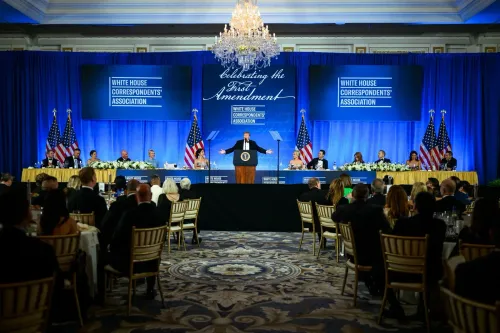
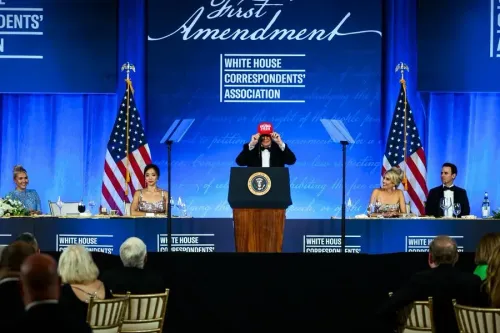
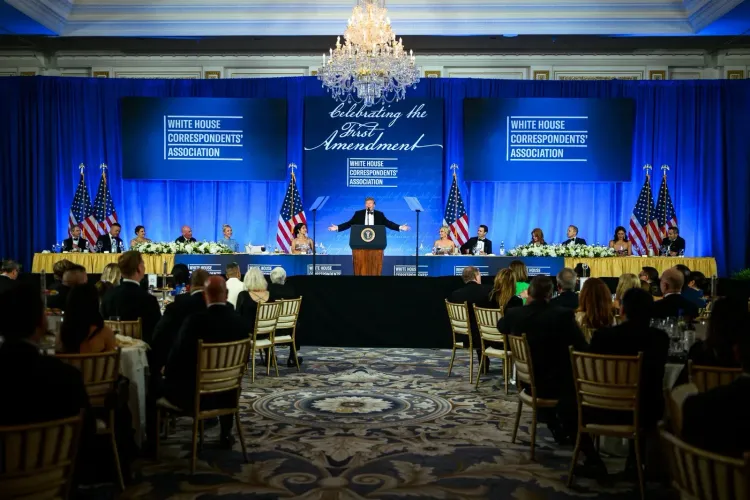
Trump spoke at the White House Correspondents' Dinner on 26 July 2026 .
The official White House X account described the venue as 'the place with the largest group of people suffering from Trump Derangement Syndrome ever.' The phrase 'Trump Derangement Syndrome' has been used by Trump allies since his first term to dismiss intense media criticism of the president.
The post continues a pattern established during the 2017–2021 first term of framing the press corps as institutionally hostile to the administration.
The White House Correspondents' Association has organised the annual dinner since the 1920s as a forum for the president and the Washington press to share the same room.
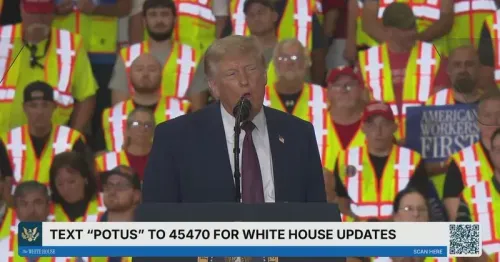
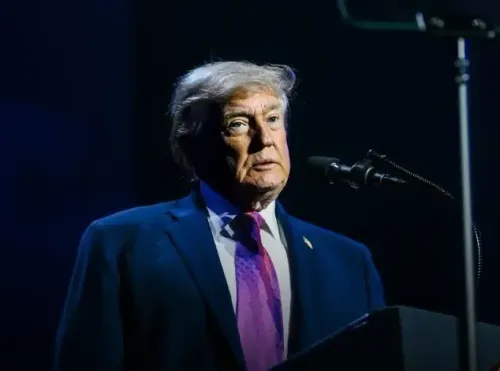
President Donald J. Trump addressed the White House Correspondents' Dinner on Saturday, 26 July 2026, with the White House official account describing the venue as 'the place with the largest group of people suffering from Trump Derangement Syndrome ever.'
Context
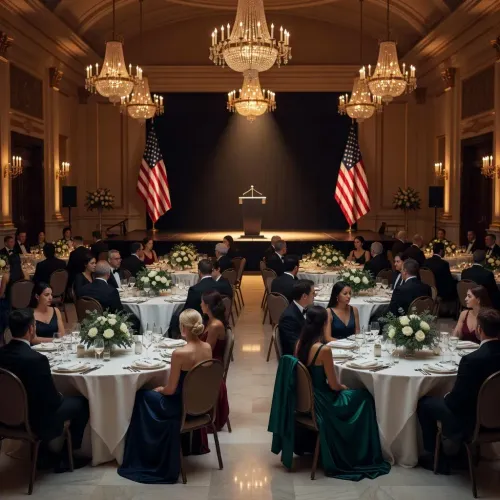
The White House Correspondents' Dinner is an annual gala organised by the White House Correspondents' Association, a tradition dating back to the 1920s. The event brings together the sitting president, senior administration officials, and members of the Washington press corps for an evening that typically features remarks from the president, often laced with humour and pointed commentary.
The White House's post, framing the assembled journalists as sufferers of 'Trump Derangement Syndrome' — a phrase used by Trump allies to dismiss intense criticism of the president — signals the combative tone President Trump brought to the occasion.
Policy Backdrop
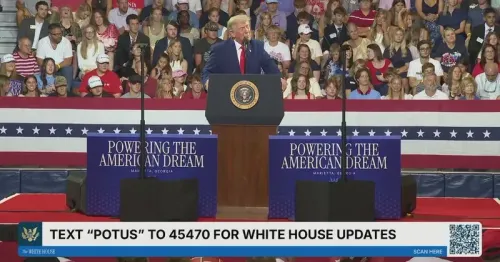
The adversarial posture toward the mainstream press is a defining feature of the Trump political brand. During his first term from 2017 to 2021, the Trump White House repeatedly characterised critical coverage as 'fake news' and curtailed traditional press access in favour of direct social-media communication.
That pattern has continued into the current term, with the administration using its official X account to frame press events through its own editorial lens rather than deferring to conventional news framing. The Correspondents' Dinner post is consistent with this strategy of speaking directly to supporters while simultaneously needling the journalists in the room.
Stakeholders and Impact
The immediate stakeholders are the White House press corps and the White House Correspondents' Association, whose annual dinner has historically served as a moment of uneasy but functional co-existence between the executive branch and the journalists who cover it. A post of this nature from the official White House account sharpens that institutional tension.
For Indian audiences, the dinner and the administration's commentary on it reflect the broader state of executive-media relations in the United States — a dynamic watched closely by democracies worldwide as a barometer of press freedom norms at the world's most powerful executive office.
What's Next
Observers will watch for any announced changes to White House briefing formats, press credentialing policies, or the administration's future participation in Correspondents' Association events. The tone of Saturday's remarks is likely to set the agenda for near-term debate over media access and the relationship between the executive branch and legacy news organisations in Washington DC.
Point of View
Biased media establishment. For democracies watching from abroad, including India, the episode underscores how the executive-media relationship in the United States has been fundamentally recast as a culture-war front rather than an institutional partnership. The longer-term question is whether the Correspondents' Association adapts its format or whether the dinner itself becomes another casualty of that polarisation.
NationPress
26 Jul 2026
Frequently Asked Questions
What is the White House Correspondents' Dinner?
The White House Correspondents' Dinner is an annual gala organised by the White House Correspondents' Association since the 1920s, where the sitting US president delivers remarks before an audience of journalists and senior officials.
What is 'Trump Derangement Syndrome'?
'Trump Derangement Syndrome' is a phrase coined by Trump supporters to describe what they characterise as irrational or extreme hostility toward President Donald Trump, particularly among media figures and political opponents.
Did Trump attend the 2026 White House Correspondents' Dinner?
According to the official White House X post dated 26 July 2026, President Donald J. Trump was present and spoke at the White House Correspondents' Dinner.
Why does Trump criticise the White House press corps?
Trump has maintained a confrontational stance toward mainstream media since his 2016 campaign, repeatedly labelling critical coverage as 'fake news' and favouring direct social-media communication over traditional press access.
How does the US president-media relationship affect India?
India, as a major democracy, closely monitors executive-press relations in the United States as a reference point for global press freedom norms and the evolving relationship between governments and legacy media organisations.