Trump Claims Record ICE and CBP Arrest Rate Under His Watch
Synopsis
The White House on June 26, 2026, quoted President Trump claiming his administration has the highest average daily arrest rate by ICE and CBP — including total detention and final orders of removal — of any U.S. president. The statement underscores the second Trump term's signature focus on maximising interior immigration enforcement.
Key Takeaways
Trump claimed on June 26, 2026 that his administration holds the highest average daily arrest rate by ICE and CBP of any U.S. president.
The claim covers three metrics: average daily arrests, total detention, and final orders of removal.
ICE handles interior enforcement while CBP secures borders; together their statistics are the standard benchmark for comparing immigration enforcement across administrations.
The Obama administration previously set widely cited removal records, with peak years exceeding 400,000 annual deportations.
Trump's first term expanded detention capacity and ended catch-and-release practices; the second term appears to be intensifying those measures.
Congressional appropriations for ICE detention beds and expanded expedited removal authority are the key policy levers to watch going forward.
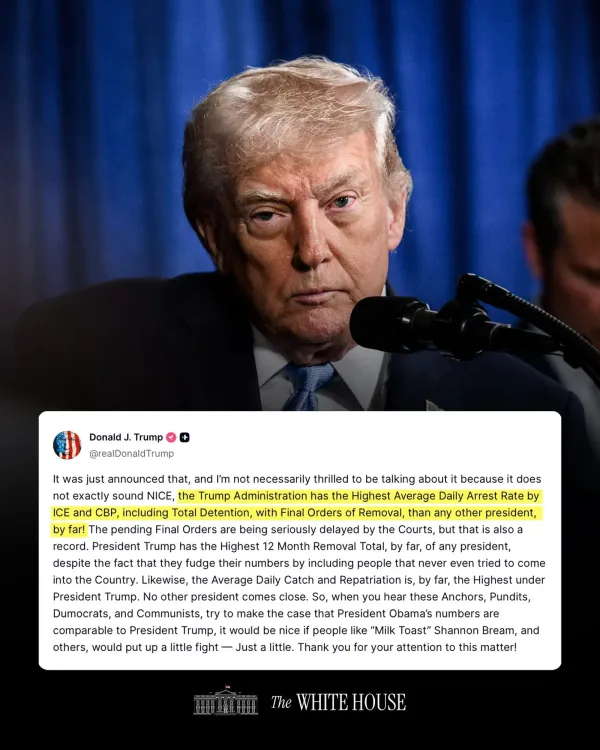
The White House posted on X on Friday, June 26, 2026, quoting President Donald J. Trump claiming that his administration has achieved the highest average daily arrest rate by U.S. Immigration and Customs Enforcement (ICE) and U.S. Customs and Border Protection (CBP) of any president in American history, including total detention figures and final orders of removal.
Context
The post quotes President Trump directly: 'The Trump Administration has the Highest Average Daily Arrest Rate by ICE and CBP, including Total Detention, with Final Orders of Removal, than any other president, by far!' The claim encompasses three distinct enforcement metrics — daily arrests, total detention capacity utilised, and final orders of removal — positioning the current administration as the most aggressive on interior immigration enforcement in U.S. history.
The statement was amplified through the official White House communications account, signalling it as an administration-level policy declaration rather than a campaign message. A linked image accompanied the post, likely containing supporting data graphics.
Policy Backdrop
ICE handles interior enforcement — arresting, detaining, and removing undocumented individuals already within the United States — while CBP secures borders and processes immigration at ports of entry. Together, their combined arrest and detention statistics form the core metrics by which administrations are compared on immigration enforcement.
The Obama administration (2009–2017) set widely cited benchmarks for formal removals, with peak years exceeding 400,000 annual deportations, earning it the informal label of 'deporter-in-chief' from critics. Trump's first term (2017–2021) shifted focus toward interior arrests and expanded detention capacity through executive orders that ended 'catch-and-release' practices and broadened ICE enforcement priorities. The current second term appears to be scaling those measures further.
Successive administrations have differed not just in raw numbers but in methodology — distinguishing between border apprehensions, interior arrests, voluntary returns, and court-ordered removals — making direct comparisons across presidencies technically complex.
Stakeholders and Impact
The primary population directly affected comprises undocumented immigrants residing in the United States, including long-term residents, asylum seekers with pending cases, and individuals with final orders of removal who had previously not been prioritised for arrest. Immigrant-rights advocates have consistently argued that broad enforcement sweeps disrupt communities and separate families.
ICE and CBP personnel, whose operational budgets and staffing levels are tied to congressional appropriations, stand to see continued or expanded resources if the administration uses these record-claim figures to justify further funding requests. The claim also carries political weight domestically, as immigration enforcement remains one of the most consistently polled priority issues among Republican voters.
What's Next
Attention will turn to Congress, where appropriations for ICE detention beds and potential legislative or executive actions expanding expedited removal authority are under active discussion. Independent verification of the specific comparative arrest-rate figures cited by President Trump will be sought by oversight bodies and policy researchers.
The administration's use of enforcement metrics as a political benchmark suggests these numbers will feature prominently in upcoming budget requests and mid-term political messaging, making the accuracy and methodology behind the statistics a likely subject of congressional scrutiny in the months ahead.
Point of View
Not merely a policy outcome. By invoking a 'higher than any other president, by far' standard, the administration is directly contesting the Obama-era deportation record that Democrats once defended and immigration advocates once criticised. The claim also pre-empts congressional budget debates by establishing a performance narrative that justifies sustained or increased funding for ICE and CBP. For Indian-origin and South Asian immigrant communities in the United States — a significant constituency — the broadening of enforcement priorities beyond criminal aliens to a wider undocumented population carries direct and immediate implications.
NationPress
25 Sept 2026
Frequently Asked Questions
What is Trump's claim about ICE and CBP arrest rates?
President Trump claimed on June 26, 2026, that his administration has the highest average daily arrest rate by ICE and CBP, including total detention and final orders of removal, of any U.S. president in history.
How does Trump's immigration enforcement compare to Obama's?
The Obama administration peaked at over 400,000 formal removals annually and was historically cited for high deportation numbers. Trump's claim focuses on average daily arrest rates and detention figures, which use different metrics and make direct comparison technically complex.
What is the difference between ICE and CBP in immigration enforcement?
ICE (Immigration and Customs Enforcement) handles interior enforcement — arresting and detaining undocumented individuals already inside the United States. CBP (Customs and Border Protection) secures the border and processes immigration at ports of entry.
What are 'final orders of removal' in US immigration law?
A final order of removal is a court-issued directive requiring a non-citizen to leave the United States after their immigration case has been fully adjudicated with no remaining appeals. The Trump administration has cited executing these orders as a key enforcement priority.
What happens next with US immigration enforcement policy?
Congressional appropriations for ICE detention beds and potential executive actions expanding expedited removal authority are the immediate policy levers to watch. Independent bodies are also expected to seek verification of the comparative statistics cited by President Trump.