Trump Declares Gulf Nations United Against Iran Threat
Synopsis
In a bold statement, President Trump asserts that the US has severely crippled Iran's military, leading to unprecedented unity among Gulf states against Tehran. This crucial development comes after a series of attacks, reshaping the geopolitical landscape in the Middle East.
Key Takeaways
US military actions have significantly weakened Iran.
Gulf nations are uniting against Tehran.
Focus is on destroying Iran's missile capabilities.
Strait of Hormuz is vital for global oil exports.
Potential for improved Gulf-Israel relations.
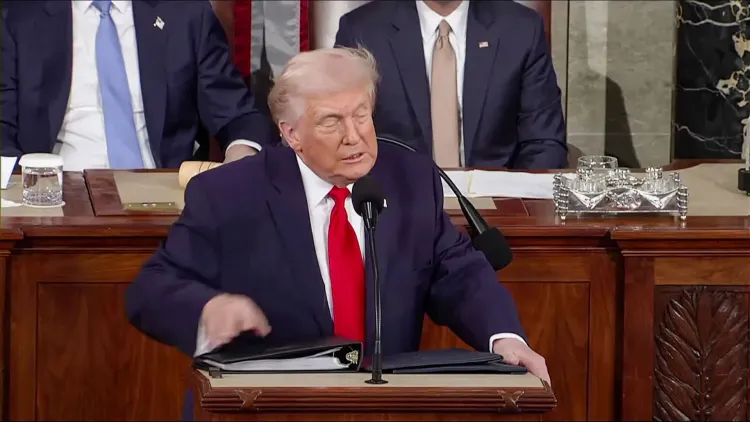
Washington, March 15 (NationPress) President Donald Trump stated that the United States has significantly diminished Iran’s military strength and asserted that this confrontation has fostered a closer bond between Gulf nations and Washington. He emphasized that regional leaders are now more unified in their stance against Tehran following recent assaults.
In a discussion with Fox News Radio’s Brian Kilmeade, Trump claimed that the US initiative has dealt substantial damage to Iran’s missile and drone capabilities.
“We are decimating them,” Trump declared. “We’ve neutralized a majority of their missiles and drones. We’ve also disrupted many of their production facilities where they create these missiles and drones.”
He remarked, “We’re hitting them harder than anyone has since World War II.”
Trump noted that the intensifying conflict has bolstered US connections with Gulf allies after several nations in the area were targeted during this crisis.
“We’re very, very solid. The relationship and unity are remarkable,” he said. “I spoke with most of them today.”
According to Trump, some Gulf countries initially aimed to remain neutral but were compelled into the conflict after attacks attributed to Iran.
“They were hit unexpectedly,” Trump said. “They were trying to stay away and… more or less neutral.”
Trump argued that Iran harbors broader regional ambitions and asserted that the US initiative seeks to prevent Tehran from gaining dominance in the Middle East.
“What Iran aimed to do is take control of the entire Middle East,” he remarked. “If we hadn’t intervened with the B-2 bombers, they would have succeeded.”
The President also claimed that Iran’s military forces have suffered greatly during the confrontations.
“Their Navy has been completely dismantled,” Trump stated. “Their Air Force is gone. Their leadership has been eliminated. Their secondary leadership is gone. Now, their tertiary leadership is in jeopardy.”
He suggested that the campaign has advanced more quickly than anticipated.
“We’re far ahead of schedule, way ahead,” Trump noted. “We had no idea we’d progress this quickly.”
Trump indicated that Iranian missile strikes have sharply reduced as a result of US actions.
“We’ve eliminated nearly 90 percent of their missiles,” he mentioned, adding that the attacks have now decreased to a “trickle.”
When asked about the security of shipping through the Strait of Hormuz, a vital energy transit route, Trump confirmed that the US could provide escort for oil tankers if necessary.
“Well, we would do it if required,” he said. “But we would do it if necessary.”
Trump also stated that the current focus of the US campaign is on destroying Iran’s missile and drone infrastructure rather than capturing its uranium stockpiles.
“No, not at all, and we’re not concentrating on that,” he said regarding the seizure of uranium. “Right now, our priority is to obliterate their missiles and drones.”
The President suggested that Iran’s weakened state could alter regional diplomacy, potentially facilitating the expansion of the Abraham Accords.
“It’s made things considerably easier,” Trump said when asked if Gulf nations might be inclined to normalize relations with Israel.
The Gulf region is home to millions of expatriate workers, including a significant Indian community across Saudi Arabia, Kuwait, Bahrain, and other areas, making the stability of the region a crucial concern for many Asian economies reliant on energy supplies from the Middle East.
The Strait of Hormuz, connecting the Persian Gulf to international shipping lanes, is responsible for a substantial portion of global oil exports. Any disruption in this narrow channel has historically led to volatility in global energy markets and increased security anxieties across the region.
Point of View
The evolving relationship between the US and Gulf states against Iran indicates a strategic shift in Middle Eastern geopolitics that could have lasting implications for regional stability and international relations.
NationPress
24 Sept 2026
Frequently Asked Questions
What has President Trump claimed about Iran's military?
President Trump has claimed that the US has significantly weakened Iran's military capabilities, particularly its missile and drone systems.
How have Gulf states reacted to the US-Iran confrontation?
Gulf states have reportedly become more united and aligned with the US in their stance against Iran following recent attacks.
What is the focus of the US military campaign against Iran?
The current focus of the US campaign is on destroying Iran's missile and drone infrastructure rather than on securing its uranium stockpiles.
What role does the Strait of Hormuz play in global energy supply?
The Strait of Hormuz is a critical shipping route that carries a significant share of the world's oil exports, making any disruptions a major concern for global energy markets.
Could this conflict affect relations between Gulf states and Israel?
Yes, President Trump suggested that Iran's weakening position could make it easier for Gulf states to normalize relations with Israel.