Hormuz Strait to reopen after Iran deal Sunday, Trump claims
Synopsis
Trump's social media post claiming a US-Iran nuclear deal will be signed Sunday — with the Strait of Hormuz reopening immediately after — is the most concrete signal yet that months of high-stakes diplomacy may be reaching a conclusion. With Pakistan's PM also signalling imminent signing, global energy markets and India's oil import calculus are on the line.
Key Takeaways
US President Donald Trump announced on Saturday, 14 June 2025 that a new agreement with Iran is scheduled to be signed on Sunday .
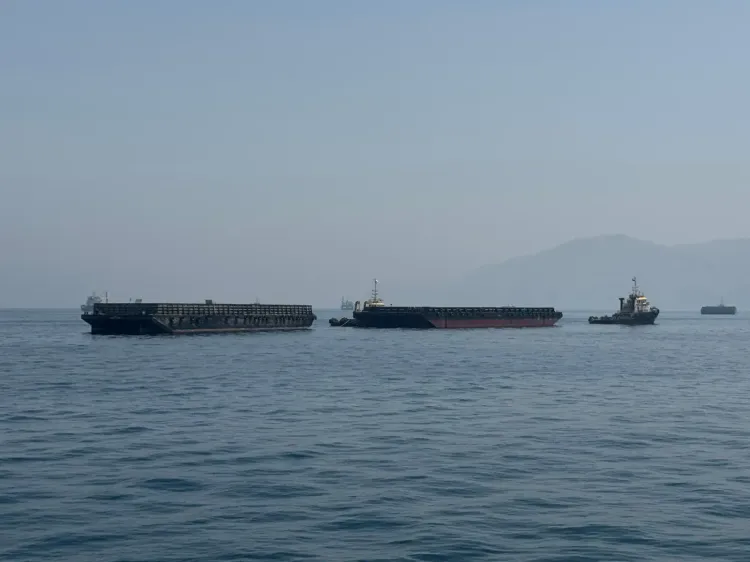
Trump said the Strait of Hormuz would reopen to international shipping immediately after the deal is signed.
The proposed accord would, according to Trump, permanently prevent Iran from obtaining a nuclear weapon — contrasted sharply with the 2015 JCPOA .
Trump stated no money would change hands, unlike the Obama-era deal which he claimed involved $1.7 billion in cash payments.
Pakistan PM Shehbaz Sharif reportedly posted that a peace deal finalisation was expected within 24 hours , with Pakistan preparing for electronic signing.
Trump warned the US retains other options if diplomacy fails, without specifying them explicitly.
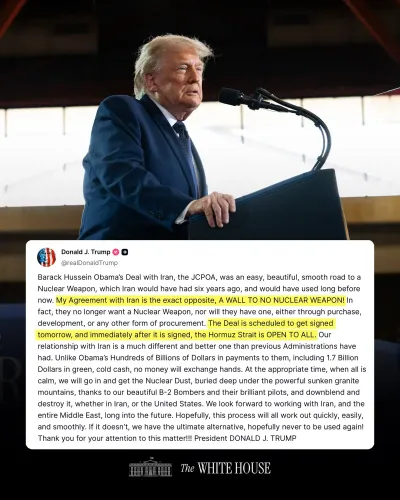
US President Donald Trump announced on Saturday, 14 June 2025, that a new agreement with Iran is set to be signed on Sunday and that the Strait of Hormuz would reopen to international shipping immediately upon the deal taking effect. The announcement, made via a social media post, signals that months of diplomatic engagement between Washington and Tehran may be nearing a conclusion.
What Trump Said About the Deal
'The Deal is scheduled to get signed tomorrow, and immediately after it is signed, the Hormuz Strait is OPEN TO ALL,' Trump wrote in the post. He described the proposed accord as one that would permanently prevent Iran from acquiring a nuclear weapon, drawing a sharp contrast with the 2015 Joint Comprehensive Plan of Action (JCPOA) negotiated under former President Barack Obama.
Trump wrote that the Obama-era deal was 'an easy, beautiful, smooth road to a Nuclear Weapon,' while characterising his own agreement as 'A WALL TO NO NUCLEAR WEAPON.' He also claimed that Iran 'no longer wants a Nuclear Weapon, nor will they have one, either through purchase, development, or any other form of procurement.'
Key Differences from the Obama-Era JCPOA
Trump stressed that, unlike the 2015 JCPOA, no financial transfers would be involved in the new agreement. 'Unlike Obama's Hundreds of Billions of Dollars in payments to them, including 1.7 Billion Dollars in green, cold cash, no money will exchange hands,' he wrote.
He further indicated that nuclear material remaining in Iran would eventually be removed and destroyed. 'At the appropriate time, when all is calm, we will go in and get the Nuclear Dust, buried deep under the powerful sunken granite mountains, thanks to our beautiful B-2 Bombers and their brilliant pilots, and downblend and destroy it, whether in Iran or the United States,' Trump said.
Implications for Global Energy Markets
The reference to the Strait of Hormuz is likely to draw immediate attention from global energy markets. The narrow waterway is one of the world's most critical energy transit chokepoints, carrying a substantial share of internationally traded crude oil and liquefied natural gas. Any disruption — or resolution — in the strait has direct consequences for global oil prices.
India, one of the world's largest importers of crude oil, closely monitors developments in the Gulf region and the Strait of Hormuz given their direct impact on energy security and shipping costs. A reopening of the strait, if confirmed, could ease pressure on Indian import bills and freight rates.
Pakistan's Role and Regional Context
The announcement came alongside a social media post attributed to Pakistan Prime Minister Shehbaz Sharif, which suggested a peace agreement was imminent. 'We are closer to a peace deal than ever before. With finalisation likely expected in the next 24 hours, Pakistan is preparing for the electronic signing of the peace deal immediately after,' the post reportedly said, thanking both the United States and Iran for their roles in the negotiations.
This comes amid a broader regional diplomatic push that has drawn in multiple actors, with the US playing a central mediating role. Notably, Trump also expressed optimism about future ties between Washington and Tehran, writing, 'We look forward to working with Iran, and the entire Middle East, long into the future.'
Trump's Warning if Diplomacy Fails
Despite the optimistic framing, Trump retained a cautionary note. 'Hopefully, this process will all work out quickly, easily, and smoothly. If it doesn't, we have the ultimate alternative, hopefully never to be used again!' he wrote, leaving open the possibility of military or other coercive options if the deal collapses.
The deal, if signed as announced, would represent one of the most significant diplomatic developments in US-Iran relations in a decade. Whether the agreement holds — and whether the Strait of Hormuz reopens as promised — will be closely watched by governments and energy markets worldwide in the hours ahead.
Point of View
No independent verification exists, and the claim that Iran 'no longer wants a nuclear weapon' is an assertion, not a verified commitment. The Strait of Hormuz angle is the real market mover — if the waterway does reopen as promised, it will be read as a major de-escalation; if it does not, credibility costs will be significant. Pakistan's parallel signalling adds another layer of ambiguity: whether Islamabad is a genuine broker or a peripheral actor claiming credit will matter for how durable any arrangement turns out to be.
NationPress
25 Sept 2026
Frequently Asked Questions
What deal did Trump announce with Iran?
Trump announced via social media on Saturday that a new agreement with Iran is set to be signed on Sunday, which he claims will permanently prevent Iran from obtaining a nuclear weapon. He described it as fundamentally different from the 2015 JCPOA, with no financial transfers involved.
Will the Strait of Hormuz reopen after the deal?
According to Trump, the Strait of Hormuz will reopen to international shipping immediately after the deal is signed on Sunday. This claim has not yet been independently verified, and the deal text has not been made public.
How does Trump's deal differ from the Obama-era JCPOA?
Trump claims his agreement permanently blocks Iran from acquiring a nuclear weapon, whereas he characterised the 2015 JCPOA as a 'smooth road' to one. He also stressed that no money will change hands, contrasting it with what he described as billions in cash payments under the Obama administration.
What is Pakistan's role in the Iran deal?
A social media post attributed to Pakistan PM Shehbaz Sharif suggested a peace deal was expected to be finalised within 24 hours, with Pakistan preparing for an electronic signing. The post thanked both the US and Iran for their roles in the negotiations, indicating Pakistan may have played a facilitative role.
Why does the Strait of Hormuz matter for India?
The Strait of Hormuz is one of the world's most critical oil and gas transit routes. India, as one of the largest importers of crude oil globally, is directly affected by any disruption or reopening of the strait, as it influences energy security, oil prices, and shipping costs.