Pentagon opens doors to defence startups under Trump procurement overhaul

Synopsis
The Trump administration is dismantling one of Washington's most entrenched systems — Pentagon procurement — and handing the door keys to startups. With Defence Secretary Hegseth declaring the old bureaucracy was 'built to keep most of you out' and $10 billion in Pennsylvania defence investments announced, this is a direct bet that commercial speed can outpace adversarial threats.
Key Takeaways
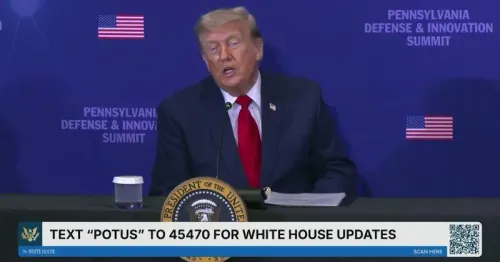
Defence Secretary Pete Hegseth announced a Pentagon procurement overhaul at the Pennsylvania Defense and Innovation Summit on Wednesday .
The administration aims to open military contracts to defence technology startups in AI, autonomy, robotics, and hypersonics.
More than 130 exhibitors participated in the summit, representing a broad cross-section of emerging defence tech firms.
Nearly $10 billion in new defence-related investments were announced across Pennsylvania , covering shipbuilding, missile production, and autonomous systems.
Investor Thomas Tull of TWG Global said the policy shift had already attracted billions in private capital to the defence sector.
Critics have long argued the Pentagon's acquisition system is too slow and too heavily weighted toward established prime contractors.
The Trump administration has pledged to fundamentally overhaul the Pentagon's procurement system, clearing the path for defence technology startups and commercial innovators to compete for military contracts. The push, announced at the Pennsylvania Defense and Innovation Summit on Wednesday, reflects Washington's urgency to accelerate military modernisation in the face of rapidly evolving security threats.
Hegseth's Case Against the Old Guard
Defence Secretary Pete Hegseth, addressing an audience of defence executives, investors, and technology entrepreneurs, said the administration was actively dismantling the bureaucratic structures that had long shielded established contractors from competition. 'Our bureaucracy was built to keep most of you out,' Hegseth said. 'We've been waging a war of attrition against the Pentagon bureaucracy to open up the aperture and make sure competition and speed and innovation and commercial options have a seat at the table.'
He added that procurement decisions must move 'at the speed of business and competition and speed and scale' rather than through drawn-out government processes. 'You shouldn't have to sue your way in to the Department of War, which is what companies in the past have had to do in order to compete,' he said.
Trump Amplifies the Message
President Donald Trump reinforced Hegseth's remarks, recounting conversations with defence industry leaders who described a dramatic shift in the operating environment. 'I was shaking hands backstage, they just came up, and they said, we couldn't even function two years ago in this country,' Trump said. 'We couldn't get anything built. We couldn't get approvals, we couldn't do anything, and now we've never... we cannot imagine the change.'
The summit drew more than 130 exhibitors representing firms specialising in artificial intelligence, autonomous systems, robotics, advanced manufacturing, and aerospace technologies.
Investor Confidence and Private Capital
Investor Antonio Gracias said the reforms were already producing tangible results. 'We are literally seeing an environment in change at the DOD that is allowing these companies to accelerate and unleashing American entrepreneurship in the defence area,' he said.
Thomas Tull, Co-Chairman of TWG Global, said the policy shift had drawn billions in private capital. 'We've invested billions of dollars in defence tech because we know that we need it,' Tull said. 'Without the change that you're causing, these things aren't possible.'
$10 Billion in Pennsylvania Investments
The administration also announced nearly $10 billion in new defence-related investments across Pennsylvania, spanning shipbuilding, missile production, robotics, artificial intelligence, and autonomous military systems. Officials said the investments would strengthen the US defence industrial base while expanding opportunities for both legacy manufacturers and emerging technology firms.
Why This Shift Matters
For years, the Pentagon's acquisition system has drawn criticism for being too slow and structurally biased toward traditional prime contractors, effectively locking out smaller innovators. Hegseth framed the reforms as strategically essential, citing the pace of change in frontier technologies. 'AI and frontier models, autonomy, quantum space, hypersonics — you name it,' he said. 'If you're ahead now and you get ahead of the game, you're going to be way ahead. If you fall behind now, you fall even further behind.'
This marks one of the most direct attempts by any US administration to restructure defence procurement in favour of commercial-first innovation — and the scale of private investor response at the summit suggests the market is taking the signals seriously.
Point of View
But because entrenched prime contractors have had every incentive to keep it closed. Hegseth's language is striking in its candour: admitting the bureaucracy was 'built to keep most of you out' is an indictment of the system his own department runs. The $10 billion Pennsylvania announcement, however, blurs the line between strategic reform and political optics — Pennsylvania is a key swing state, and the geographic concentration of investment invites scrutiny. The deeper question is whether procurement rule changes will survive contact with the contracting bureaucracy, or whether startups will find a new set of barriers once the summit energy fades.
NationPress
15 Oct 2026
Frequently Asked Questions
What is the Trump administration's Pentagon procurement reform?
The Trump administration is overhauling the Pentagon's acquisition system to make it easier for defence technology startups and commercial innovators to compete for military contracts. Defence Secretary Pete Hegseth announced the push at the Pennsylvania Defense and Innovation Summit, citing the need to match the pace of adversarial technological advances.
Why has the Pentagon's procurement system been criticised?
For years, the Pentagon's acquisition process has been criticised for being too slow and structurally biased toward large, established defence contractors. Smaller technology firms have historically struggled to navigate the system, with Hegseth acknowledging the bureaucracy was 'built to keep most of you out.'
What technologies are at the centre of the new defence push?
The administration has highlighted artificial intelligence, autonomous systems, robotics, quantum computing, hypersonics, and aerospace technologies as priority areas. Hegseth argued that falling behind in these fields now would compound the disadvantage over time.
What investments were announced at the Pennsylvania summit?
The administration announced nearly $10 billion in new defence-related investments across Pennsylvania, covering shipbuilding, missile production, robotics, AI, and autonomous military systems. Officials said the investments target both established manufacturers and emerging tech companies.
Who are the key private investors backing US defence tech startups?
Investor Antonio Gracias said reforms at the Department of Defense were already accelerating startup growth. Thomas Tull, Co-Chairman of TWG Global, said his firm had invested billions in defence tech, crediting the administration's policy shift as the enabling factor.