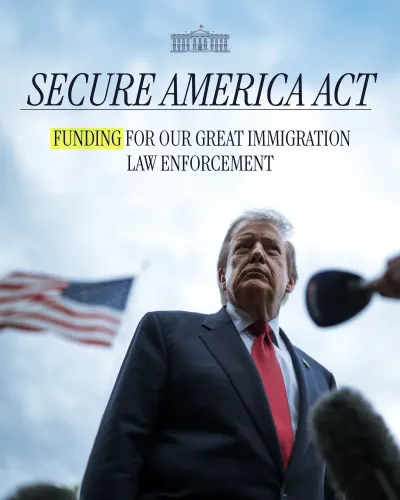
Trump Signs Secure America Act to Fund DHS Through Term End
Synopsis
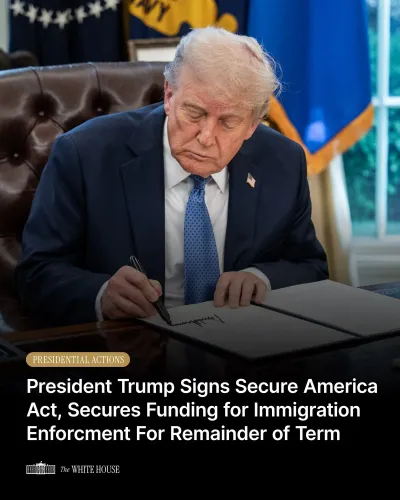
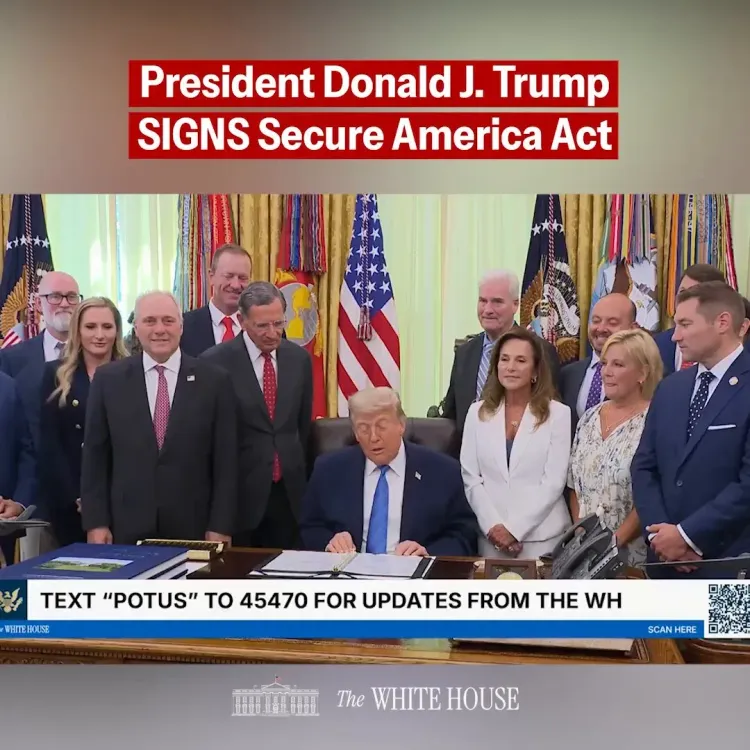
President Donald J. Trump signed the Secure America Act on June 10, 2026, guaranteeing full funding for the Department of Homeland Security through the end of his term, ending the cycle of stopgap appropriations that has long disrupted federal law enforcement operations.
Key Takeaways
President Trump signed the Secure America Act on June 10, 2026 , committing to fully fund DHS through the end of his presidential term.
The White House framed the signing as a direct action in support of American law enforcement, announcing it under the heading 'Fighting for America's Law Enforcement.' The Department of Homeland Security , created after the September 11, 2001 attacks, oversees border security, immigration enforcement, disaster response, and counterterrorism.
Historically, DHS funding has been subject to repeated continuing resolutions and partisan budget standoffs, particularly over immigration policy.
The legislation is expected to benefit the roughly 260,000 federal employees across DHS component agencies, including CBP , ICE , and FEMA .
Congressional oversight committees are expected to scrutinise the act's policy riders and long-term spending commitments.
President Donald J. Trump signed the Secure America Act on Wednesday, June 10, 2026, committing to 'immediately and fully fund' the Department of Homeland Security through the end of his presidential term. The White House announced the signing on X, framing it as a decisive move in support of America's law enforcement apparatus.
Context
In his own words, President Trump declared: 'I'm thrilled to sign the Secure America Act to immediately and fully fund the Department of Homeland Security through the END of my term.' The statement, capitalising 'END' for emphasis, signals an intent to remove the cycle of stopgap funding measures that has historically disrupted DHS operations. The White House framed the signing under the banner of 'Fighting for America's Law Enforcement.'
The Department of Homeland Security was established by the Homeland Security Act of 2002 in the aftermath of the September 11 attacks, consolidating domestic security, border enforcement, immigration processing, and disaster response under a single Cabinet department. It oversees agencies including Customs and Border Protection (CBP), Immigration and Customs Enforcement (ICE), the Secret Service, and the Federal Emergency Management Agency (FEMA).
Policy Backdrop
Funding for DHS has repeatedly become a flashpoint in Congressional budget battles, particularly over immigration enforcement policy. During Trump's first term from 2017 to 2021, lawmakers relied on a series of continuing resolutions and emergency supplemental bills to keep the department operational, often tying funding disputes to broader debates over border wall construction and immigration enforcement priorities.
The pattern of short-term funding patches has long been criticised by federal law enforcement unions and agency administrators, who argue it hampers long-range planning, recruitment, and equipment procurement. A full-term funding guarantee, if enacted through the Secure America Act, would represent a departure from that cycle. Republican administrations have consistently prioritised full and uninterrupted funding for border and interior enforcement agencies as a core platform commitment.
Stakeholders and Impact
The most immediate beneficiaries of guaranteed DHS funding are the roughly 260,000 federal employees across the department's component agencies, including front-line border agents, immigration officers, and disaster response personnel. Sustained appropriations allow agencies to maintain staffing levels, honour existing contracts, and avoid the operational disruptions that accompany government shutdowns or funding lapses.
Immigration advocacy groups and civil liberties organisations are likely to scrutinise the policy riders attached to the legislation, given the administration's stated emphasis on enforcement. State and local law enforcement agencies that receive DHS grants for counterterrorism and emergency preparedness programmes also stand to benefit from funding continuity.
What's Next
Congressional oversight committees will examine the scope of the Secure America Act, including whether it contains mandatory spending floors, enforcement directives, or conditions on how DHS component agencies allocate resources. Any accompanying policy riders on immigration enforcement are expected to draw significant legislative debate. The legislation's durability beyond the current term will depend on whether future Congresses choose to maintain, modify, or repeal its funding provisions. The signing sets a political benchmark that both parties will reference in upcoming appropriations cycles.
Point of View
The Trump administration removes a lever that opposition lawmakers have historically used to extract immigration policy concessions. The framing around law enforcement support is deliberate, appealing to a coalition of federal agency unions, border-state voters, and Republican base voters for whom DHS funding is a proxy for immigration control. Whether the act survives legal or legislative challenge will determine if it becomes a durable policy legacy or a symbolic gesture.
NationPress
14 Sept 2026
Frequently Asked Questions
What is the Secure America Act signed by Trump?
The Secure America Act is legislation signed by President Donald J. Trump on June 10, 2026 , that provides full and immediate funding for the Department of Homeland Security through the end of his presidential term, ending reliance on short-term continuing resolutions.
What does the Department of Homeland Security do?
The Department of Homeland Security is a US Cabinet department established in 2002 that oversees border security, immigration enforcement, counterterrorism, disaster response through FEMA , and protective services through the Secret Service .
Why has DHS funding been controversial in the US Congress?
DHS funding has repeatedly stalled in Congress because lawmakers on both sides have attached immigration policy conditions — such as border wall funding or enforcement restrictions — to appropriations bills, leading to government shutdowns and stopgap measures.
How does the Secure America Act affect US law enforcement?
By guaranteeing full-year funding, the act provides operational certainty to the roughly 260,000 employees across DHS agencies including CBP and ICE , allowing sustained staffing, procurement, and planning without the disruptions caused by funding lapses.
What happens to DHS funding after Trump's term ends?
The Secure America Act funds DHS through the end of President Trump's current term. Beyond that, funding levels will be determined by future Congressional appropriations, and successor administrations may seek to modify or repeal the act's provisions.