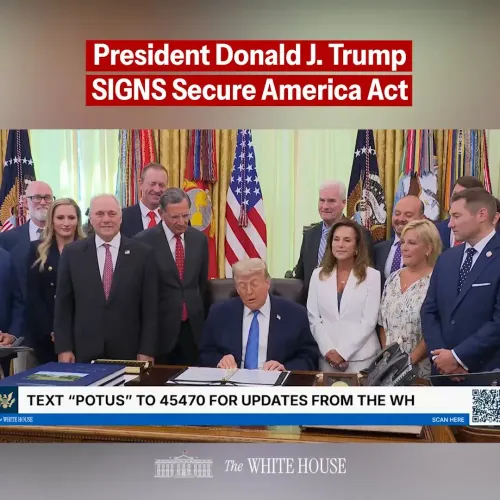
White House Backs Secure America Act to Fund DHS Through Term

Synopsis
The White House on June 12, 2026, announced support for the Secure America Act, which would fully fund the Department of Homeland Security through the end of the presidential term, ending a years-long pattern of short-term continuing resolutions and sharpening border security and immigration enforcement.
Key Takeaways
The White House announced support for the Secure America Act on June 12, 2026 .
The legislation would fully fund the Department of Homeland Security through the end of the current presidential term.
The act is framed as ending reliance on short-term continuing resolutions that have funded DHS since at least fiscal year 2024 .
The White House characterised the bill as ending 'Democrats' political games' over homeland security appropriations.
Key beneficiaries include DHS personnel and border patrol agents , who would gain multi-year funding certainty.
Senate passage remains the critical legislative hurdle before the act can be enacted into law.
The White House on Friday, June 12, 2026, announced its support for the Secure America Act, declaring the legislation would fully fund the Department of Homeland Security (DHS) through the end of the current presidential term and sharpen border security and immigration enforcement.
Context
The official White House account posted that the Secure America Act 'puts an END to Democrats' political games, fully funding the Dept. of Homeland Security through the end of the term to strengthen border security and further enforce immigration laws.' The announcement frames the legislation as a decisive break from what the administration characterises as prolonged partisan obstruction over homeland security appropriations.
DHS was established in 2002 to consolidate border security, immigration enforcement, and domestic counterterrorism functions that had previously been spread across multiple federal agencies. Funding the department has been a perennial flashpoint in congressional budget negotiations.
Policy Backdrop
Throughout fiscal years 2024 and 2025, DHS operations were sustained through a series of continuing resolutions that locked spending at prior-year levels while Congress debated standalone border legislation. Each cycle ended without a full-year appropriations bill, leaving border patrol agents and DHS personnel operating under short-term funding uncertainty.
Republican-led proposals in recent years have consistently emphasised enforcement resources — additional personnel, detention capacity, and physical barriers — while Democratic priorities centred on asylum processing infrastructure and legal immigration pathways. The Secure America Act, as described by the White House, aligns with the enforcement-first approach.
Stakeholders and Impact
DHS personnel and border patrol agents stand to benefit most directly from multi-year funding certainty, which advocates say allows for longer-term hiring, training, and infrastructure planning rather than stop-gap operations. Advocacy groups focused on immigration reform have historically argued that enforcement-only funding packages neglect asylum processing backlogs and humanitarian obligations at the border.
The framing of the act as ending 'political games' signals that the administration intends to use the legislation as a political contrast heading into the remainder of the term, drawing a sharp line between its enforcement agenda and Democratic legislative priorities.
What's Next
Attention now turns to House and Senate floor action on the Secure America Act. Whether the bill can secure the votes needed for passage — particularly in the Senate, where filibuster thresholds have historically complicated immigration and appropriations measures — will determine whether the White House's announcement translates into enacted law.
If passed, full-year DHS funding through the end of the term would mark a significant departure from the continuing-resolution pattern that has defined homeland security appropriations for the better part of a decade. The outcome will likely shape the administration's broader immigration enforcement posture for the remainder of its tenure.
Point of View
The administration is doing as much political work as legislative work — the announcement is as much a messaging salvo as a policy signal. The recurring pattern of continuing resolutions funding DHS reflects a decade-long congressional impasse; whether this act breaks that cycle depends on Senate arithmetic, not just executive enthusiasm. If enacted, it would represent the most durable homeland security funding commitment in years, with real operational consequences for border enforcement capacity.
NationPress
26 Oct 2026
Frequently Asked Questions
What is the Secure America Act?
The Secure America Act is a legislative proposal backed by the White House that would fully fund the Department of Homeland Security through the end of the current presidential term, with a focus on border security and immigration enforcement.
Why has DHS funding been controversial in the US?
DHS funding has been a recurring flashpoint in Congress since the mid-2010s, with Republicans prioritising enforcement resources and Democrats emphasising asylum processing and legal immigration reform, leading to repeated short-term continuing resolutions instead of full-year budgets.
What does full DHS funding mean for border patrol agents?
Full-year funding provides border patrol agents and DHS personnel with greater operational certainty, enabling longer-term hiring, training, and infrastructure investment rather than operating under stop-gap spending measures.
What is a continuing resolution and how does it affect DHS?
A continuing resolution is a temporary spending bill that funds government agencies at prior-year levels when Congress has not passed a full appropriations bill. DHS has relied on multiple such resolutions since fiscal year 2024, limiting its ability to plan and expand operations.
What happens next with the Secure America Act in Congress?
The bill must pass both the House and Senate. The Senate is the key hurdle, as filibuster rules have historically complicated immigration and homeland security legislation, requiring 60 votes to advance most measures.