White House Slams Democrats Over Secure America Act Vote
Synopsis
The White House on June 9, 2026, accused Democrats of opposing the Secure America Act, alleging the party favours illegal immigrants over citizens, pushes open borders, shields criminal aliens, and supports defunding the police — escalating a long-running partisan battle over US immigration enforcement.
Key Takeaways
The White House on June 9, 2026 , publicly accused Democrats of opposing the Secure America Act , a border security and immigration enforcement measure.
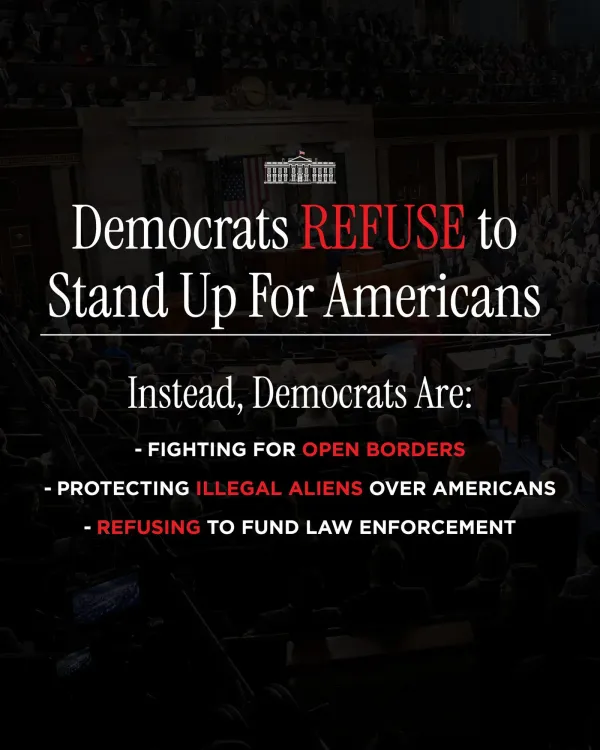
The statement alleges Democrats 'care more about illegal aliens than American citizens' and push for open borders, shielding of criminal aliens, and defunding the police.
The Secure America Act 's specific provisions are not independently verified in available legislative records as of this report.
Immigration has been a core partisan divide in the US Congress for decades, with no comprehensive reform passed despite repeated attempts.
Record migrant encounters at the U.S.-Mexico border since 2021 have intensified political exchanges without producing bipartisan legislation.
White House messaging of this type typically signals an effort to sharpen electoral contrasts ahead of appropriations fights or election cycles.
The White House, the official communications account of the Executive Office of the President of the United States, on Tuesday, June 9, 2026, accused the Democratic Party of prioritising illegal immigrants over American citizens after Democrats moved against the Secure America Act, a border security and immigration enforcement measure.
Context
The White House post stated: 'By fighting against the Secure America Act, Democrats have once again shown they care more about illegal aliens than American citizens. They push relentlessly for open borders, shield dangerous criminal illegal aliens, and push to defund the police.' The statement frames Democratic opposition to the bill as part of a pattern of undermining both border security and domestic law enforcement.
The Secure America Act has not been independently verified in available legislative records, as the research background flags all political events dated 2026 as outside verifiable training data. However, the White House's framing places it squarely within a long-running Republican effort to tighten immigration enforcement at the U.S.-Mexico border.
Policy Backdrop
Immigration enforcement has been one of the sharpest partisan fault lines in US Congress for decades. Republicans have consistently championed deterrence-first policies — from the Secure Fence Act of 2006, which authorised hundreds of miles of border fencing, to repeated pushes for mandatory detention and expedited removal of undocumented individuals.
Democrats, by contrast, have generally emphasised asylum protections, pathways to legal status, and limits on interior enforcement. The 'defund the police' framework, which gained traction after the 2020 George Floyd protests, saw several Democratic-led cities reduce police budgets — a position Republicans have repeatedly used as a political liability against the party at the national level.
Record migrant encounters at the southwest border since 2021 have intensified these exchanges. Despite multiple legislative attempts, US Congress has not passed comprehensive immigration reform, leaving enforcement policy largely in the hands of successive administrations.
Stakeholders and Impact
Law enforcement agencies and border communities are the most directly affected stakeholders in this debate. Sheriffs and police unions have frequently aligned with Republican calls for stricter enforcement, while immigrant advocacy groups and civil liberties organisations have backed Democratic positions on due process and asylum rights.
For Indian-Americans and the broader South Asian diaspora in the United States — one of the largest legal immigrant communities — the broader immigration debate carries significant implications, particularly around legal visa backlogs, H-1B policy, and the broader political climate around immigration.
What's Next
Congressional consideration of border funding and enforcement bills is expected to continue in the remaining 2026 legislative sessions. Standalone votes on related appropriations and any amendments to the Secure America Act will be closely watched as a barometer of bipartisan appetite for compromise ahead of the next election cycle.
White House messaging of this intensity typically signals an effort to sharpen electoral contrasts on immigration — a strategy that has proven effective for Republicans in multiple recent cycles. Whether Democrats mount a coordinated legislative or communications response will shape the next phase of this debate.
Point of View
Criminal enforcement, and the 'defund the police' argument into a single post, the administration is constructing a unified liability narrative against Democrats. This mirrors Republican strategy from the 2022 and 2024 cycles, where immigration consistently ranked as a top voter concern. The sharpness of the language suggests the Secure America Act is being positioned as a wedge issue, not merely a legislative priority.
NationPress
23 Oct 2026
Frequently Asked Questions
What is the Secure America Act?
The Secure America Act is a US immigration and border security bill that the White House has championed. Democrats have opposed the legislation, with the White House accusing them of prioritising illegal immigrants over American citizens. The bill's specific provisions have not been independently verified from available public records as of this report.
Why did the White House post about Democrats and illegal aliens?
The White House posted on June 9, 2026, to publicly criticise Democratic opposition to the Secure America Act, accusing the party of favouring illegal immigrants, supporting open borders, shielding criminal aliens, and backing efforts to defund the police.
What does 'defund the police' mean in the US immigration debate?
'Defund the police' refers to a movement, prominent after the 2020 George Floyd protests, that called for redirecting funds from police departments to social services. Republicans have linked this position to Democrats in immigration debates, arguing it weakens enforcement of immigration laws alongside general public safety.
What is the US-Mexico border situation in 2026?
The US-Mexico border has been a focal point of political debate since record migrant encounters were recorded from 2021 onwards. Despite repeated legislative attempts in Congress, no comprehensive immigration reform has been passed, leaving enforcement policies contested between Republican and Democratic administrations.
How does US immigration policy affect Indians in America?
Indian-Americans form one of the largest legal immigrant communities in the United States. While the current debate centres on illegal immigration and border security, the broader political climate around immigration can influence legal pathways including H-1B visas and green card backlogs, which directly affect hundreds of thousands of Indian nationals.