White House Stands Firm on Trump's Bold Iran Rhetoric
Synopsis
The White House defends President Trump’s aggressive rhetoric towards Iran, asserting it was instrumental in achieving a ceasefire and resuming negotiations after a tense military conflict. Press Secretary Karoline Leavitt emphasizes results over tone, while acknowledging the fragility of the ceasefire agreement.
Key Takeaways
The White House supports Trump's aggressive rhetoric as a strategic tool.
Iran acknowledged pressure leading to a ceasefire.
The ceasefire remains delicate and could face challenges.
Negotiations on long-term security, including nuclear issues, are forthcoming.
Military readiness played a crucial role in negotiations.
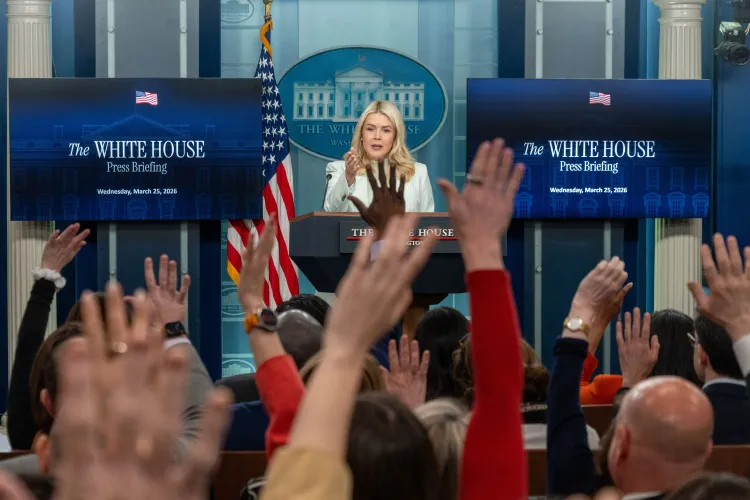
Washington, April 9 (NationPress) On Wednesday, the White House provided a robust defense of President Donald Trump's assertive rhetoric during the recent conflict with Iran, asserting that his statements were pivotal in pushing Tehran towards a ceasefire and resuming negotiations after a prolonged period of military engagement.
This defense came in response to challenging inquiries from journalists regarding the President's choice of words, including his alarming prediction that an entire civilization could face annihilation if a resolution was not achieved.
When pressed on the appropriateness of such language, a reporter questioned: “Why is it suitable for the President of the United States to employ that kind of terminology when discussing civilian targets?”
In response, White House Press Secretary Karoline Leavitt emphasized that outcomes, rather than tone, should be evaluated as the true measure of success.
“What matters most to the President is the results, and indeed, his formidable rhetoric and negotiating tactics have led to the success you are witnessing today,” she stated.
Leavitt further noted that Iran itself had recognized the mounting pressure.
“Iran publicly admitted last night that they sought this ceasefire with the United States because they could no longer endure the relentless bombardment from our highly powerful and lethal military,” Leavitt remarked.
Another reporter expressed concerns about the implications of the President's comments, pointing out that previous U.S. leaders framed conflicts as battles against governments rather than entire populations.
“How can the President assert that America maintains the moral high ground while issuing threats to obliterate civilizations?” the reporter asked.
Leavitt dismissed that characterization, instead highlighting the administration's military strategies over the previous six weeks.
“The President unquestionably holds the moral high ground over the Iranian terrorist regime,” she asserted, labeling any challenge to that stance as “frankly, insulting.”
She maintained that the President's warnings were crucial in determining the outcome.
“I believe it was a very, very strong threat from the President of the United States that compelled the Iranian regime to plead for a ceasefire,” Leavitt stated.
“It was a formidable threat that yielded results,” she continued.
The administration indicated that Iran ultimately consented to reopen the Strait of Hormuz—a critical demand from Washington—after facing a stringent deadline reinforced by the possibility of further military action.
“What did they do? Last night, they consented to reopen the Strait of Hormuz,” Leavitt said.
She also highlighted that these warnings were supported by genuine military preparedness.
“The Pentagon had a target list prepared to strike… had the Iranian regime not complied,” she mentioned, characterizing the threat as “anything but empty.”
The White House has linked this rhetoric directly to a broader military campaign, which it claims created leverage for diplomatic efforts.
“The President's maximum pressure strategy and the leverage established by the success of Operation Epic Fury led to the Iranian regime requesting and ultimately agreeing to a ceasefire proposal with the United States,” Leavitt explained.
However, officials acknowledged that the ceasefire remains unstable.
“This is a delicate truce. Ceasefires are inherently fragile,” Leavitt warned, indicating that disruptions could arise as the agreement takes effect.
She pointed out that damage to Iran's command and control systems during U.S. strikes could complicate communication within the country, potentially affecting compliance in the initial phases.
The administration has now embarked on a two-week negotiation period, with discussions expected to center on long-term security agreements, including Iran's nuclear program.
Point of View
This content reflects a strategic defense of President Trump's rhetoric amidst a complex geopolitical situation. The administration's focus on results rather than language may resonate with certain audiences while raising ethical questions about the implications of threatening entire civilizations.
NationPress
17 Oct 2026
Frequently Asked Questions
What was the outcome of Trump's rhetoric regarding Iran?
The White House claims that President Trump’s assertive rhetoric contributed to Iran agreeing to a ceasefire and resuming negotiations after military confrontations.
How did the White House justify Trump's statements?
White House Press Secretary Karoline Leavitt argued that the results achieved are more important than the tone of the President's language.
What are the potential risks of the ceasefire?
Officials indicated that the ceasefire is fragile and could face disruptions, especially due to damage to Iran's command systems.
What negotiations are expected to follow the ceasefire?
The administration is entering a two-week negotiation phase focusing on long-term security arrangements, including Iran's nuclear program.
What was Operation Epic Fury?
Operation Epic Fury refers to the broader military campaign by the U.S. that the White House claims provided leverage for diplomatic negotiations with Iran.