UN climate chief Simon Stiell urges AI industry to shift to renewables at COP31
Synopsis
At COP31 in Antalya, UN climate chief Simon Stiell told AI companies their 'licence to operate is already on thin ice' — warning that building gas-fired plants to power data centres is incompatible with global climate goals, and that the technology's gains must reach developing nations or risk a two-speed energy transition.
Key Takeaways
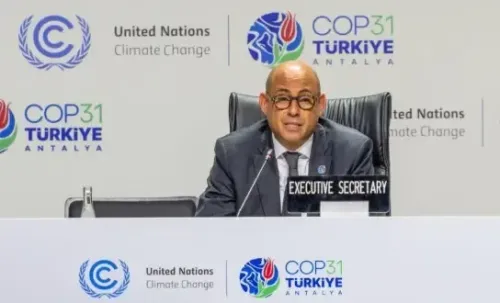
Simon Stiell , UNFCCC Executive Secretary, addressed a Green Digital Action Roundtable at COP31 in Antalya, Turkey on 16 November 2026 .
He warned that surging data centre electricity demand is straining power grids and pushing up costs for households and businesses.
Stiell criticised AI companies building gas-fired power plants on-site to bypass grid constraints, saying this does not remove emissions from the atmosphere.
He called for data centres to run entirely on renewable energy , with efficiency gains reducing absolute emissions rather than enabling further consumption growth.
Tanzania's CLIMAID project, developed by Upendo Ernest Lyimo , won the UN Climate Change AI for Climate Action Award for combining AI and satellite data for climate risk planning.
Stiell flagged that AI and climate policy will be a central issue at Britain's G20 presidency in 2027.
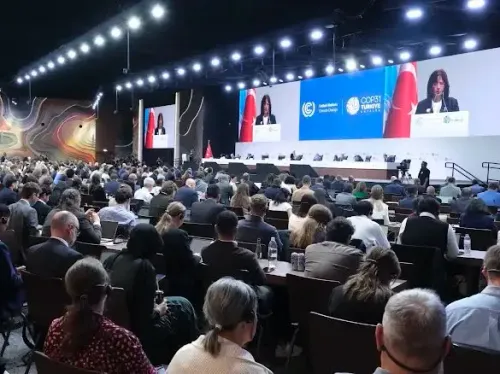
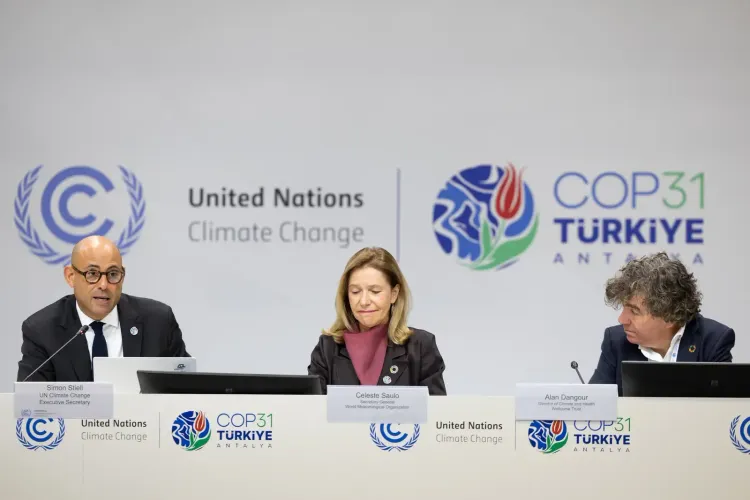
Simon Stiell, Executive Secretary of the UN Framework Convention on Climate Change (UNFCCC), on Monday, 16 November 2026, issued a sharp warning to the global Artificial Intelligence industry, calling on companies to abandon fossil-fuel-powered data centres, invest in renewable energy and ensure that the technology's gains reach developing nations. Stiell delivered the remarks at a high-level Green Digital Action Roundtable on AI held during the final week of COP31, the UN Climate Change Conference convening in Antalya, Turkey's Mediterranean resort city.
AI's Double-Edged Energy Problem
Stiell described AI and other frontier technologies as a 'double-edged sword,' warning that the surge in electricity demand from data centres was straining power systems, pushing up costs for households and businesses, and jeopardising globally agreed climate targets. 'The task ahead is to blunt their dangerous edges, sharpen their catalytic ones, and put these technologies responsibly to work,' he said.
He singled out companies that are bypassing constrained electricity grids by building gas-fired power plants at their own facilities. 'Taking fossil fuels off the grid does not take their emissions out of the atmosphere,' Stiell cautioned, warning that unchecked global warming would ultimately threaten the very economies on which technology firms depend.
Social Risks and Corporate Accountability
Beyond energy, Stiell raised concerns about the broader social fallout from AI, citing the spread of disinformation, the erosion of scientific consensus, widening social divisions and the concentration of wealth as factors that could corrode public confidence in the industry. Communities are already pushing back against data centre developments over worries about water usage, electricity bills and environmental impacts, he noted.
'AI companies' licence to operate is already on thin ice,' he said, adding that political shifts could usher in far stricter regulation. He urged chief executives and boards to align business and investment strategies with internationally agreed climate commitments, including those enshrined in the 2015 Paris Agreement. Companies should establish credible climate targets, improve energy efficiency, disclose energy and water consumption, and give affected communities a meaningful say, he said.
What the Industry Must Do
Stiell was specific about the standard he expects: data centres should run on renewable energy, with new clean generation capacity added in step with rising demand — and without shifting costs to households or other sectors. Efficiency gains must translate into lower absolute emissions rather than simply enabling the industry to consume more energy overall.
'Claims about future emissions savings cannot excuse rising pollution now, making climate disasters even worse,' he said. The remarks are notable because they directly challenge a narrative popular in Silicon Valley, where AI companies have cited long-term net-zero pledges to offset near-term emissions growth. This comes amid growing scrutiny from regulators in the European Union and investor groups over the carbon footprint of large language models and hyperscale data infrastructure.
Bridging the AI Divide for Developing Countries
Access to finance, computing capacity and reliable data remain major barriers for the Global South, Stiell warned, calling for affordable tools built around the needs of developing nations. AI, he argued, could provide families with earlier flood warnings, help farmers prepare for droughts and improve electricity grid efficiency as more wind and solar power is integrated.
Stiell highlighted the UN Climate Change AI for Climate Action Award, with this year's winner, CLIMAID, developed by Tanzania's Upendo Ernest Lyimo, combining AI, satellite data and local inputs to support climate risk assessments and adaptation planning. 'The energy transition already risks moving at two speeds. AI must help to close that divide,' he said.
He also noted that Turkey and the International Telecommunication Union (ITU) had taken an initial step in this direction, and that AI is expected to be a central issue during Britain's G20 presidency in 2027 and in climate negotiations for years ahead.
Point of View
He is targeting a practice that has quietly become common among hyperscale operators. The harder challenge is enforcement — COP declarations carry no binding mechanism on private companies. What gives Stiell's warning some teeth is the regulatory tailwind: the EU AI Act and emerging data centre disclosure rules in the US and UK mean that voluntary compliance is slowly being replaced by legal obligation. The developing-country dimension is the story mainstream tech coverage consistently underplays — if AI-driven grid optimisation and early warning systems remain inaccessible to the Global South, the technology accelerates, rather than closes, the climate adaptation gap.
NationPress
16 Nov 2026
Frequently Asked Questions
What did UN climate chief Simon Stiell say about AI at COP31?
Simon Stiell warned at COP31 in Antalya on 16 November 2026 that the AI industry must stop relying on fossil fuels to power data centres, invest in renewable energy and ensure benefits reach developing countries. He said AI companies' licence to operate is 'already on thin ice' given growing community and regulatory pushback.
Why is AI energy consumption a climate concern?
Data centres powering AI systems require enormous and rapidly growing amounts of electricity. When that demand is met by fossil fuels — including through on-site gas plants built by tech companies — it generates emissions that directly undermine global climate targets, while also raising electricity costs for households and businesses.
What is COP31 and where is it being held?
COP31 is the 31st UN Climate Change Conference, held in Antalya, Turkey. The final week of the conference was under way when Stiell made his remarks on 16 November 2026.
What is the CLIMAID project and why did it win a UN award?
CLIMAID is an AI-driven climate risk assessment tool developed by Tanzania's Upendo Ernest Lyimo that combines artificial intelligence, satellite information and local data to support adaptation planning. It won the UN Climate Change AI for Climate Action Award for demonstrating how developing countries can shape and benefit from AI-led climate solutions.
What must AI companies do according to Stiell?
Stiell called on companies to establish credible climate targets, run data centres on renewable energy, improve energy efficiency so that gains reduce absolute emissions rather than enabling more consumption, disclose energy and water usage, and give communities affected by data centre development a meaningful voice in decision-making.