US Congress Intensifies Investigation into Systematic Religious Repression in China
Synopsis
A former US official's remarks have reignited Congress's focus on China's religious persecution, describing it as a 'war on belief systems.' This report details the implications of these allegations on US-China relations.
Key Takeaways
The US Congress is focusing on China's treatment of religious groups.
Sam Brownback labels CCP's actions as a 'war on belief systems.' Advanced surveillance technology is used to enforce repression.
The implications extend beyond China's borders, affecting global politics.
Various faiths are targeted under these oppressive policies.
Male, March 3 (NationPress) The treatment of religious and spiritual groups in China has again attracted the attention of the US Congress after a former high-ranking American official criticized the policies of the Chinese Communist Party, labeling them a “war on belief systems”, according to a report released on Tuesday.
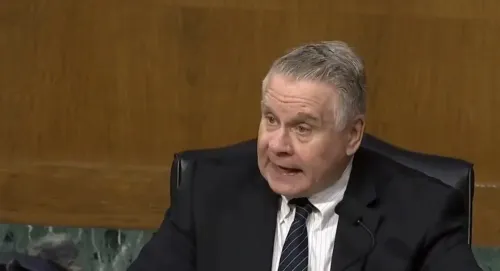
In a recent address to US lawmakers, Sam Brownback, who previously served as the US Ambassador-at-Large for International Religious Freedom, accused the Chinese Communist Party of conducting a global campaign of persecution against religious individuals, as highlighted by a report from the Maldivian media outlet Etruth MV.
During a hearing held on Capitol Hill in Washington, his statements described Beijing's actions not merely as isolated incidents of human rights violations, but rather as “a coordinated effort to suppress belief systems viewed as threats to state control.”
According to Brownback, “This campaign targets a wide array of faiths, including Christians, Buddhists, Uyghur Muslims, Tibetan Buddhists, and practitioners of Falun Gong.”
The report indicated that Brownback claimed the Chinese government invests substantial financial and institutional resources to suppress religion.
He informed lawmakers that billions of dollars are spent annually by the Chinese government to control or dismantle independent belief systems, asserting that the “most severe repression is directed towards Falun Gong practitioners.”
Brownback portrayed believers in China as individuals operating ‘behind enemy lines’, arguing that their convictions empower them to confront state control and overcome fear. His testimony highlighted that the Chinese state perceives faith-based resistance as a destabilizing force, rather than political ideology.
The report emphasized that a primary focus of Brownback’s testimony was the deployment of advanced surveillance technology to enforce religious repression.
He stated that China's extensive monitoring systems allow authorities to identify and neutralize individuals seen as capable of mobilizing others through their faith.
The hearing on Capitol Hill, according to the report, “placed China’s domestic religious policies within a broader international context.”
Brownback characterized the repression as a global issue, claiming that pressure extends beyond China’s borders through the coercion of diaspora communities and diplomatic influence.
“As lawmakers deliberate on further actions, the allegations presented during the hearing contribute to a growing body of evidence that frames religious persecution as a central element of China’s political framework. While the description of a ‘war on belief systems’ may be rhetorical, the discussed policies and practices—surveillance, detention, alleged forced organ harvesting, and transnational pressure—illustrate a sustained effort to control belief,”
the report noted.
“For US lawmakers, this issue now resides at the crossroads of human rights, foreign policy, and legislative oversight, with ramifications extending far beyond the borders of China,”
it concluded.
Point of View
The perspective here is clear: the escalating scrutiny of China's religious policies highlights a critical intersection of human rights and international diplomacy. The implications of these allegations extend beyond China, impacting global human rights discussions.
NationPress
24 Sept 2026
Frequently Asked Questions
What did Sam Brownback accuse the Chinese Communist Party of?
Sam Brownback accused the Chinese Communist Party of waging a worldwide campaign of persecution against various religious believers.
How does the US Congress view China's religious policies?
The US Congress is increasingly viewing China's religious policies as a coordinated effort to suppress belief systems seen as threats to state authority.
What technologies are being used for religious repression in China?
Advanced surveillance technology is being utilized to enforce religious repression in China, allowing authorities to identify and neutralize dissenting individuals.
What impact might these allegations have on US-China relations?
These allegations could significantly affect diplomatic relations, as they frame religious persecution as integral to China's political system.
Which religious groups are particularly targeted in China?
The targeted groups include Christians, Buddhists, Uyghur Muslims, Tibetan Buddhists, and practitioners of Falun Gong.