Is the US Naval Force Heading Towards Iran?
Synopsis
As tensions escalate between the US and Iran, President Trump confirms a significant naval deployment aimed at deterring conflict. With diplomatic solutions in the air, the question arises: will military action be necessary?
Key Takeaways
US naval deployment aims to deter Iran amidst rising tensions.
Trump emphasizes the hope for diplomacy over military action.
The situation is linked to regional stability and US support for Israel.
Military preparedness is seen as a critical leverage point.
US involvement in global conflicts continues with a focus on resolution.
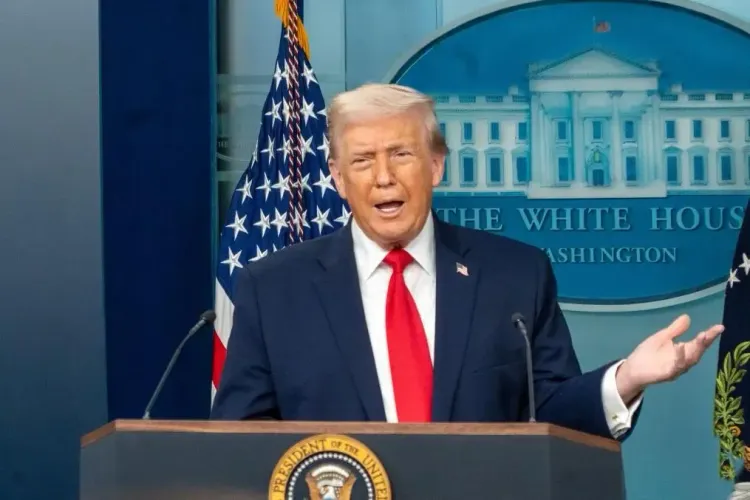
Washington, Jan 28 (NationPress) President Donald Trump confirmed that a significant US naval fleet is en route to the Middle East amidst rising tensions with Iran. He emphasized that while Washington hopes to avoid military action, it is prepared to take such measures if diplomatic efforts fall short.
In an interview on WABC with host Sid Rosenberg, Trump stated that the deployment aims to deter any further escalation and to apply increased pressure on Tehran. “We have a large armada moving there right now,” he remarked. He noted the force's power, claiming it surpasses a recent US deployment associated with operations concerning Venezuela.
When asked about the substantial military buildup, Trump reiterated the intention to prevent conflict while maintaining leverage. “Hopefully, we won’t have to use it,” he mentioned, without disclosing specifics about the size, location, or timeline of the deployment.
The president associated this military movement with ongoing threats from Iran and the heightened tensions impacting Israel. He stated that US support has instilled confidence in Israel amid repeated warnings from Tehran. “Israel is responding in kind,” Trump remarked, referencing Israel’s recent decision to temporarily close its airspace.
Trump contended that American intervention has averted a potentially disastrous situation in the region. “I don’t think you would have Israel,” he stated, insisting that without US involvement, the circumstances could have been dire. He highlighted a crucial phase of negotiations and military readiness that helped prevent catastrophe.
Furthermore, Trump noted the successful return of hostages under his administration, linking the conflict to his presidency. “We got the last of the hostages back,” he said. “We recovered the last of the deceased today.” He described the endeavor as something many deemed impossible, noting that families had been desperate to reunite with their loved ones.
Trump reiterated that Iran remains a central concern for US security and suggested that sustained pressure is limiting Tehran's options. Although he did not announce any new diplomatic initiatives, he asserted that US actions align with broader regional stability. “Hopefully, we won’t have to use it,” he reiterated concerning the naval deployment.
Beyond the Middle East, Trump framed the Iran situation within a larger narrative of resolving global conflicts. He claimed his administration had concluded eight wars and is striving to halt another major conflict. He referred to the war in Ukraine as a “bloodbath,” highlighting heavy monthly casualties among soldiers.
“Last month, 27,000 soldiers died,” Trump stated. “The month before, 31,000.” He expressed a desire for the fighting to cease and asserted that progress is achievable through direct negotiations, though he did not provide a timeline or framework.
Trump also discussed recent developments in Venezuela, asserting that US involvement has yielded results and financial advantages. He claimed that the US has gained influence in Caracas, describing collaboration with Venezuelan leadership as “working beautifully.”
The interview underscored Trump's reliance on military pressure and personal diplomacy as pivotal foreign policy tools. His statements suggest that the administration perceives the US naval presence near Iran as both a warning and a bargaining chip, designed to avert escalation while keeping military options readily available.
Trump expressed confidence that force would not be necessary. “We have a lot of support,” he said, noting that the deployment aims to foster peace rather than incite war.
Point of View
It is crucial to remain focused on the implications of military actions and diplomatic efforts in international relations. The US military presence in the Middle East should be viewed within the broader context of maintaining stability and preventing escalation, keeping the nation's best interests at heart.
NationPress
22 Sept 2026
Frequently Asked Questions
Why is the US deploying a naval force to the Middle East?
The US is deploying a naval force to the Middle East to deter further escalation of tensions with Iran and reinforce pressure on Tehran amid ongoing threats.
What was President Trump's stance on military action?
President Trump indicated that while he hopes military force will not be necessary, the US is prepared to act if diplomatic efforts do not succeed.
How does this deployment relate to Israel?
Trump stated that US backing has bolstered Israel's confidence against threats from Iran, highlighting the significant military presence as a deterrent in the region.