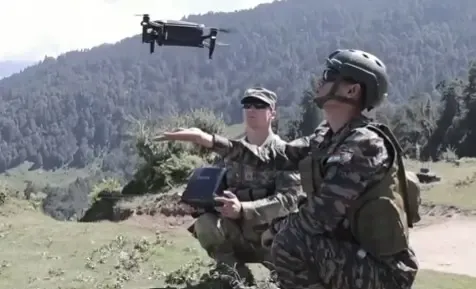
US to launch Autonomous Warfare Command by 2027 in drone strategy shift

Synopsis
The Pentagon isn't just buying more drones — it's rewiring the entire command structure around them. Project Agincourt's plan for a four-star Autonomous Warfare Command by 2027 signals that Washington views the proliferation of low-cost unmanned systems not as a peripheral trend but as a civilisational shift in how wars are fought and won.
Key Takeaways
The US Pentagon plans to establish a four-star Autonomous Warfare Command (Autowarcom) by 1 October 2027 .
The initiative is led by Project Agincourt , presented by Owen West and Senior Chief Max Strasiser .
Operational units will serve as live testing grounds, with battlefield performance — not administrative milestones — determining which systems receive further funding.
Defence Secretary Pete Hegseth identified autonomous systems and AI as central military priorities in remarks on 20 October in Ohio .
The roadmap draws a historical warning from the US Army's failure to institutionalise mechanised warfare before World War II .
Regional flexibility is built in: the letter explicitly states the Pacific and European theatre requirements demand different autonomous system portfolios.
The United States plans to establish a four-star Autonomous Warfare Command (Autowarcom) by 1 October 2027, as the Pentagon moves to fundamentally reshape how the American military develops, procures and deploys drones, robotics and other autonomous weapons systems. The initiative, outlined in a letter from the leadership of the Pentagon's Project Agincourt, represents the most significant institutional reorganisation of US military technology strategy in decades.
What Project Agincourt Proposes
Owen West and Senior Chief Max Strasiser, who presented the roadmap, said the changing economics of warfare demanded a break from conventional military acquisition. The letter identified two core missions for Project Agincourt: establishing Autowarcom by 1 October 2027 with authority to coordinate autonomous warfare capabilities across all armed services, and developing a new acquisition model that connects autonomous technology and robotics companies directly with operational military units.
'Low-cost drones have changed the character, speed and economics of war,' the letter stated. Under the proposed framework, operational units would function as live testing grounds for emerging technologies, with battlefield performance — rather than administrative milestones — determining whether a system receives further funding or is discontinued.
A Deliberate Break from Traditional Procurement
The Pentagon's existing model has historically relied on a relatively small number of sophisticated, expensive weapons platforms to project power globally. Project Agincourt's leadership argues this approach is being directly challenged by the proliferation of inexpensive drones and autonomous systems capable of producing significant battlefield effects at a fraction of the cost.
The new framework would rely on competitions, military exercises and actual combat performance to identify effective technologies. 'The goal is not a particular drone. It is a system built to adapt at scale,' the letter said. Systems that fail to meet operational requirements could be discontinued rather than sustained through traditional procurement arrangements — a sharp departure from entrenched defence contracting norms.
Cost Efficiency and Personnel Risk at the Core
A key stated objective is reducing the cost of military operations while limiting risks to American personnel. 'To flip the cost exchange, every auditable dollar we spend should reduce cost-per-kill or risk-to-force,' the letter read. The initiative also emphasises exploiting American strengths in advanced artificial intelligence and the experience of its non-commissioned officer corps.
Notably, the roadmap stresses that autonomous warfare capabilities must be tailored to different regional requirements. 'The ideal Pacific portfolio is not right for Europe,' the letter noted — indicating that theatre commanders would retain flexibility to develop different combinations of autonomous systems based on their specific operational environments.
Historical Parallel and the Urgency Argument
Project Agincourt's leadership drew a pointed historical comparison: the US Army's failure to institutionalise mechanised warfare before World War II, which delayed its adaptation until Germany demonstrated the effectiveness of armoured operations in 1940. The letter argued the Pentagon must avoid repeating that mistake with autonomous warfare.
'Urgency does not excuse imprecision,' West and Strasiser wrote, adding that evidence — not bureaucratic process — would determine which capabilities were expanded and which were abandoned. 'We will not replace one bureaucracy with another,' the letter stated.
Context: Hegseth's Remarks and Broader Pentagon Direction
The roadmap follows Defence Secretary Pete Hegseth's remarks on 20 October in Ohio, where he identified autonomous systems, artificial intelligence and faster defence procurement as central priorities for modernising the US military. The growing battlefield prominence of relatively inexpensive unmanned systems — reshaping surveillance, precision strikes, logistics and force protection — has accelerated the Pentagon's push to institutionalise this capability at the command level.
If approved, Autowarcom would mark a structural pivot in American military doctrine, with implications for allied defence partnerships and global arms competition well beyond 2027.
Point of View
The real question is whether this shift accelerates co-development pathways or deepens the technological gap between American and allied autonomous capabilities.
NationPress
21 Oct 2026
Frequently Asked Questions
What is the US Autonomous Warfare Command (Autowarcom)?
Autowarcom is a proposed four-star military command the United States plans to establish by 1 October 2027 to coordinate the development, procurement and deployment of drones, robotics and autonomous weapons systems across all armed services. It is being developed under the Pentagon's Project Agincourt initiative.
What is Project Agincourt and who is leading it?
Project Agincourt is a Pentagon initiative tasked with reforming how the US military acquires and deploys autonomous warfare capabilities. Its roadmap was presented by Owen West and Senior Chief Max Strasiser, who argue that low-cost drones have fundamentally changed the character and economics of modern warfare.
How does the new procurement model differ from existing US defence acquisition?
Under the proposed model, operational military units serve as live testing grounds and their battlefield performance determines which technologies receive further funding — replacing the traditional approach of sustaining systems through administrative procurement cycles. Systems that fail in the field can be discontinued rather than kept alive by contract obligations.
What did Defence Secretary Pete Hegseth say about autonomous systems?
Defence Secretary Pete Hegseth, in remarks delivered on 20 October in Ohio, identified autonomous systems, artificial intelligence and faster defence procurement as central priorities for modernising the US military, directly aligning with the Project Agincourt roadmap.
Why does the Pentagon compare this initiative to World War II mechanised warfare?
Project Agincourt's leadership drew a parallel to the US Army's failure to institutionalise mechanised warfare before World War II, which left it unprepared until Germany demonstrated the effectiveness of armoured operations in 1940. The letter argues the Pentagon must avoid repeating that delay with autonomous warfare, framing urgency as a strategic imperative.