US Senate passes $70 billion Secure America Act to fund ICE, border security
Synopsis
The US Senate has handed President Trump a major immigration win, passing a $70 billion bill to fund ICE and CBP through his second term — with no DACA protections, no mandatory oversight reforms, and no body-camera requirements after an 18-hour Democratic amendment blitz failed. The real test now moves to the House.
Key Takeaways
The US Senate passed the Secure America Act on 6 June , allocating roughly $70 billion to ICE and CBP .
Funding covers additional personnel, surveillance technology, AI-assisted inspection systems, and enforcement operations through fiscal year 2029 .
A DACA protection amendment by Senator Dick Durbin was defeated 48–51 during an 18-hour vote-a-rama .
Democrats criticised the bill for providing no reforms, no guardrails, and no accountability for ICE and CBP.
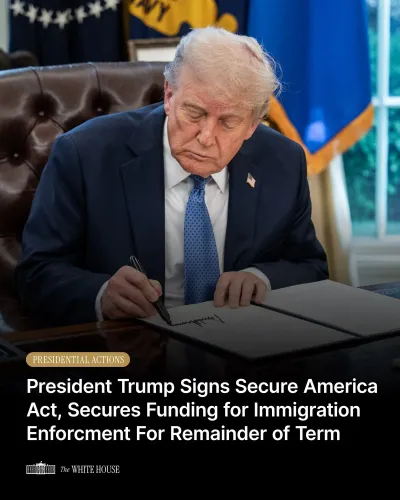
The bill now moves to the House of Representatives before it can go to President Trump for signature.
The US Senate on 6 June passed the Secure America Act, a Republican-backed immigration enforcement bill that allocates roughly $70 billion in additional funding to US Immigration and Customs Enforcement (ICE) and US Customs and Border Protection (CBP). The legislation now heads to the House of Representatives, where it faces a high-stakes vote before it can be sent to President Donald Trump for his signature.
What the Legislation Covers
The bill provides funding for ICE and CBP through the remainder of President Trump's second term, covering additional personnel, border security technology, enforcement operations, and CBP staffing. It also authorises spending on surveillance technology, artificial intelligence-assisted inspection systems, and expanded border security capabilities through fiscal year 2029.
According to Republican supporters, the measure was necessary to resolve a prolonged dispute over Department of Homeland Security (DHS) funding that had left the agency in an extended period of uncertainty.
What Senate Republicans Said
Senator Kevin Cramer of North Dakota said after the vote: 'For 76 days, Democrats kept the Department of Homeland Security in limbo. Then they made it crystal clear they'd rather defund law enforcement than defend law enforcement.' He added that the Act 'delivers the immigration security and rule of law that we all promised when we ran and that the American people expect.'
Senator Marsha Blackburn of Tennessee said Democrats had 'jeopardised our homeland security at a time when America faces countless national security threats,' and credited Senate Republicans with ensuring immigration enforcement personnel 'have everything they need to get the job done.'
Senator John Cornyn of Texas argued the bill gives immigration agencies 'the resources they desperately need to protect our homeland' and would prevent future funding standoffs.
Democratic Opposition and the Vote-a-Rama
Democrats mounted a sustained challenge during an 18-hour 'vote-a-rama', proposing a series of amendments that were ultimately rejected. The most closely watched came from Senate Democratic Whip Dick Durbin, who sought protections for recipients of the Deferred Action for Childhood Arrivals (DACA) programme. His amendment would have redirected funds toward DACA renewals and barred their use for the arrest, detention, or deportation of qualifying recipients.
Ahead of the vote, Durbin said: 'They came to the United States as infants, toddlers, and children. What they are looking for is a job — to legally work in the United States and not to be deported.' The amendment was defeated 48–51.
Other Democratic proposals — seeking restrictions on ICE operations, mandatory body cameras for immigration agents, and healthcare protections — were also rejected.
Critics Flag Lack of Oversight
Senator Alex Padilla of California criticised the bill, saying Republicans were providing 'another $70 billion to an out-of-control ICE and CBP with no reforms, no guardrails, and no accountability.' Representative Jimmy Gomez, whose district includes parts of Los Angeles, called it an effort to 'expand his mass deportation agenda and supercharge ICE and CBP without accountability or meaningful reform.'
This comes amid a broader pattern in Trump's second administration, where immigration enforcement has been a defining legislative priority. Republicans argue stricter policies have sharply reduced illegal crossings at the US-Mexico border, while Democrats have increasingly raised concerns about deportation practices, detention conditions, and civil liberties.
What Happens Next
The Secure America Act now moves to the House of Representatives, where its passage is not guaranteed. House Democrats are expected to mount fresh opposition, and the bill's fate will depend on whether Republican leadership can hold its caucus together. If cleared, it proceeds to President Trump, who is widely expected to sign it into law.
Point of View
Including the 48–51 rejection of DACA protections, signals that the Senate majority is not interested in a negotiated compromise. What is notable is the absence of any accountability framework: no body cameras, no reform guardrails, no civil liberties audit. The bill's House journey will test whether Republican moderates in swing districts are willing to own that record heading into the next election cycle.
NationPress
21 Oct 2026
Frequently Asked Questions
What is the Secure America Act passed by the US Senate?
The Secure America Act is a Republican-backed immigration enforcement bill passed by the US Senate on 6 June, providing roughly $70 billion in additional funding to ICE and CBP. It covers personnel, technology, enforcement operations, and border security capabilities through fiscal year 2029, and now moves to the House of Representatives.
Why did Democrats oppose the Secure America Act?
Democrats argued the bill expands ICE and CBP funding without any reforms, oversight mechanisms, or accountability measures. Critics including Senator Alex Padilla called it a blank cheque for agencies they described as 'out-of-control,' while others raised concerns about deportation practices and civil liberties.
What happened to the DACA amendment during the Senate vote?
Senate Democratic Whip Dick Durbin proposed an amendment to protect DACA recipients from arrest, detention, and deportation, and redirect funds toward DACA renewals. The amendment was defeated 48–51 during an 18-hour vote-a-rama in which all major Democratic proposals were rejected.
What does the bill fund specifically?
The legislation funds additional ICE and CBP personnel, border security technology, AI-assisted inspection systems, surveillance infrastructure, and expanded enforcement operations. Funding is authorised through fiscal year 2029 and covers the remainder of President Trump's second term.
What happens next after the Senate passed the bill?
The Secure America Act now moves to the House of Representatives, where it must pass before being sent to President Trump for his signature. House Democrats are expected to mount fresh opposition, and the outcome will depend on Republican leadership's ability to hold its caucus.