Jaishankar's V4 reset: India eyes Central Europe's eastern flank
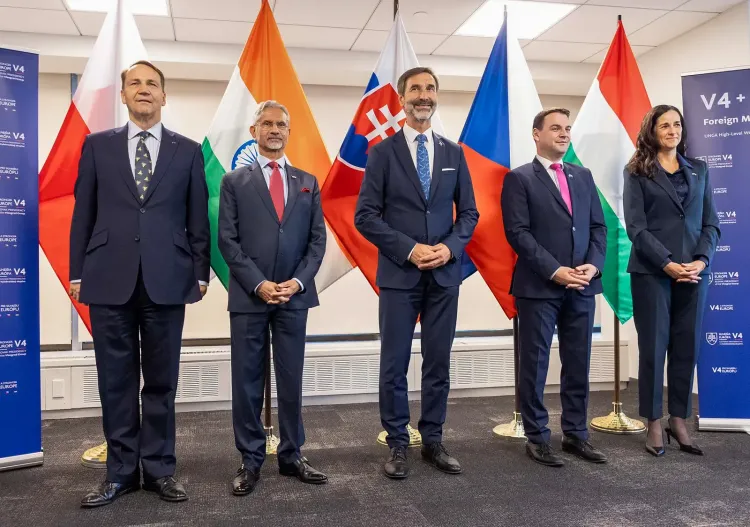
Synopsis
India's diplomatic tilt toward Central Europe's eastern flank just got its most structured form yet. Jaishankar's V4 meeting at UNGA locked in annual ministerial talks and a business forum — a calibrated move that lets India engage Poland, Hungary, Czechia, and Slovakia without taking sides on Russia, at a moment when the V4 itself is still rebuilding after its internal fracture.
Key Takeaways
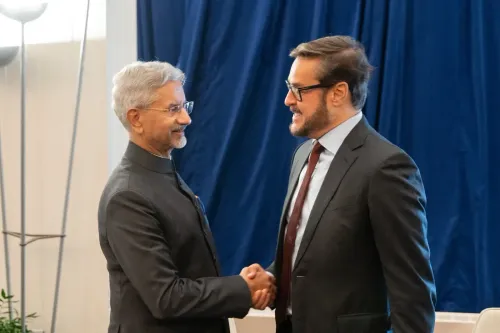
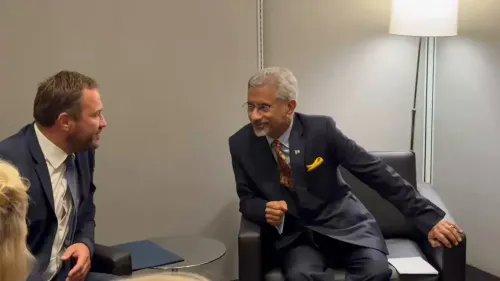
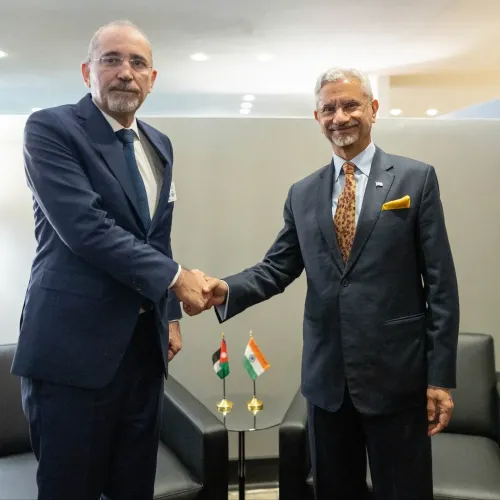
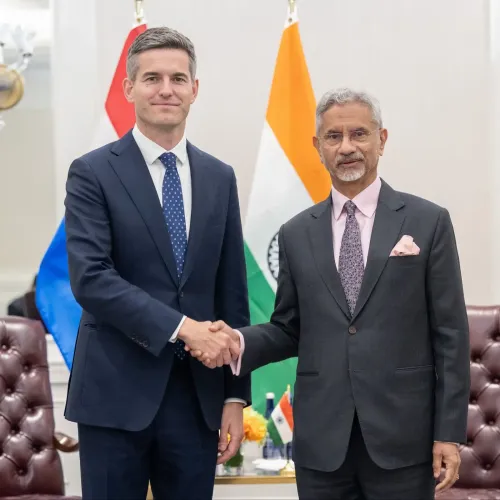
EAM S Jaishankar met all four Visegrad-4 foreign ministers on the sidelines of the 81st UNGA in New York on 21 September .
The V4 agreed to hold annual foreign minister-level meetings with India and establish an annual business forum covering technology, defence, space, and connectivity.
All four V4 states endorsed India's permanent seat on the UN Security Council , confirmed by Slovakia's Foreign Minister Juraj Blanar .
The V4's internal reset followed Peter Magyar's election victory in Hungary in April 2026 , ending Viktor Orban's 16-year tenure .
India's sequenced diplomacy — Moscow , Warsaw , Kyiv , BRICS summit , then New York V4 meeting — reflects a deliberate multi-track European strategy.
Preparations are reportedly underway for Polish Prime Minister Donald Tusk's visit to India, signalling a further de-hyphenation of India–Russia in Warsaw's calculus.
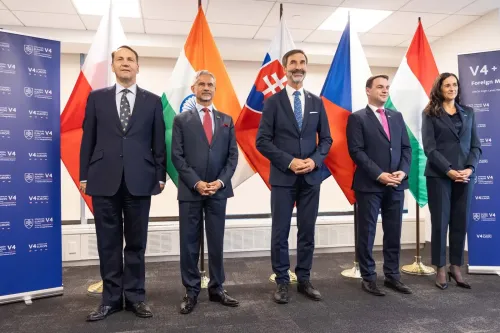
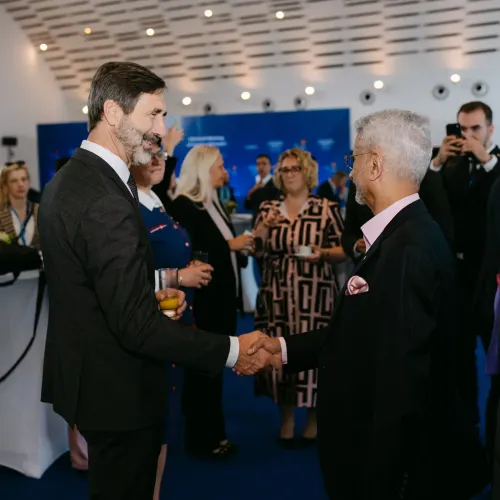
External Affairs Minister S Jaishankar met the foreign ministers of Poland, Hungary, the Czech Republic, and Slovakia — collectively the Visegrad-4 (V4) — on the sidelines of the 81st session of the United Nations General Assembly (UNGA) in New York on 21 September, in what diplomats have described as a 'historic occasion'. The four nations agreed to hold annual foreign minister-level meetings with India and establish an annual business forum focused on technology, defence, space, and connectivity.
What Was Agreed in New York
The meeting formalised two concrete deliverables: a structured diplomatic calendar and a business engagement channel. Slovakia's Foreign Minister Juraj Blanar confirmed that all four V4 governments support India's permanent membership of the United Nations Security Council — a significant collective endorsement. While most UNGA sideline meetings amount to routine stocktaking, analysts note that the timing of this one carries unusual weight, given the V4's internal rupture and reset over the past year.
India and the V4: A Relationship Older Than the Grouping
India's ties with Central Europe predate both the V4 and Indian independence. During the Second World War, the Maharaja of Nawanagar sheltered hundreds of Polish children at Balachadi near Jamnagar, and a larger Polish settlement took shape at Valivade near Kolhapur — a chapter that Warsaw remembers with documented gratitude. Rabindranath Tagore visited Hungary in 1926, and painter Amrita Sher-Gil was born to a Hungarian mother. During the Cold War, when all four were inside the Soviet bloc, trade had a practical shape: Czechoslovak industry, Polish shipyards, and aircraft factories supplied the Indian armed forces with armoured vehicles, Iskra jet trainers, and landing ships.
When Jaishankar told his counterparts in New York that India has a 'very strong defence history with every V4 country,' he was invoking this layered record. The relationship cooled after the fall of the Iron Curtain, as all four states pivoted westward. The V4 itself was founded at Visegrad, Hungary, in 1991 with a single purpose: to help post-communist states return to Europe. That goal was largely fulfilled when all four joined NATO and then the European Union in 2004.
The V4's Internal Fracture and Reset
The grouping evolved into a regional pressure bloc within the EU and NATO but took a sharp ideological turn after the 2015 migration crisis. Under Viktor Orban's Hungary and Poland's PiS government, the V4 became synonymous in Brussels with opposition to refugee quotas, rule-of-law conditionality, and further EU federalisation. For nearly a decade it was widely characterised, fairly or otherwise, as the capital of European populism.
Russia's full-scale invasion of Ukraine in 2022 fractured that alignment. Warsaw saw Moscow as an existential threat; Budapest maintained channels to the Kremlin. The V4 largely stopped functioning as a coherent unit. The reset came this year when Peter Magyar won a landslide election in April, ending Orban's 16-year tenure in Hungary. In June, the four prime ministers met at Godollo, agreeing to coordinate in EU forums and resume consultations ahead of European Council meetings. Notably, the reset is not purely ideological: while Poland's Prime Minister Donald Tusk and Magyar belong to the centre-right European People's Party, Czech Prime Minister Andrej Babis and Slovak Prime Minister Robert Fico are sovereigntist populists closer in instinct to the old V4.
India's Dual-Track European Diplomacy
India's engagement with Europe currently runs on two distinct tracks. With France, Germany, and the Nordic countries, the relationship centres on trade, technology, and investment. With the frontline states, Russia is the existential variable in their domestic politics. The sequencing of Jaishankar's recent travel reveals how New Delhi is managing this second track: he was in Moscow on 23–24 August, co-chairing the intergovernmental commission and meeting Russian President Vladimir Putin at the Kremlin; within ten days, he was in Warsaw and Kyiv — his first standalone mission to Ukraine since the war began in February 2022. Putin then travelled to New Delhi for the BRICS summit, and a week later Jaishankar was with the V4 foreign ministers in New York.
The approach is deliberate compartmentalisation. As recently as January, when Polish Foreign Minister Radoslaw Sikorski visited New Delhi, the exchange was reportedly sharp — Jaishankar telling him that Poland should not help fuel terrorist infrastructure in India's neighbourhood and that singling India out over Ukraine was 'unfair and unjustified'. Eight months later, Poland is co-signing a collective V4 endorsement of India's Security Council bid, and preparations are reportedly underway for Prime Minister Donald Tusk's visit to India. Analysts describe this as a gradual de-hyphenation of the India–Russia relationship in Polish foreign policy calculus.
Divergent Russia Readings and What That Means for India
The V4 is not a monolith on Russia. Poland and, to a lesser extent, the Czech Republic view Moscow as the primary security threat. Fico's Slovakia holds positions reportedly closer to New Delhi's than to Warsaw's, and Hungary under Magyar is still recalibrating. Paradoxically, this divergence works in India's favour: New Delhi can engage a grouping whose members read Russia differently precisely because it does not ask any of them to choose a side. Jaishankar appeared aware of this when he said that 'how the V4 come together is for them to decide' — a carefully neutral formulation that shields India if the grouping fractures again. Slovakia's continued dependence on Russian gas means energy security emerged as a common point of conversation, underscoring how domestic policy constraints shape each member's engagement with India.
The Economic and Strategic Opportunity
Japan and South Korea have operated V4 Plus formats for years, embedding their companies in the region's automotive and battery supply chains. India's defence relationship with the V4 could be refreshed through co-production under the Make in India programme, drawing on historic platform familiarity. The proposed business forum could position Central Europe as an entry point into the wider EU market. Jaishankar himself linked the V4 engagement to India's broader relationship with the European Union. If annual meetings are held and Tusk's visit proceeds, the frontline track may become a more structurally durable strand of India's European strategy — though that outcome depends as much on the V4's internal cohesion as on New Delhi's statecraft.
Point of View
Fico and Babis remain sovereigntist actors with different incentives from Tusk and Magyar, and any fresh fracture over Ukraine funding or EU budget politics could strand India's newly formalised engagement. India's non-prescriptive posture on Russia is diplomatically elegant and tactically sound, but it means New Delhi's influence on the grouping's durability is effectively zero. The historical depth of India-V4 ties — from Balachadi to Cold War arms transfers — gives the relationship cultural credibility that most non-European partners lack, and the Make in India defence co-production angle is genuinely underexplored. The harder question is whether annual foreign minister meetings will accumulate into strategic weight, or remain the kind of institutionalised courtesy that fills UNGA calendars without changing policy on either side.
NationPress
3 Oct 2026
Frequently Asked Questions
What was agreed at the Jaishankar-V4 meeting at UNGA 2026?
India and the four Visegrad-4 nations agreed to hold annual foreign minister-level meetings and establish an annual business forum covering technology, defence, space, and connectivity. All four V4 states also endorsed India's bid for a permanent seat on the UN Security Council.
Why is India engaging the Visegrad-4 group now?
The V4 has undergone a significant internal reset in 2026 following Peter Magyar's election victory in Hungary, ending Viktor Orban's 16-year tenure and reviving the grouping's ability to coordinate. India is deepening its European diplomacy beyond traditional partners like France and Germany, seeking a foothold on the EU's central-eastern flank where defence histories and new supply-chain opportunities exist.
How does India balance its ties with Russia and the V4 countries simultaneously?
India maintains deliberate compartmentalisation: it sustains its relationship with Moscow while separately engaging V4 states without asking any of them to choose sides. Jaishankar explicitly stated that how the V4 comes together is 'for them to decide,' giving India diplomatic insulation if the grouping fractures again.
What is the historical background of India-Visegrad relations?
India's ties with Central Europe predate the V4 grouping itself. The Maharaja of Nawanagar sheltered Polish children near Jamnagar during the Second World War, Rabindranath Tagore visited Hungary in 1926, and during the Cold War, Czechoslovak and Polish industry supplied the Indian armed forces with armoured vehicles, jet trainers, and landing ships. EAM Jaishankar referenced this shared defence history in New York.
What are the risks to India's newly formalised V4 engagement?
The V4 revival is only a few months old, and fundamental differences among its members — particularly over Ukraine and EU budget policy — have not been resolved. If the grouping fractures again, India's structured engagement mechanisms could stall. Analysts note that India's influence over the V4's internal cohesion is effectively limited, making its diplomacy dependent on political developments in four separate capitals.