Vivek Ramaswamy Eyes Energy, Workforce Push for Ohio
Synopsis
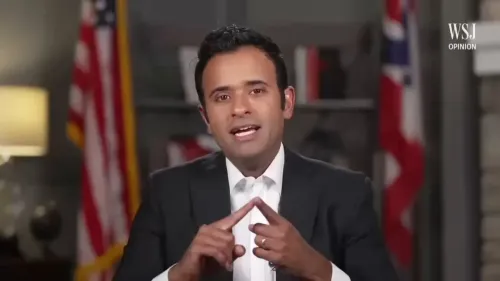
Entrepreneur Vivek Ramaswamy has announced plans to pursue energy abundance and workforce development in Ohio starting January, framing the two pillars as the most direct path to supercharging the state's economy.
Key Takeaways
Vivek Ramaswamy posted on 31 July 2026 that energy abundance and workforce development are 'the simplest keys to supercharging Ohio's economy.' He set a January start date for both initiatives, without specifying the programme or legislative mechanism.
Ramaswamy is the founder of Strive Asset Management and former co-lead of the DOGE advisory effort.
Ohio is a core Midwestern industrial state where energy costs and workforce skills gaps are longstanding economic pressure points.
Expanded domestic energy output paired with workforce training is a recurring Republican strategy for Midwest manufacturing revival.
A promise and a deadline — that is what entrepreneur Vivek Ramaswamy delivered to Ohio on 31 July 2026, naming energy abundance and workforce development as the twin engines he intends to fire up come January.
Ramaswamy, the founder and executive chairman of Strive Asset Management and a former co-lead of the US Department of Government Efficiency (DOGE) advisory effort, posted on X that the two pillars are 'the simplest keys to supercharging Ohio's economy' — and that work begins in January.
Why Energy and Jobs Are Ohio's Pressure Points
Ohio sits at the heart of America's industrial Midwest, a region where manufacturing output, agricultural supply chains, and energy infrastructure are tightly interlocked. Cheaper, more reliable energy directly compresses input costs for factories and farms alike — a dynamic Ramaswamy championed during his 2024 Republican presidential campaign, when he repeatedly called for expanded domestic production and lighter regulation.
Workforce development is the other half of the equation. Industrial states across the Midwest have long wrestled with a skills gap — facilities that exist but cannot find trained hands to run them. Pairing energy deregulation with targeted training programmes has become a signature playbook among Republican state and federal figures seeking to revive the manufacturing belt.
A January Start Date — and an Open Question
Ramaswamy's post sets a clear clock without specifying the vehicle: no programme name, no legislative vehicle, no agency is named. The January timeline is unambiguous; the mechanism is not yet public. That gap is precisely what Ohio's workers, energy producers, and policymakers will be watching to fill.
For a figure who built his national profile on blunt economic prescriptions and a distrust of bureaucratic complexity, the framing — 'two of the simplest keys' — is characteristically direct. Whether the simplicity of the diagnosis survives contact with Ohio's regulatory and legislative landscape is the story that January will begin to answer.
Point of View
But the January deadline gives it an unusual specificity that invites accountability. For a figure who exited the DOGE advisory role and the presidential race, an Ohio-focused economic agenda signals a pivot toward state-level influence. The absence of any named programme or legislative vehicle is the critical gap: it leaves open whether this is a policy commitment or a positioning statement. How January's specifics materialise will determine whether Ramaswamy translates national profile into tangible Ohio outcomes.
NationPress
1 Aug 2026
Frequently Asked Questions
What is Vivek Ramaswamy planning for Ohio's economy?
Ramaswamy has announced plans to pursue energy abundance and workforce development in Ohio, calling them the two simplest keys to supercharging the state's economy, with a start date of January.
When does Ramaswamy plan to start his Ohio economic initiatives?
He stated work will begin in January, though no specific programme names or legislative details have been made public yet.
What is Vivek Ramaswamy's connection to Ohio?
Ohio is Ramaswamy's home state. He is the founder and executive chairman of Strive Asset Management and ran as a Republican presidential candidate in 2024.
What does energy abundance mean in Ramaswamy's policy context?
During his 2024 presidential campaign, Ramaswamy advocated energy abundance through expanded domestic production and reduced regulation — a formula he is now applying to Ohio specifically.
Why are energy and workforce development important for Ohio?
Ohio's manufacturing, agricultural, and industrial sectors are sensitive to energy costs, and the state faces a persistent workforce skills gap, making both areas central to any economic revival strategy.