US senators Warren, Scott urge Trump to label China a currency manipulator
Synopsis
In a rare bipartisan move, Senators Elizabeth Warren and Rick Scott have jointly called on the Trump administration to formally label China a currency manipulator — pointing to a record $1.2 trillion trade surplus and a covert forex network that, they argue, is designed to evade detection. The letter, sent after the G7 summit, pushes for coordinated allied pressure on Beijing — raising the stakes in an already fraught US-China trade standoff.
Key Takeaways
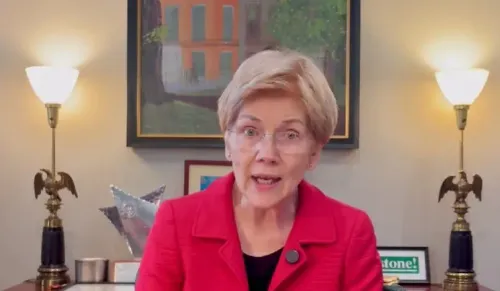
Democratic Senator Elizabeth Warren and Republican Senator Rick Scott sent a joint letter to Treasury Secretary Scott Bessent on 19 June urging action on China's currency manipulation .
The senators allege China routes dollar purchases through state-owned banks and its sovereign wealth fund to avoid detection — bypassing the People's Bank of China 's traceable balance sheet.
China's trade surplus hit a record $1.2 trillion in 2025 , representing nearly 70% of all global goods trade surpluses, according to the letter.
The lawmakers called for a formal currency manipulator designation in the next US Treasury Foreign Exchange Report .
They urged the Trump administration to coordinate a unified response with G7 allies following the Evian summit .
Democratic Senator Elizabeth Warren and Republican Senator Rick Scott have jointly urged the Trump administration to take stronger action against what they described as China's deliberate currency manipulation, warning that Beijing's policies are distorting global trade and undermining American manufacturers and workers. The bipartisan appeal came in a letter dated 19 June addressed to Treasury Secretary Scott Bessent, sent in the immediate aftermath of the G7 summit in Evian, France.
What the Senators Alleged
The two lawmakers — Warren serving as ranking member of the Senate Banking Committee — argued that China is suppressing the value of its currency, the renminbi, to make its exports artificially cheap and US-made goods artificially expensive. 'China appears to be deliberately suppressing the value of its currency to make its exports artificially cheap and American-made goods artificially expensive, unfairly undermining the competitiveness of US manufacturers and workers,' the senators wrote in the letter.
How China's Methods Have Evolved
The senators argued that Beijing has shifted away from direct central bank intervention — which was previously traceable through the People's Bank of China (PBoC)'s balance sheet — toward a 'less visible approach' that routes dollar purchases through a network of state-owned commercial banks, policy banks, and its sovereign wealth fund. They described this as 'a system deliberately designed to evade detection,' noting that China is 'the only major US trading partner that does not publicly disclose its foreign exchange interventions.'
The Trade Surplus Evidence
China's trade surplus reached a record $1.2 trillion in 2025, according to the letter — representing nearly 70 percent of all global goods trade surpluses. The senators argued that under normal market conditions, a surplus of that scale would drive currency appreciation, yet no such rise has occurred. 'The reason is likely due to a deliberate policy of manipulation,' they wrote. They further characterised an undervalued currency as a 'hidden subsidy' that simultaneously lowers the cost of Chinese imports into the US and raises the price of American exports abroad.
What the Senators Are Asking For
The letter called on the Treasury Department to address China's currency practices directly in its next Foreign Exchange Report, including formal consideration of a currency manipulator designation. The senators also urged the administration to coordinate with G7 allies — who, according to the lawmakers, share concerns about Chinese trade imbalances — to press Beijing toward greater transparency and market-driven currency appreciation. 'Our G7 allies share concerns about China's currency, and the aftermath of the summit presents an opportunity to coordinate a unified response,' they wrote.
Broader Context
The bipartisan push comes as the Trump administration has been seeking allied support to address trade imbalances with China — a theme that featured prominently at the G7 summit. The US Treasury publishes a semi-annual Foreign Exchange Report that assesses whether trading partners are manipulating their currencies; a formal designation carries significant diplomatic and trade consequences. The last time the US formally labelled China a currency manipulator was in August 2019, during the first Trump administration, a designation that was later reversed. Whether the current administration acts on the senators' request will be closely watched by markets and trading partners alike.
Point of View
Which signals that China's currency practices have become one of the few genuine consensus issues in Washington. Yet the senators' call is not new: the US last designated China a currency manipulator in 2019, only to reverse it months later as a trade deal took shape. The harder question is whether a formal designation would change Beijing's behaviour or simply escalate tensions without a clear off-ramp. With China's trade surplus at a record $1.2 trillion and the renminbi showing no market-driven appreciation, the economic case the senators make is difficult to dismiss — but the diplomatic calculus of acting on it is far more complex than the letter acknowledges.
NationPress
19 Sept 2026
Frequently Asked Questions
What are US senators Warren and Scott urging the Trump administration to do about China?
Senators Elizabeth Warren and Rick Scott have urged the Trump administration to formally designate China as a currency manipulator in the next US Treasury Foreign Exchange Report. They also called for coordinated pressure on Beijing through G7 allies to push for greater transparency and market-driven appreciation of the renminbi.
What evidence did the senators cite for China's alleged currency manipulation?
The senators pointed to China's record trade surplus of $1.2 trillion in 2025 — nearly 70% of all global goods trade surpluses — as evidence that market forces alone cannot explain the renminbi's current value. They argued that a surplus of that size would normally trigger currency appreciation, which has not occurred.
How does China allegedly conduct currency intervention without detection?
According to the senators' letter, China has shifted from direct People's Bank of China interventions — which were visible on its balance sheet — to routing dollar purchases through state-owned commercial banks, policy banks, and its sovereign wealth fund, making the activity harder to track.
Has the US ever formally designated China a currency manipulator before?
Yes. The US last formally designated China a currency manipulator in August 2019, during the first Trump administration. That designation was later reversed as part of trade negotiations. A formal designation carries significant diplomatic and trade policy consequences.
What role did the G7 summit play in this development?
The letter was sent to Treasury Secretary Scott Bessent following the G7 summit held in Evian, France, where China's trade imbalances were reportedly a central topic. The senators argued that allied concern expressed at the summit creates an opportunity to coordinate a unified response against Beijing's currency practices.