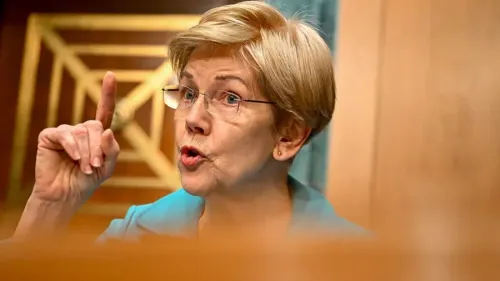
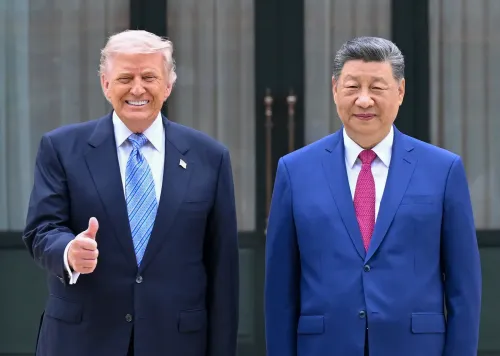
Senator Warren calls Trump's China visit 'a corruption tour disguised as diplomacy'
Synopsis
A formal Senate minority report has accused President Trump of taking billion-dollar-connected CEOs — including Elon Musk, Jensen Huang, and Tim Cook — to China not to fight for American workers, but to secure deals for campaign donors. With tariff costs reportedly hitting $1,700 per household and farm bankruptcies up 46 per cent, Senator Warren's case is blunt: the corruption was hiding in plain sight.
Key Takeaways
Senator Elizabeth Warren released a Senate minority report on 28 May accusing President Donald Trump of conducting 'a corruption tour disguised as diplomacy' during his China visit.
The delegation reportedly included executives from Tesla , NVIDIA , Apple , Boeing , Qualcomm , Blackstone , and Citigroup , with combined wealth approaching $1 trillion .
Trump's tariffs allegedly cost the average American household $1,700 in 2025 , with projections of $2,500 in 2026 .
Farm bankruptcies rose 46 per cent in 2025 , with a 70 per cent increase in the Midwest, according to the report.
Senior US military officials, including Admiral Samuel Paparo , reportedly warned against AI chip exports to China on national security grounds.
The White House has defended the China trade strategy as necessary to protect American manufacturing and supply chains.
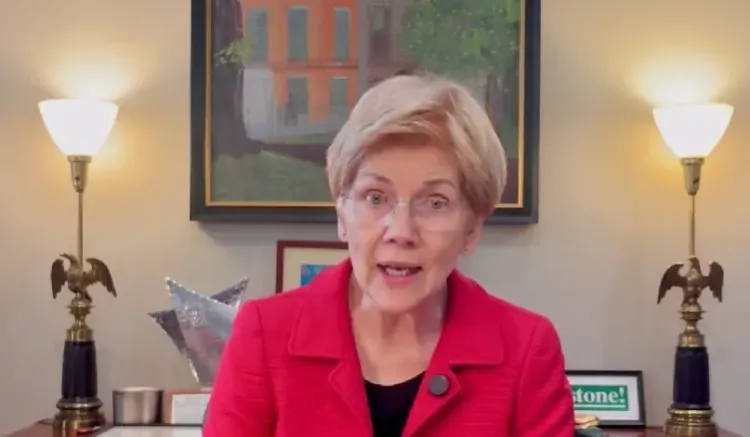
US Senator Elizabeth Warren has accused President Donald Trump of using his recent China trip to benefit billionaire allies and corporate donors, branding the visit 'a corruption tour disguised as diplomacy'. The charge was laid out in a formal report released by the minority staff of the Senate Banking, Housing and Urban Affairs Committee, which Warren leads in opposition.
What the Senate Report Alleges
The report alleged that Trump's China policy systematically favoured wealthy business interests over American workers, farmers, and families. It said Trump travelled to China alongside a delegation of billionaire executives whose combined wealth 'approaches $1 trillion', each with direct business interests tied to the outcome of trade and regulatory discussions with Beijing.
Executives named in the report included Tesla and SpaceX chief Elon Musk, NVIDIA CEO Jensen Huang, Apple CEO Tim Cook, Boeing CEO Kelly Ortberg, Qualcomm chief Cristiano Amon, Blackstone chairman Stephen Schwarzman, and Citigroup CEO Jane Fraser. The report further alleged that Trump held stock in several of the companies represented on the trip, and that many of the executives or their firms had donated to Trump's inauguration fund or White House ballroom project.
Warren's Direct Charges
'President Trump didn't go to China to fight for American workers or farmers — he went to cut deals for the billionaires who funded his campaign and his ballroom,' Warren said in a statement. 'The American people will not forget this brazen display of corruption.'
The report concluded: 'American families pay more, farmers make less, and national security warnings are brushed aside so that the President and his billionaire allies can profit.'
Tariff Costs and Farm Bankruptcies
A significant portion of the report focused on the economic fallout of Trump's tariff policies. According to the report, tariffs cost the average American household $1,700 in 2025 and could rise to an average of $2,500 in 2026. It also said farm bankruptcies rose 46 per cent in 2025, including a 70 per cent increase in the Midwest. The report argued that American households — not China — were bearing the cost of the trade dispute.
The report also alleged that Trump failed to secure commitments from China to end what it described as 'unfair trade practices' or 'currency manipulation'.
NVIDIA, AI Chips, and National Security Warnings
A major section of the report examined NVIDIA and the sale of advanced artificial intelligence chips to China. It alleged that Jensen Huang joined the delegation after lobbying the administration to permit additional AI chip exports to Chinese firms. Senior US military and intelligence officials had reportedly warned that exporting advanced AI chips to China could threaten American national security — warnings the report said were disregarded. It cited concerns raised by Admiral Samuel Paparo, head of the US Indo-Pacific Command, and General Joshua Rudd of the National Security Agency.
White House Position and Broader Context
Trump has repeatedly defended his China trade strategy as necessary to counter Beijing's economic practices and protect American manufacturing. The White House has maintained that its tariff and trade measures are aimed at strengthening US industry and supply chains.
This comes amid continuing tensions between Washington and Beijing over trade, tariffs, technology controls, and national security. China remains one of the United States' largest trading partners even as the two nations compete for dominance in technology, manufacturing, and global supply chains. The Senate report, driven by minority Democrats, is unlikely to trigger legislative action but significantly sharpens the political narrative heading into the next electoral cycle.
Point of View
But its factual scaffolding is harder to dismiss. A president travelling with executives who hold direct financial stakes in the regulatory outcomes being negotiated is a structural conflict of interest — regardless of whether any explicit quid pro quo is proven. The AI chip angle is the sharpest edge: if senior military and intelligence officials warned against expanded exports and were overruled, that is a national security accountability question, not merely a trade one. The White House's defence — that tariffs protect American industry — runs directly into the report's own numbers on household costs and farm bankruptcies. Both things can be true, but the administration has not yet reconciled the contradiction publicly.
NationPress
11 Oct 2026
Frequently Asked Questions
What did Senator Warren's report accuse Trump of during his China visit?
The Senate minority report accused President Trump of using his China trip to benefit billionaire campaign donors and corporate allies rather than securing meaningful concessions for American workers or farmers. Warren described the visit as 'a corruption tour disguised as diplomacy.'
Which executives were named in the Senate report on Trump's China trip?
The report named Elon Musk of Tesla and SpaceX, Jensen Huang of NVIDIA, Tim Cook of Apple, Kelly Ortberg of Boeing, Cristiano Amon of Qualcomm, Stephen Schwarzman of Blackstone, and Jane Fraser of Citigroup. Their combined wealth reportedly approaches $1 trillion.
How much did Trump's tariffs reportedly cost American households?
According to the Senate report, Trump's tariffs cost the average American household $1,700 in 2025 and could cost families an average of $2,500 in 2026. The report argued that American consumers, not China, were bearing the cost of the trade dispute.
What are the national security concerns raised about AI chip exports to China?
The report cited warnings from Admiral Samuel Paparo of the US Indo-Pacific Command and General Joshua Rudd of the National Security Agency, who reportedly cautioned that exporting advanced AI chips to China could threaten American national security. It alleged these warnings were set aside after NVIDIA CEO Jensen Huang lobbied for expanded export permissions.
How has the White House responded to Warren's corruption allegations?
The White House has defended Trump's China trade strategy as necessary to counter Beijing's economic practices and strengthen US industry and supply chains. Trump has repeatedly framed his tariff and trade measures as protective of American manufacturing, though the administration has not directly addressed the specific conflict-of-interest allegations in Warren's report.