White House Calls on Congress to End Birthright Citizenship
Synopsis
The White House on June 30, 2026, publicly urged Congress to immediately end birthright citizenship, calling it 'expensive and unfair.' The move escalates a long-running immigration debate rooted in the Fourteenth Amendment and carries major implications for immigrant communities, including Indians in the US.
Key Takeaways
The White House on June 30, 2026 , called on US Congress to start work 'TODAY' on ending birthright citizenship.
Birthright citizenship is guaranteed by the Fourteenth Amendment of the US Constitution, ratified in 1868 .
A previous executive order in 2025 seeking to limit birthright citizenship was blocked by federal courts.
Legal experts say ending birthright citizenship would likely require a constitutional amendment, needing two-thirds congressional approval and ratification by three-fourths of US states.
The policy change would directly affect children of Indian and other immigrant nationals on temporary US visas.
The White House's public call signals a shift from executive action to legislative pressure on this immigration issue.
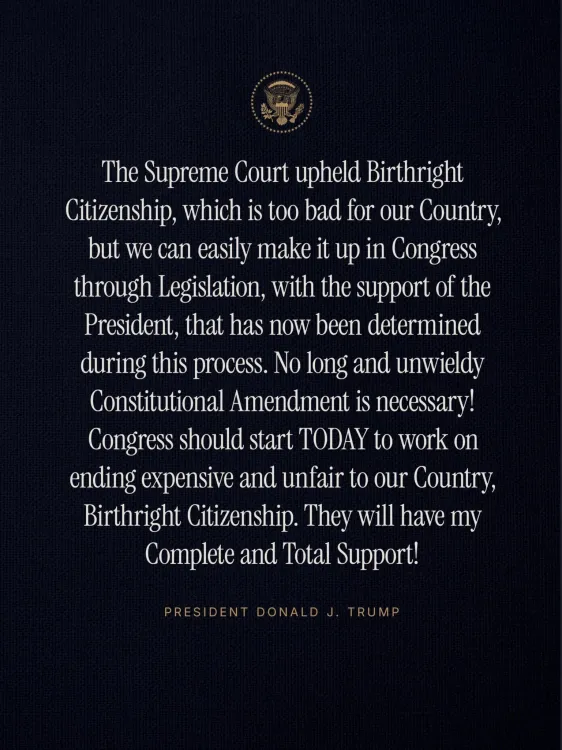
The White House, the official communications account of the Executive Office of the President of the United States, on Tuesday, June 30, 2026, publicly called on the US Congress to immediately begin work on eliminating birthright citizenship, describing the policy as 'expensive and unfair' to the country.
Context
The post stated plainly: 'Congress should start TODAY to work on ending expensive and unfair to our Country, Birthright Citizenship.' The use of 'TODAY' in capitals signals urgency and is consistent with the current administration's long-standing position that automatic citizenship granted to children born on US soil represents a policy vulnerability. Birthright citizenship in the United States is rooted in the Fourteenth Amendment, ratified in 1868, which grants citizenship to 'all persons born or naturalized in the United States and subject to the jurisdiction thereof.'
The current administration has repeatedly argued that this constitutional provision is being exploited, particularly in the context of undocumented immigration and what critics call 'birth tourism' — the practice of travelling to the US specifically to give birth and secure citizenship for a child.
Policy Backdrop
Efforts to curtail birthright citizenship are not new. Over several decades, legislators and executive administrations have periodically attempted to reinterpret or legislatively narrow the scope of the Fourteenth Amendment. Legal scholars remain divided on whether Congress can restrict birthright citizenship through ordinary legislation or whether a constitutional amendment would be required.
Earlier in 2025, the administration had issued an executive order seeking to limit birthright citizenship for children of undocumented immigrants and those on temporary visas. That order faced immediate legal challenges and was blocked by federal courts, which ruled it exceeded executive authority — reinforcing that any durable change would need to pass through Congress or a constitutional amendment process.
The call directed at Congress reflects a strategic pivot: rather than pursuing executive action that courts have repeatedly struck down, the administration is now publicly pressuring the legislature to take ownership of the issue.
Stakeholders and Impact
The debate carries significant implications for immigrant communities worldwide, including a large Indian-origin diaspora in the United States. India is consistently among the top source countries for both legal immigrants and temporary visa holders in the US, and children born to Indian nationals on H-1B or other non-immigrant visas currently qualify for birthright citizenship under existing law.
Any legislative change would directly affect families of skilled workers, students, and others on temporary status. Advocacy groups representing immigrant communities have consistently opposed such measures, arguing they would create a two-tiered system of citizenship and undermine foundational American values. Business groups reliant on high-skilled immigration have also warned against policy shifts that could deter talent from settling in the US.
What's Next
For the White House's call to translate into law, Congress would need to pass legislation — a process that faces significant procedural and constitutional hurdles, including the likelihood of immediate judicial review. The Republican-controlled legislature has shown varying levels of appetite for this specific reform, and bipartisan support remains elusive.
Legal experts broadly agree that a definitive end to birthright citizenship would require a constitutional amendment, which demands a two-thirds majority in both chambers of Congress and ratification by three-fourths of US states — an exceptionally high bar. The coming weeks will test whether this public pressure campaign translates into concrete legislative movement or remains a political signal ahead of the next electoral cycle.
Point of View
Not merely a cultural one. By using the word 'expensive,' the administration is attempting to broaden the coalition of support beyond hardline immigration restrictionists to fiscal conservatives. The move also acknowledges the limits of executive power after courts blocked earlier orders, suggesting the administration now wants Congress to own the political and legal risk. For Indian and other immigrant communities in the US, this represents a direct threat to a right that has underpinned family and career planning for decades.
NationPress
30 Jun 2026
Frequently Asked Questions
What is birthright citizenship in the United States?
Birthright citizenship means that any person born on US soil is automatically a US citizen, regardless of the immigration status of their parents. This right is guaranteed by the Fourteenth Amendment to the US Constitution, ratified in 1868.
Can Congress end birthright citizenship without a constitutional amendment?
This is legally disputed. Many constitutional scholars argue that because birthright citizenship is enshrined in the Fourteenth Amendment, ending it would require a constitutional amendment — a far harder process than passing ordinary legislation. Some administration-aligned legal scholars argue Congress can reinterpret the amendment's scope through statute.
How does the birthright citizenship debate affect Indians in the US?
India is one of the largest sources of H-1B visa holders and other temporary immigrants in the US. Children born to Indian nationals on such visas currently receive automatic US citizenship. Any legislative change could eliminate this, significantly affecting the calculus for skilled Indian workers considering long-term stays in the US.
Why did the White House address Congress and not issue an executive order?
A 2025 executive order seeking to limit birthright citizenship was struck down by federal courts, which ruled it exceeded presidential authority. By calling on Congress to act, the White House is seeking a legislative path that would be harder to overturn in court.
What would it take to pass a constitutional amendment ending birthright citizenship?
A constitutional amendment requires a two-thirds majority vote in both the Senate and the House of Representatives, followed by ratification by at least three-fourths — or 38 — of the 50 US states. This is considered an extremely high bar and has rarely been achieved in US history.