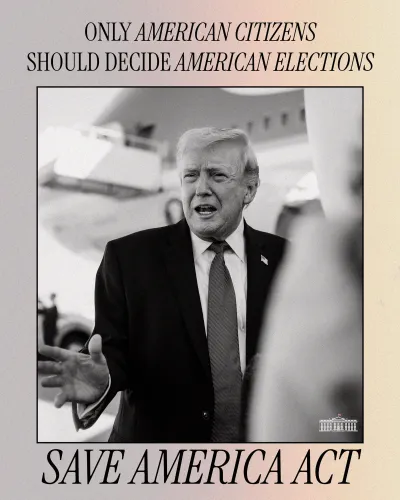
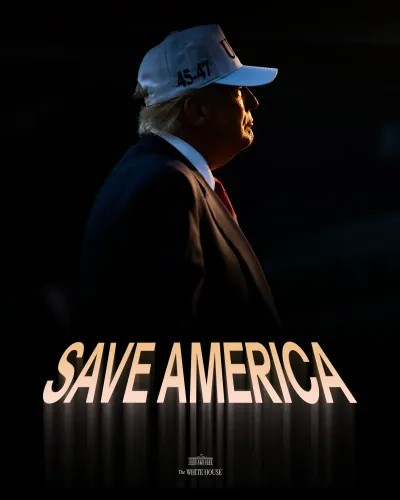
White House Calls to 'Save Our Elections' Ahead of 2026 Midterms
Synopsis
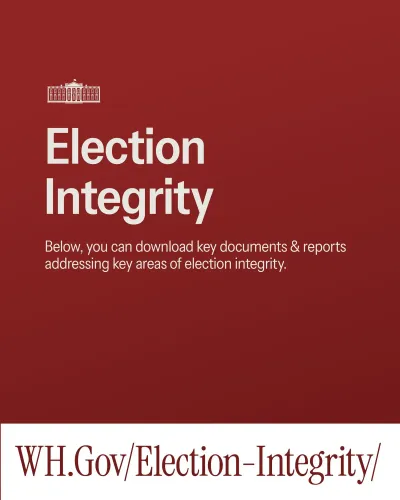
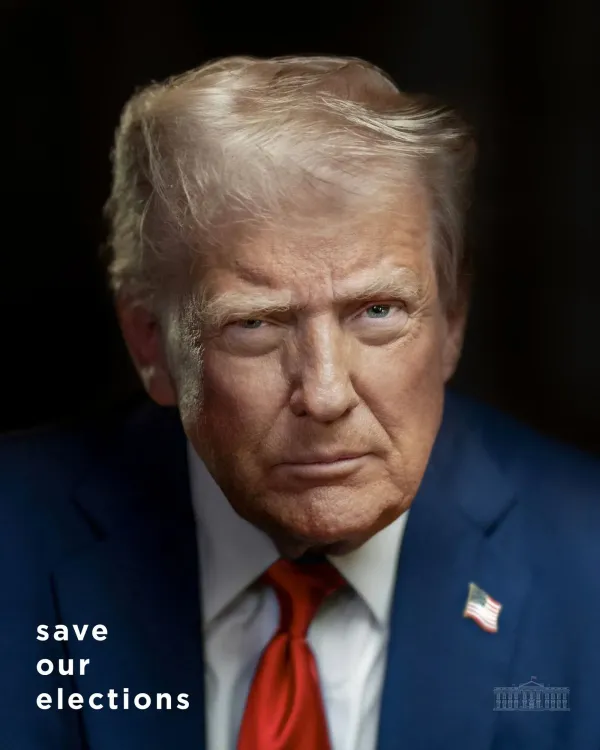
The White House issued a stark 'SAVE OUR ELECTIONS' declaration on 17 July 2026, raising the stakes on election integrity ahead of the 2026 US midterms. The post, backed by one image and no elaboration, signals the administration's intent to make electoral security a defining issue in the months before November polling.
Key Takeaways
The White House posted 'SAVE OUR ELECTIONS' on 17 July 2026 , with one accompanying image and no further text.
The message arrives as the United States approaches its 2026 midterm elections , when all 435 House seats and 34 Senate seats are at stake.
US election-security debates have intensified since 2016 , when foreign interference in federal elections was formally documented.
The Help America Vote Act of 2002 remains the primary federal framework governing election administration and equipment standards.
State election officials are the key implementers of any federal election-integrity push, operating under a patchwork of state laws.
Congressional action on new election-security legislation and state-level voting rules will be closely watched in coming months.
The White House, the official communications account of the Executive Office of the President of the United States, posted a pointed two-word directive on Friday, 17 July 2026, declaring 'SAVE OUR ELECTIONS' — a message that arrives as the country heads toward its 2026 midterm elections.
Context
The post, carrying no additional text beyond the four-word declaration, was accompanied by one image. Its brevity is itself a signal: the White House chose to lead with urgency rather than policy detail, amplifying a phrase that has become a rallying call in American political discourse around election security and integrity.
The statement lands at a moment when United States election administration is under intense public scrutiny, with 2026 midterm contests drawing closer and debates over voting access, identification requirements, and mail-in ballots continuing to divide lawmakers and voters alike.
Policy Backdrop
American election law has a long legislative lineage. The Voting Rights Act of 1965 established federal oversight mechanisms to prevent discriminatory barriers to the ballot. Decades later, the Help America Vote Act (HAVA) of 2002 — passed in the wake of the disputed 2000 presidential election — created the Election Assistance Commission and directed federal funds toward upgrading voting equipment and standardising state-level administration.
Since 2016, documented concerns over foreign interference in federal elections have added a national-security dimension to what was once primarily a domestic administrative debate. The tension between expanding voter access and tightening security requirements has persisted across successive administrations and Congresses, making 'election integrity' one of the most contested phrases in contemporary American politics.
Stakeholders and Impact
State election officials sit at the operational centre of this debate: they administer ballots, certify results, and implement federal mandates, yet operate under widely varying state laws. Voters are the ultimate stakeholders, and public confidence in electoral systems — whether eroded by concerns over security or over access — directly shapes participation rates.
Executive messaging of this kind, issued from the White House platform, carries institutional weight beyond a single social-media post. It signals the administration's intent to make election integrity a visible priority in the months leading up to the midterms, and can influence both legislative agendas on Capitol Hill and the posture of state governments toward new voting rules.
What's Next
Observers will be watching for whether this post presages a concrete legislative push — such as new election-security bills in Congress — or executive actions aimed at shaping how states conduct the November 2026 midterm elections. State-level implementation of voter-identification and mail-voting rules will be a key battleground in the months ahead.
The White House's choice to elevate election security as a message priority so early in the midterm cycle suggests that the administration intends to keep the issue at the forefront of the national conversation well before polling day.
Point of View
The administration stakes out election integrity as its terrain ahead of the midterms. This mirrors a well-established pattern in which executive messaging on elections precedes concrete legislative or regulatory moves, putting pressure on Congress to respond. For Indian observers tracking US democratic institutions, the post underscores how executive social-media communication has become a primary instrument of policy signalling in Washington. The broader arc here is one of sustained tension between access and security in American democracy — a tension that shows no sign of resolution before November 2026.
NationPress
17 Jul 2026
Frequently Asked Questions
What did the White House post about elections on 17 July 2026?
The White House posted 'SAVE OUR ELECTIONS' on 17 July 2026, accompanied by one image and no additional text, signalling a focus on election integrity ahead of the 2026 US midterms.
What are the 2026 US midterm elections?
The 2026 US midterm elections are scheduled for November 2026 and will decide all 435 seats in the House of Representatives and 34 of the 100 Senate seats, making them a major test of the sitting administration's political standing.
What is the Help America Vote Act?
The Help America Vote Act (HAVA) is a federal law passed in 2002 following the disputed 2000 presidential election. It created the Election Assistance Commission and funded upgrades to voting equipment and state election administration systems.
Why is US election security a major issue?
Since 2016, when foreign interference in US federal elections was formally documented, election security has become a national-security concern alongside longstanding domestic debates over voter identification rules, mail-in voting, and ballot access.
What could follow the White House's election message?
Observers expect potential Congressional action on new election-security legislation and possible executive steps to shape how states implement voting rules ahead of the November 2026 midterm elections.