White House Claims Record Jobs, Income, and Tax Refunds in 2026

Synopsis
The White House posted a five-point economic scorecard on X claiming record employment, lowest-ever poverty rates, all-time stock market highs, a record median household income, and the largest tax refund season in US history — without attaching sourcing or data citations.
Key Takeaways
The White House posted five economic claims on X on 2 October 2026 , framing them as simultaneous records.
The administration claims more Americans are working than at any point in US history — an absolute employment figure tied to population growth.
Lowest poverty rates on record, if verified by the Census Bureau, would mark a significant social-policy milestone.
A claim of record median household income speaks directly to middle-of-the-distribution financial wellbeing, not averages skewed by top earners.
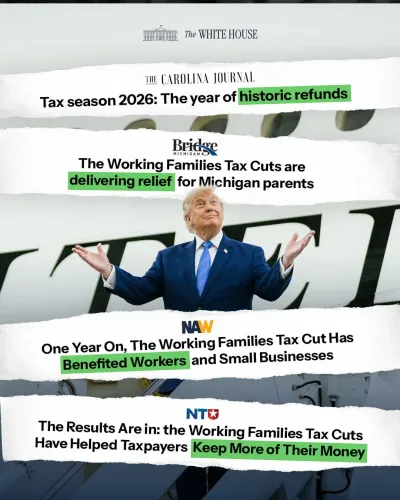
The biggest tax refund season on record represents one of the most personally felt government interactions for ordinary American families.
No sourcing, agency citations, or comparison baselines were provided alongside any of the five claims.
Five green checkmarks. Five sweeping claims. The White House opened October 2026 with a blunt economic scorecard posted to X, asserting that the United States is simultaneously running the most employed workforce in its history, the lowest poverty rates on record, all-time stock market highs, a record-high median household income, and the biggest tax refund season ever seen.
The post, brief but pointed, reads like a campaign billboard compressed into a single tweet — each line a data point the administration is betting Americans will feel in their wallets and checking accounts. The five metrics span every major dimension of household financial health: jobs, poverty, wealth, income, and cash-in-hand from the IRS.What the Five Claims Actually Say
The White House did not attach sourcing, agency citations, or comparison baselines to any of the five assertions. 'Most Americans working in history' points to an absolute employment figure — the raw number of people with jobs — rather than necessarily an unemployment rate, a distinction that matters given population growth over decades. 'Lowest poverty rates' would, if borne out, represent a significant social-policy milestone, as official U.S. poverty measurement has historically been a contested and politically charged number.
'Record stock market highs' is a claim that cycles in and out of accuracy depending on the index and the trading day. 'U.S. median household income record high' — if verified by the Census Bureau — would be the metric most directly felt by ordinary families, since it tracks the middle of the distribution rather than averages skewed by the wealthy. And 'biggest tax refund season on record' speaks to the lived experience of millions of households who received larger-than-usual checks from the IRS in early 2026.
The Politics Behind the Scoreboard
Economic messaging of this kind from the White House is a deliberate act of political framing — an attempt to shape how voters and markets interpret data that the administration does not fully control. Posting a checklist rather than a press release strips away caveats and nuance by design. Each bullet is constructed to land as a fact rather than a claim.
The choice to lead with employment numbers — 'most Americans working in history' — echoes a long-standing White House communications strategy of anchoring economic credibility in jobs above all other indicators, since employment is the metric most Americans use as a personal barometer of prosperity. Pairing it with a tax refund claim — among the most tangible and personally felt government interactions most Americans have each year — rounds out a message aimed squarely at kitchen-table voters.
Whether independent economic agencies and the Congressional Budget Office validate all five claims simultaneously remains to be confirmed. But the White House clearly believes the numbers are strong enough to put them on the record — publicly, prominently, and without qualification.
Five checkmarks. Now the data has to hold up.
Point of View
Shareable political currency ahead of what is shaping up to be an intensely contested electoral cycle. By anchoring the message in absolute employment numbers rather than rates, and pairing poverty claims with a tangible tax-refund figure, the administration is targeting both working-class credibility and middle-class wallet sentiment simultaneously. The absence of citations is strategic, not accidental — it keeps the message clean and forces critics to do the work of complicating it. Whether the claims survive independent scrutiny will determine whether this scorecard becomes a campaign asset or a liability.
NationPress
2 Oct 2026
Frequently Asked Questions
What economic records did the White House claim in October 2026?
The White House claimed five simultaneous records: most Americans ever working, lowest poverty rates, all-time stock market highs, record-high US median household income, and the biggest tax refund season in history.
What does 'most Americans working in history' mean?
It refers to the absolute number of employed Americans being at an all-time high — a figure that naturally grows with population, and is distinct from the unemployment rate.
Has the US median household income hit a record high in 2026?
The White House made this claim, but did not cite a specific Census Bureau report. Independent verification from official agencies is required to confirm the figure.
Why did the White House post an economic scorecard on X?
Economic milestone messaging on social media is a standard White House communications strategy to shape public perception of the administration's policy outcomes, particularly ahead of electoral cycles.
What is the significance of the 'biggest tax refund season on record' claim?
Tax refunds are among the most direct and personally felt government transactions for American households, making this claim highly relatable to ordinary voters and a key part of kitchen-table economic messaging.