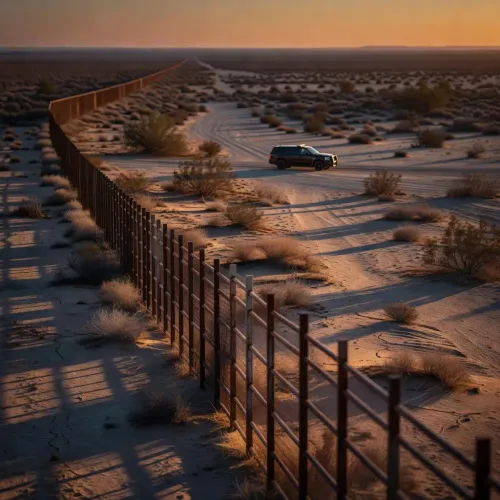
White House Declares 'Our Border Is Secure' in Sharp Post
Synopsis
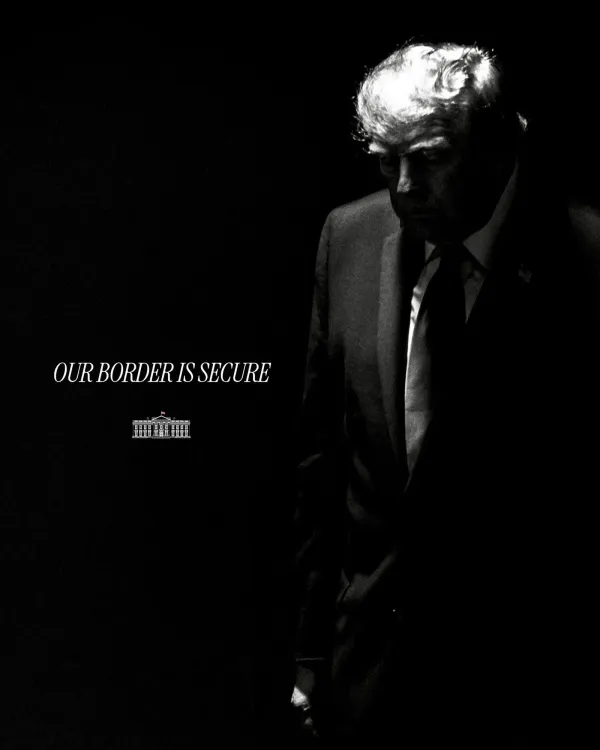
The White House posted a blunt four-word declaration — 'OUR BORDER IS SECURE' — on September 28, 2026, projecting executive confidence on one of America's most contested policy fronts as Congressional debates over immigration enforcement funding continue.
Key Takeaways
The White House posted 'OUR BORDER IS SECURE' on its official X account on September 28, 2026 .
The statement is a declarative assertion, not a policy detail — no statistics, locations, or legislative measures were included.
US administrations historically issue border-security statements during Congressional funding negotiations or periods of elevated political pressure.
The capitalized, four-word format signals a deliberate rhetorical choice aimed at projecting confidence and closing political debate.
Border communities from California to Texas experience border-security policy differently from how it is framed in Washington.
Congressional action on immigration funding in subsequent weeks will be the key test of whether this post signals a new policy push.
A four-word declaration — blunt, confident, and unmistakably political — landed on the White House's official X account on Monday, September 28, 2026. The executive office of the United States posted 'OUR BORDER IS SECURE,' a statement that compresses one of America's most contested policy debates into a single assertive sentence.
Four Words, One of America's Longest-Running Fights
Border security has functioned as a defining fault line in American politics for decades, oscillating between legislative grand bargains, executive order surges, and sharply worded public messaging campaigns. The White House framing the issue in the declarative — not 'we are securing the border' or 'enforcement is up,' but 'the border IS secure' — signals a deliberate rhetorical choice: closing the argument, not continuing it. US administrations across the political spectrum have periodically issued public statements asserting control over the southern border, typically timed to legislative negotiations over enforcement funding or in response to opposition criticism. The verb tense and the capitalization in this post do extra work — this reads less like a policy update and more like a rebuttal.What the White House Is Signalling to Congress and Critics
Statements of this kind rarely appear in a vacuum. Historically, White House communications on border security spike around Congressional appropriations cycles, debates over immigration enforcement resources, or periods of elevated political pressure from either direction. A one-line assertion from the official executive communications account — without accompanying statistics, locations, or legislative language — is a messaging move as much as it is a policy statement. The brevity is itself the signal: the administration is projecting confidence, not requesting debate. Whether that confidence is tested by Congressional scrutiny or independent data in the weeks ahead will determine how this declaration ages.Border Communities and the Gap Between Statement and Experience
For the millions of Americans living in border communities — from San Diego, California to Brownsville, Texas — the lived reality of border security is rarely reducible to four words. These communities have long occupied the uncomfortable intersection of federal policy, cross-border commerce, family ties, and law-enforcement presence. A White House assertion of security will resonate differently on the ground than in Washington briefing rooms. The coming weeks of Congressional action on immigration funding will offer the clearest read on whether this post marks the beginning of a new policy push or the punctuation on one already underway.Point of View
Not a status update. It arrives at a moment when US immigration policy debates are perennially tied to appropriations battles and mid-term political positioning, suggesting the administration is attempting to lock in a narrative ahead of Congressional action. For Indian observers, the statement underscores how US domestic border politics — with its deep implications for immigration pathways, visa policy, and bilateral labour mobility — continues to be shaped as much by communication strategy as by on-the-ground enforcement metrics. The real test of the claim will come in the weeks ahead, when Congressional hearings, independent data releases, and events on the border itself will either validate or complicate the administration's confident framing.
NationPress
28 Sept 2026
Frequently Asked Questions
What did the White House post about the US border on September 28 2026?
The White House posted 'OUR BORDER IS SECURE' on its official X account on September 28, 2026 — a brief, capitalized declaration asserting executive control over US border security.
Why is the White House making statements about border security?
US administrations historically make public border-security statements during Congressional negotiations over immigration enforcement funding or in response to political criticism, using messaging to shape the policy debate.
What does 'Our Border Is Secure' mean for US immigration policy?
The statement signals that the current administration is projecting confidence in its border enforcement posture, though specific policy details, statistics, or legislative measures were not included in the post.
How does US border security policy affect India?
US border and immigration policy directly influences visa processing, H-1B and other work-visa pathways, and broader bilateral labour mobility for hundreds of thousands of Indian nationals.
What happens next after the White House border security statement?
Congressional action on immigration funding and any related executive orders in the coming months will be the clearest indicator of whether this declaration marks the start of a new enforcement push or consolidates existing policy.