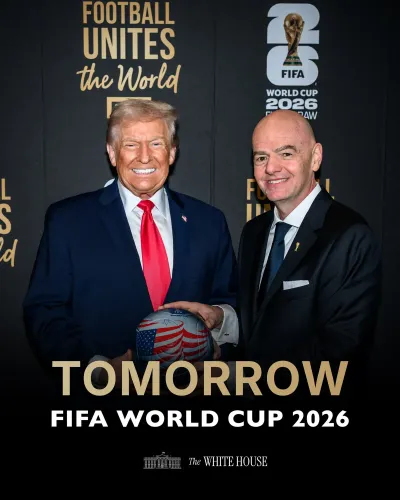
White House Hails FIFA World Cup 2026 Closing as Uniquely American

Synopsis
The White House marked the conclusion of FIFA World Cup 2026 with a celebratory post crediting the United States for an exceptional hosting performance, thanking international visitors and law enforcement for making the expanded 48-team tournament possible.
Key Takeaways
The White House posted a celebratory message on 21 July 2026 marking the close of FIFA World Cup 2026 .
FIFA awarded the 2026 World Cup to a joint United States, Canada, and Mexico bid on 13 June 2018 .
The 2026 edition featured an expanded 48-team format , the largest in tournament history.
The White House specifically acknowledged law enforcement agencies and international visitors in its closing message.
The post included a video alongside the text, amplifying the celebratory message from the executive office.
Post-event focus is expected to shift to economic impact assessments and infrastructure legacy tied to the tournament.
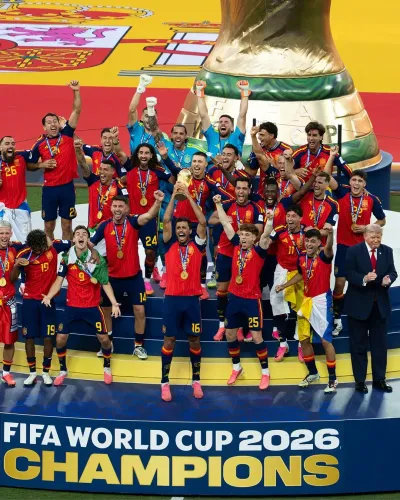
The White House, the official communications account of the Executive Office of the President of the United States, posted a celebratory message on Tuesday, 21 July 2026, marking the close of the FIFA World Cup 2026 and crediting the United States for delivering an unforgettable tournament experience to fans from across the globe.
Context
The post declared, 'Nobody does it quite like POTUS and America,' extending gratitude to international visitors and law enforcement for making the event possible. The message underscored American exceptionalism in hosting large-scale global events, calling the World Cup 'an unforgettable way to close out FIFA World Cup 2026.'
The statement was accompanied by a video, amplifying the celebratory tone and giving the post a visual dimension beyond the text alone. The White House framed the tournament's conclusion as a moment of national pride and logistical achievement.
Policy Backdrop
FIFA awarded the 2026 World Cup hosting rights to a joint bid by the United States, Canada, and Mexico on 13 June 2018, marking the first time three nations would co-host the tournament. The 2026 edition also featured an expanded 48-team format, the largest in the competition's history, significantly increasing the logistical demands on host nations.
The sitting administration had publicly supported the hosting arrangements, with security coordination across multiple venues being a key area of federal involvement. The White House's post is consistent with a broader pattern of the executive branch using major international sporting events to project American soft power and demonstrate organisational capacity.
Stakeholders and Impact
The White House specifically thanked 'law enforcement and everyone who made it possible,' acknowledging the extensive security apparatus deployed across host cities. International visitors who travelled to the United States for the tournament were also directly addressed, with the post noting their role in experiencing 'the hype firsthand.'
Large-scale international sporting events of this nature have historically generated significant economic activity for host cities, including hospitality, transportation, and retail sectors. The executive branch's public messaging at the tournament's close positions the government as a key enabler of that experience.
What's Next
Attention is now expected to turn to the post-event legacy, including any official assessments of economic impact, infrastructure improvements, and the broader diplomatic gains from hosting teams and delegations from 48 nations. Follow-up statements from the administration on these outcomes are anticipated in the coming weeks.
The co-hosting arrangement with Canada and Mexico may also prompt trilateral discussions on the model's success and its implications for future joint bids among neighbouring nations. How the United States leverages the goodwill generated by the tournament in its international engagements will be closely watched.
Point of View
The administration signals both outward diplomacy and domestic pride simultaneously. The framing of 'nobody does it quite like America' echoes a long tradition of US administrations leveraging mega-events to project national brand value. The real test of this narrative will come when post-event economic and infrastructure legacy data is made public.
NationPress
21 Jul 2026
Frequently Asked Questions
When did the FIFA World Cup 2026 end?
The FIFA World Cup 2026 concluded around 21 July 2026 , when the White House posted its celebratory closing message on X.
Which countries co-hosted the FIFA World Cup 2026?
The FIFA World Cup 2026 was co-hosted by the United States , Canada , and Mexico , following a joint bid that was awarded by FIFA on 13 June 2018 .
How many teams played in the FIFA World Cup 2026?
The FIFA World Cup 2026 featured an expanded format of 48 teams , the largest field in the tournament's history.
What did the White House say about the FIFA World Cup 2026?
The White House called it 'an unforgettable way to close out FIFA World Cup 2026 ,' thanking international visitors and law enforcement for making the event possible.
Why did the US host the FIFA World Cup 2026?
The United States , along with Canada and Mexico , won the hosting rights in 2018 ; the US has historically used large international sporting events to project soft power and demonstrate logistical capacity.