White House Warns ICE Operations Will Not Be Deterred
Synopsis
The White House issued a forceful warning on June 1, 2026, declaring ICE operations will not be stopped in Newark or anywhere in the US. It threatened arrest and prosecution for anyone who riots, obstructs, or assaults a federal officer, signalling an uncompromising stance on immigration enforcement.
Key Takeaways
The White House posted a direct warning on June 1, 2026 that ICE operations will not be deterred by protests or obstruction.
Newark, New Jersey was specifically cited, though the message was framed as applying nationwide.
The post warned that rioting, obstructing, or assaulting a federal officer will result in arrest and prosecution 'to the fullest extent of the law.' ICE was established in 2003 under the Department of Homeland Security to handle interior immigration enforcement.
The warning follows a broader pattern of federal-local conflict over sanctuary policies that restrict cooperation with ICE detainers.
Federal charging documents or court proceedings linked to the referenced Newark incident are expected to be closely watched.
The White House, the official communications account of the Executive Office of the President of the United States, issued a sharp warning on Monday, June 1, 2026, declaring that U.S. Immigration and Customs Enforcement (ICE) operations will not be stopped by protests or physical obstruction — citing Newark as a specific flashpoint while extending the message nationwide.
Context
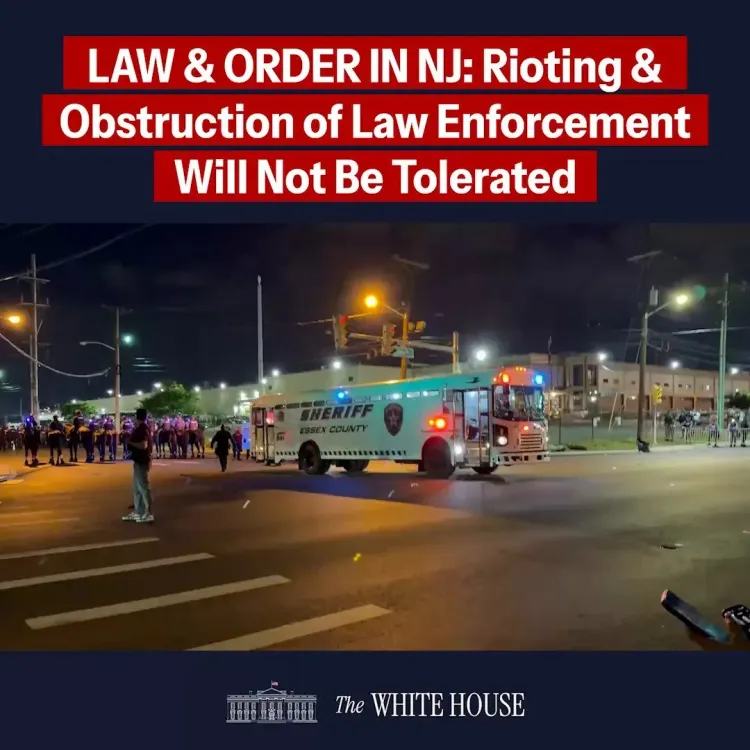
The post stated bluntly: 'Newark or anywhere in America, the message doesn't change: ICE operations will NOT be deterred.' It warned that anyone who 'riots, obstructs, or assaults an officer' will be 'arrested and prosecuted to the fullest extent of the law.' The message closed with the phrase 'Play stupid games, win stupid prizes' — an unusually direct colloquial warning from an official government account.
Newark, New Jersey — the state's largest city — has historically been a focal point in debates over sanctuary policies and local resistance to federal immigration enforcement. The post accompanied a video, suggesting the White House was responding to or documenting a specific on-the-ground incident.
Policy Backdrop
ICE was established under the Homeland Security Act of 2002, which created the Department of Homeland Security and consolidated immigration enforcement functions previously held by the Immigration and Naturalization Service. Since its founding in 2003, ICE has been at the centre of repeated confrontations between federal enforcement priorities and local sanctuary jurisdictions.
Sanctuary policies — adopted by several cities and counties — restrict local law enforcement from cooperating with ICE detainers, creating recurring tension with federal authorities. Successive administrations have maintained that interference with federal officers constitutes a violation of federal law, regardless of local ordinances. The White House messaging pattern of issuing firm, public warnings after high-profile protest incidents is consistent with prior administrations' communications strategies.
Stakeholders and Impact
The warning directly addresses multiple groups: ICE officers conducting enforcement operations, immigrant communities affected by those operations, and local protesters who have in various instances physically intervened at ICE actions. For immigrant rights advocates, the statement signals an uncompromising federal posture that dismisses local political opposition as irrelevant to operational decisions.
For local governments with sanctuary policies — including in New Jersey — the post reaffirms that federal enforcement will proceed irrespective of municipal directives. Any individuals who face federal charges stemming from obstruction incidents referenced in the post could face prosecution under statutes governing assault or interference with federal officers.
What's Next
Observers will watch for any federal charging documents or court proceedings linked to the Newark incident referenced in the post. The White House's decision to name a specific city while framing the warning as national in scope suggests the administration may be prepared to use individual cases as precedents to deter future obstruction of ICE operations.
As immigration enforcement remains one of the most contested domestic policy arenas in the United States, the tone and language of this post indicate the administration intends to escalate both the operational tempo and the public rhetoric around ICE activity in the months ahead.
Point of View
Win stupid prizes' is a deliberate departure from formal executive communication — designed to signal cultural and political alignment with a base that views sanctuary policies as lawless. By naming Newark specifically while framing the warning as national, the administration is using a single incident as a template to deter future obstruction across multiple jurisdictions. This fits a broader arc of the federal government asserting supremacy over local immigration governance, a tension that has intensified with each successive administration. The escalating rhetoric suggests the White House views public confrontation over ICE operations as politically advantageous rather than a liability.
NationPress
17 Oct 2026
Frequently Asked Questions
Why did the White House warn about ICE operations in Newark?
The White House cited Newark in a June 1, 2026 post warning that ICE operations will not be stopped by protests or obstruction, likely in response to a specific incident there, though details remain unconfirmed.
What happens if someone obstructs an ICE officer in the US?
Under US federal law, obstructing, assaulting, or interfering with a federal officer is a criminal offence that can result in arrest and prosecution. The White House warned on June 1, 2026, that such actions will be prosecuted 'to the fullest extent of the law.'
What is ICE and what does it do?
ICE, or US Immigration and Customs Enforcement, is a federal agency created in 2003 under the Department of Homeland Security. It is responsible for interior immigration enforcement, including detentions and deportations.
What are sanctuary cities and how do they relate to ICE?
Sanctuary cities are jurisdictions that limit local law enforcement cooperation with ICE detainers. They have been a source of ongoing tension with federal immigration authorities, who maintain that federal law supersedes local sanctuary policies.
What is the significance of the White House naming Newark specifically?
Newark, New Jersey, is the state's largest city and has historically been associated with sanctuary policies and resistance to federal immigration enforcement. Naming it signals the administration is prepared to use specific cases as examples to deter obstruction elsewhere.