White House Launches 'Trump Accounts' for American Children

Synopsis
The White House unveiled 'Trump Accounts' on 27 July 2026, directing American families to TRUMPACCOUNTS.GOV and framing the initiative as the government returning fiscal resources to children — the latest move in a long-running Republican push to embed savings incentives in family tax policy.
Key Takeaways
The White House announced 'Trump Accounts' on 27 July 2026 , a savings initiative aimed at American children.
The official portal TRUMPACCOUNTS.GOV was cited as the primary information source for the programme.
The initiative is framed as the government 'giving money back' to children, echoing Republican fiscal messaging on household savings.
The announcement follows the policy lineage of the Tax Cuts and Jobs Act of 2017 , which expanded child tax credits.
Key programme details — including whether accounts are government-seeded or tax-sheltered containers — remain subject to Treasury Department guidance.
Congressional action will determine whether the programme is enshrined in statute or operates through existing executive authority.
The White House announced on Sunday, 27 July 2026 the rollout of what it is calling 'Trump Accounts,' a government-backed savings initiative framed as returning fiscal resources directly to American children, with details directed to a dedicated portal at TRUMPACCOUNTS.GOV.
Context
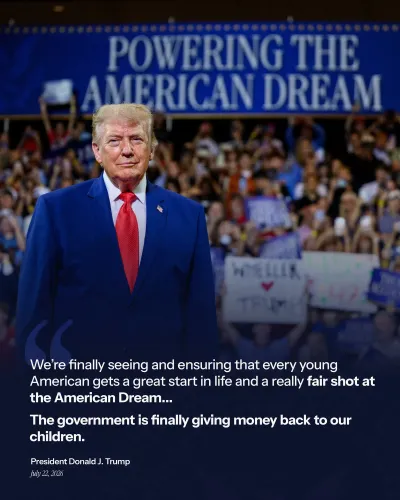
The White House post, captioned 'AMERICAN DREAM UNLOCKED,' carried the quote: 'The government is finally giving money BACK to our children.' The messaging positions the programme as a reversal of the conventional direction of public finance — from households to government — framing it instead as a vehicle for intergenerational wealth building.
A video accompanied the post, suggesting a formal communications rollout rather than an off-the-cuff announcement. The programme appears to be directed at American families with children, with the government acting as a facilitator of savings or credits rather than a direct-spending intermediary.
Policy Backdrop
The announcement fits within a broader arc of Republican fiscal philosophy that traces back to the Tax Cuts and Jobs Act of 2017, which expanded the Child Tax Credit and reduced individual tax rates with the stated aim of increasing household savings. That legislation was a signature achievement of President Donald Trump's first term and set the template for framing tax policy as money 'returned' to families rather than revenue foregone by the state.
Tax-advantaged children's savings accounts have been debated in Washington for years, with various proposals — from baby bonds to expanded 529 education accounts — circulating across party lines. The 'Trump Accounts' branding suggests the current administration is moving to claim this policy space with a distinctly executive identity, potentially building on or superseding earlier legislative frameworks.
Stakeholders and Impact
The primary beneficiaries, as framed by the White House, are American families and children. If the accounts function as tax-advantaged savings vehicles — similar in structure to 529 plans or Coverdell Education Savings Accounts — the benefit would accrue most to households with disposable income to contribute, a distributional pattern that has drawn scrutiny in past savings-account proposals.
For lower-income families, the value of the programme would depend heavily on whether the government seeds the accounts with an initial deposit or merely creates a tax-sheltered container. The distinction between a seeded account and a tax credit is significant: the former delivers value regardless of a family's tax liability, while the latter primarily benefits those who owe federal taxes. Programme details on the official portal would clarify this critical design choice.
What's Next
Congressional action will determine the legislative durability of the initiative, particularly whether 'Trump Accounts' are established by statute or through executive authority over existing Treasury mechanisms. Treasury Department guidance on eligibility criteria, funding sources, and contribution limits will be the next key disclosure to watch.
The White House's decision to anchor the announcement to a dedicated web domain signals an intent to build a sustained public-facing campaign around the programme. Advocates for child savings policy and fiscal watchdog groups are likely to scrutinise the programme's design, cost projections, and distributional impact in the days ahead.
Point of View
The White House is deploying the same rhetorical architecture that made the 2017 tax cuts politically potent — positioning government inaction on revenue collection as an act of generosity. The critical design question — whether accounts are seeded with public funds or are merely tax-advantaged shells — will determine whether this is transformative child-savings policy or repackaged tax relief. How Congress and the Treasury respond will reveal whether 'Trump Accounts' is a lasting programme or an election-cycle messaging vehicle.
NationPress
27 Jul 2026
Frequently Asked Questions
What are Trump Accounts?
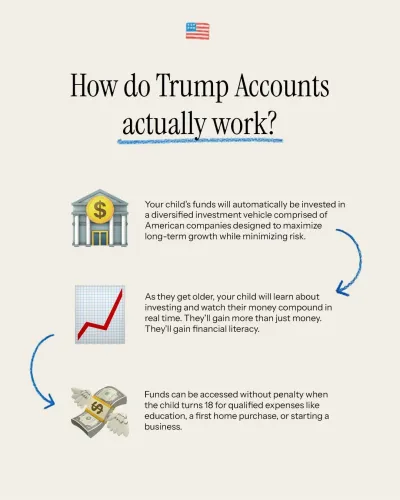
'Trump Accounts' is a government savings initiative announced by the White House on 27 July 2026, framed as returning money to American children. Details are available at TRUMPACCOUNTS.GOV, and the precise mechanism — whether accounts are government-seeded or tax-advantaged — is subject to Treasury guidance.
Who is eligible for Trump Accounts?
The White House has framed the programme as benefiting American children and families broadly. Specific eligibility criteria, income limits, and contribution rules are expected to be outlined through official Treasury Department guidance and the TRUMPACCOUNTS.GOV portal.
How are Trump Accounts different from existing child savings plans?
Existing vehicles like 529 education savings plans and Coverdell accounts are tax-advantaged but require families to contribute their own funds. Whether 'Trump Accounts' include a government seed deposit — making them accessible to lower-income families — is a key design question not yet publicly resolved.
Did Congress approve Trump Accounts?
No congressional vote has been publicly reported in connection with this announcement. The programme's legislative basis — whether it requires new statute or operates through existing executive authority — is one of the key details to watch as the rollout unfolds.
What is TRUMPACCOUNTS.GOV?
TRUMPACCOUNTS.GOV is the official government portal cited by the White House for the 'Trump Accounts' initiative, intended to provide information and access to the programme for American families.