White House targets schools over gender transition secrecy
Synopsis
The White House on 28 July 2026 amplified reports that the Trump administration is moving against schools accused of concealing students' gender transitions from parents, escalating a long-running federal battle over Title IX, parental rights, and school authority over student gender identity.
Key Takeaways
The White House officially signalled on 28 July 2026 that the Trump administration is targeting schools accused of hiding students' gender transitions from parents.
The action aligns with the administration's broader parental rights agenda and its rollback of Obama-era transgender guidance in schools.
Title IX , the federal law barring sex-based discrimination in federally funded schools, is central to the legal dispute over how gender identity is treated in education.
The US Department of Education is expected to be the enforcement vehicle; any formal directive could affect public schools across all 50 states .
Legal challenges from civil liberties and LGBTQ+ advocacy groups are widely anticipated if binding federal guidance is issued.
State laws on parental notification already conflict across the country, adding complexity to any federal enforcement effort.
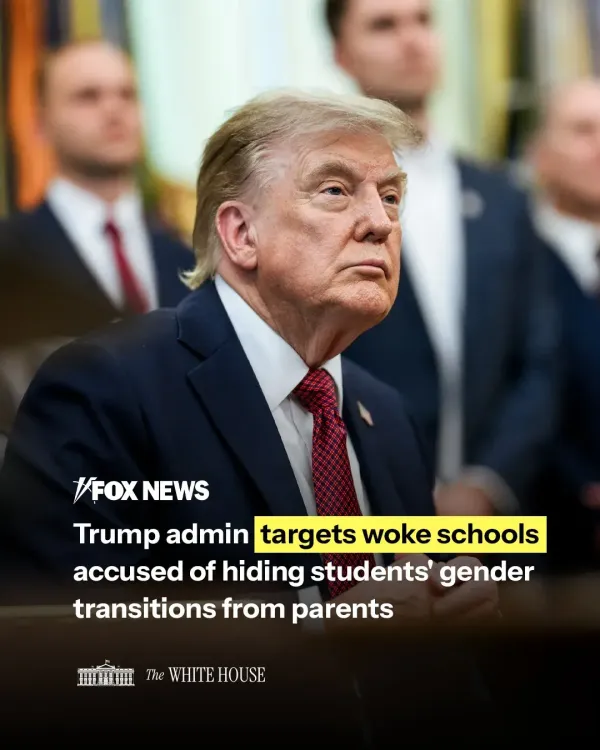
The White House, the official communications account of the Executive Office of the President of the United States, shared a post on Tuesday, 28 July 2026, amplifying coverage that the Trump administration is taking action against schools accused of concealing students' gender transitions from their parents.
Context
The post, shared by the official White House account, referenced reporting on what it described as 'woke schools' hiding students' gender transitions from parents — framing the administration's stance as a defence of parental rights in education. The phrase 'woke schools' reflects the administration's broader rhetorical positioning against progressive education policies.
This is not the first time the Trump administration has moved to reshape federal education policy on gender identity. During President Donald Trump's first term (2017–2021), his administration withdrew Obama-era guidance that had directed schools to allow transgender students to use facilities consistent with their gender identity.
Policy Backdrop
At the heart of the dispute is the interpretation of Title IX, the federal statute prohibiting sex-based discrimination in schools receiving federal funding. Successive administrations have issued conflicting guidance on whether 'sex' under Title IX covers gender identity — creating a shifting legal landscape for school districts across the country.
The US Department of Education is the federal body responsible for enforcing Title IX and issuing guidance to schools. Any formal directive or enforcement action from the department on parental notification policies would carry significant weight, potentially affecting thousands of public school districts that rely on federal funding.
State-level legislation has mirrored this federal tension, with several Republican-led states passing laws requiring schools to notify parents if a student requests to be identified by a different gender, while others have moved in the opposite direction to protect student privacy.
Stakeholders and Impact
The primary stakeholders in this debate are parents and public schools, whose interests are framed as competing by advocates on both sides. Parental rights groups argue that schools have an obligation to keep parents informed about significant aspects of their children's lives, including social transitions at school.
LGBTQ+ advocacy organisations counter that mandatory parental notification policies can put vulnerable students at risk, particularly those from unsupportive home environments. School administrators, caught between federal directives and state laws, face mounting legal and operational uncertainty.
The administration's move, if followed by formal guidance or enforcement action, could affect public schools across all 50 US states, with implications for how educators handle student privacy and parental communication.
What's Next
The immediate focus will be on whether the Department of Education issues formal guidance or initiates enforcement proceedings against specific school districts. Legal challenges from civil liberties groups are widely anticipated if binding directives are issued.
Congressional oversight committees are also expected to weigh in, with the debate likely to intensify as the administration signals its intent to hold schools accountable through federal mechanisms. The outcome will further define the boundaries of parental rights versus student privacy in American public education for years to come.
Point of View
' the administration is consolidating a political coalition of parents and conservative voters ahead of potential enforcement actions. The move continues a pattern stretching back to the first Trump term of using federal education authority — particularly Title IX — as a lever to reverse progressive gender policies embedded during the Obama years. Whether this translates into enforceable guidance or remains largely rhetorical will determine its real-world impact on school districts caught between competing federal and state mandates.
NationPress
28 Jul 2026
Frequently Asked Questions
What is the Trump administration doing about schools hiding gender transitions from parents?
The Trump administration is reportedly targeting schools accused of concealing students' gender transitions from their parents, framing the action as a defence of parental rights. The White House amplified this on 28 July 2026, though formal guidance or enforcement actions from the Department of Education are yet to be officially announced.
What is Title IX and how does it relate to gender identity in schools?
Title IX is a US federal law that prohibits sex-based discrimination in schools receiving federal funding. Different administrations have interpreted whether 'sex' includes gender identity, leading to conflicting guidance and ongoing legal battles over transgender student rights and parental notification policies.
Can the US federal government force schools to tell parents about a child's gender transition?
The federal government can issue guidance and tie enforcement to federal funding under Title IX, which gives it significant leverage over public schools. However, any binding directive would likely face immediate legal challenges from civil liberties organisations.
What did the Trump administration do on transgender school policies in the first term?
During President Trump's first term (2017–2021), the administration withdrew Obama-era guidance that had directed schools to allow transgender students to use facilities consistent with their gender identity, signalling a rollback of progressive gender policies in education.
How does the US debate over parental rights in schools affect Indian readers?
While the policy directly affects US public schools, the debate is closely watched globally as it reflects broader tensions between state authority, parental rights, and student privacy — themes that resonate in education policy discussions in India and other democracies as well.