Giriraj Singh hails ₹3,855 cr projects for Daman, Lakshadweep
Synopsis
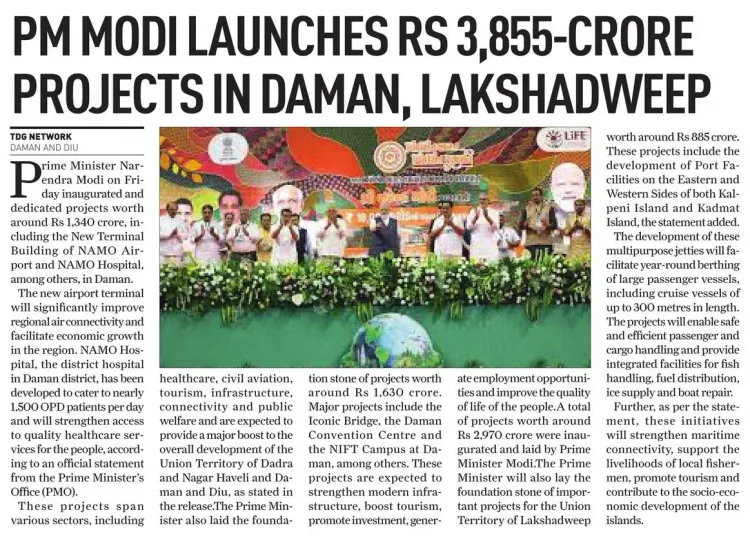
Union Textiles Minister Giriraj Singh on 6 June 2026 hailed the inauguration and foundation-laying of ₹3,855 crore worth of projects in Daman and Lakshadweep, covering health, connectivity, tourism, education and infrastructure under PM Modi's Viksit Bharat 2047 vision.
Key Takeaways
Union Textiles Minister Giriraj Singh welcomed development projects worth ₹3,855 crore in Daman and Lakshadweep on 6 June 2026 .
Projects span health, connectivity, tourism, education and basic infrastructure sectors.
The initiative is framed under the Viksit Bharat 2047 and Atmanirbhar Bharat policy frameworks.
Job creation and local economic strengthening are stated outcomes of the investment.
The central government has consistently prioritised capital expenditure in geographically peripheral union territories since 2014 .
Fund utilisation reports and NITI Aayog reviews will be key indicators of on-ground delivery.
Union Textiles Minister Giriraj Singh on Saturday, 6 June 2026, welcomed the inauguration and foundation-laying of development projects worth ₹3,855 crore in Daman and Lakshadweep, crediting the initiative to Prime Minister Narendra Modi's vision of reaching every corner of the country with growth.
Context
Singh posted on X in Hindi, stating that 'हर कोने तक विकास पहुँचाने का संकल्प निरंतर साकार हो रहा है' ('the resolve to bring development to every corner is continuously being realised'). He described the projects as covering health, connectivity, tourism, education and basic infrastructure, sectors long identified as gaps in India's smaller union territories.
The minister framed the announcement not merely as project launches but as a 'significant step towards realising a self-reliant and developed India' — invoking the government's twin slogans of Atmanirbhar Bharat and Viksit Bharat 2047.
Policy Backdrop
The Atmanirbhar Bharat initiative, launched in 2020, set the framework for self-reliant development through large infrastructure and economic packages. The PM Gati Shakti national master plan, announced in 2021, further institutionalised multi-modal connectivity investments, including in geographically peripheral regions.
Since 2014, the central government has consistently prioritised capital expenditure in island and coastal union territories such as Lakshadweep and Daman, which lack the tax-base and administrative scale of larger states. Simultaneous foundation-laying and inauguration events across multiple regions have become a signature format for projecting balanced national development under the current administration.
The Viksit Bharat 2047 vision — targeting a fully developed India by the centenary of independence — provides the long-term policy anchor for such investments, with infrastructure, job creation and local economic strengthening identified as core pillars.
Stakeholders and Impact
The most direct beneficiaries are residents of Daman and the Lakshadweep archipelago, communities that have historically depended on central transfers for public services. Improved connectivity and health infrastructure are expected to reduce the isolation that characterises island living, where even routine medical referrals can require sea or air transport.
The local tourism and services sector stands to gain significantly: Lakshadweep has been positioned as a premium island-tourism destination, and investments in connectivity and hospitality infrastructure directly support that push. Singh specifically noted that the projects will 'create new employment opportunities and strengthen the local economy' — a signal that job generation in these territories is a stated policy outcome.
What's Next
Attention will now turn to rollout timelines and fund-utilisation reports for the ₹3,855 crore outlay. NITI Aayog reviews on island development and upcoming Union Budget allocations will be watched for follow-through on these commitments. Any acceleration in Lakshadweep's tourism infrastructure, in particular, will be seen as a test of the government's ability to translate high-profile launches into on-ground delivery for some of India's most remote communities.
Point of View
Making them clean showcases for central government delivery. The simultaneous invocation of Atmanirbhar Bharat and Viksit Bharat 2047 signals an effort to nest individual project launches within a larger civilisational ambition ahead of 2047. The real test, as with similar announcements in Andaman and Nicobar, will be whether project timelines and fund utilisation match the scale of the rhetoric.
NationPress
21 Oct 2026
Frequently Asked Questions
What are the ₹3,855 crore projects in Daman and Lakshadweep?
The projects cover health, connectivity, tourism, education and basic infrastructure, and were inaugurated and foundation-laid as part of the central government's development push in these union territories on 6 June 2026.
Who announced the Daman and Lakshadweep development projects?
Union Textiles Minister Giriraj Singh highlighted the projects on X, attributing them to Prime Minister Narendra Modi's leadership and the Viksit Bharat 2047 vision.
What is Viksit Bharat 2047?
Viksit Bharat 2047 is the central government's long-term vision to make India a fully developed nation by 2047, the centenary of independence, with infrastructure, self-reliance and economic growth as core pillars.
How does Lakshadweep benefit from central infrastructure investment?
Lakshadweep, an island union territory, benefits through improved connectivity, health services and tourism infrastructure, reducing its geographic isolation and boosting the local economy.
What is Atmanirbhar Bharat and how does it relate to these projects?
Atmanirbhar Bharat, launched in 2020, is the government's self-reliance initiative that channels infrastructure and economic investment to reduce dependence on imports and strengthen local economies — the Daman and Lakshadweep projects are presented as part of this framework.