August 5 in J&K vs PoJK: Seven years of diverging realities
Synopsis
On the same date, India celebrates J&K's integration and Pakistan mourns it — but seven years of evidence on both sides of the Line of Control tell strikingly different stories. While J&K gets its first rail link, record tourism, and restored elections, PoJK residents are reportedly taking to the streets over unaffordable electricity and bread shortages, with protests met by curfews and communication blackouts.
Key Takeaways
India marks 5 August as the anniversary of the 2019 constitutional changes that integrated Jammu and Kashmir into the Union; Pakistan observes it as 'Youm-e-Istehsal' (Day of Exploitation).
The Udhampur-Srinagar-Baramulla Rail Link , featuring the world's highest railway bridge over the Chenab , began Vande Bharat services in June 2025 .
J&K reportedly recorded more than two crore tourists in a recent year; new AIIMS , IIM , and IIT campuses have been established in the region.
Assembly elections in 2024 restored elected governance to J&K, including significant participation by women and young candidates.
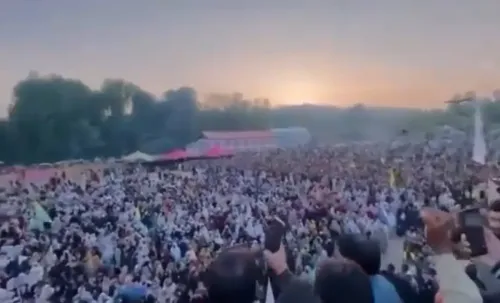
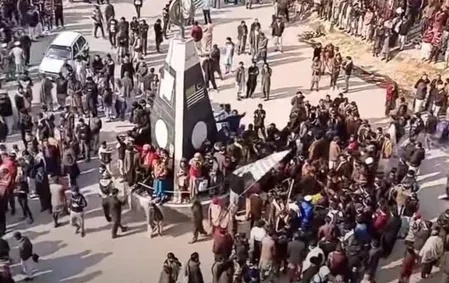
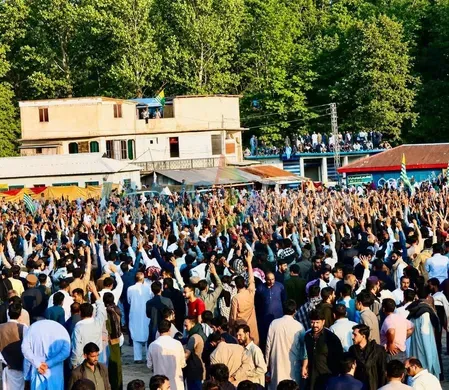
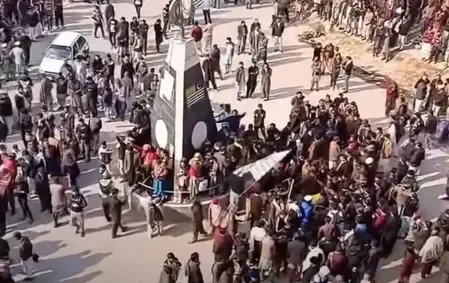
Residents of Pakistan-occupied Jammu and Kashmir (PoJK) have staged repeated protests over high electricity tariffs and food costs, reportedly met with curfews and communication shutdowns.
India's Ministry of External Affairs in October 2025 called on Pakistan to be held accountable for human rights violations in PoJK, citing systemic resource exploitation.
New Delhi, 5 August — Few dates on the subcontinent's calendar are observed in such opposing spirit by two neighbouring nations. On this day, India marks the sixth anniversary of the constitutional changes of 2019 that revoked the special status of Jammu and Kashmir and integrated it fully into the Union. Across the Line of Control (LoC), Pakistan observes what it calls 'Youm-e-Istehsal' — a Day of Exploitation — framing that integration as an act of subjugation against the Kashmiri people. Seven years on, the evidence on both sides of the line tells a more complicated story than either government's official narrative.
What Seven Years Have Built in Jammu and Kashmir
On the Indian side, the record is largely one of documented infrastructure and institutional expansion. According to figures cited by the Government of India, investment proposals worth tens of thousands of crores have flowed into the Union Territory since 2019 — capital that had long been difficult to attract. The most visible symbol of this shift is the Udhampur-Srinagar-Baramulla Rail Link, a national project that now connects the Kashmir Valley to the rest of the country for the first time in history. The line is carried across the Chenab River by what is reported to be the world's highest railway bridge, and a Vande Bharat service was flagged off on the route in June 2025.
The transformation extends beyond rail. An All India Institute of Medical Sciences (AIIMS) has been established in Jammu, alongside new campuses of the Indian Institute of Management (IIM) and the Indian Institute of Technology (IIT) — institutions that anchor healthcare and higher education in a region that previously had to send students and patients elsewhere. Tourism, the Valley's traditional economic lifeblood, reportedly reached record levels, with government figures pointing to more than two crore visitors in a single recent year.
Honesty, however, requires acknowledging what remains unfinished. The Pahalgam attack of April 2025 was a stark reminder that the security challenge has not been resolved, and it sharply disrupted the tourist season. The work of normalisation, by any candid assessment, is ongoing.
The Return of Local Democracy
Perhaps the quietest but most consequential change has been the restoration of grassroots electoral politics. Panchayat and District Development Council (DDC) elections were followed by Assembly polls in 2024, placing decision-making in the hands of elected local representatives — including, notably, a significant number of young people and women entering public life for the first time. Whatever one's view of the 2019 constitutional changes, the return of the ballot at the village level is not, critics and supporters alike would concede, the hallmark of a territory under permanent subjugation.
Where the Real Exploitation Argument Falls
Turn the map around to the territory Pakistan administers — Pakistan-occupied Jammu and Kashmir (PoJK) — and the word 'Istehsal' acquires an unintended resonance. The picture that has emerged from PoJK over the past three years is not one of contented governance. It is one of sustained popular unrest against economic hardship and political powerlessness, met by the state with force.
The grievances are specific and documented. According to accounts from the territory's own civil society coalitions and traders' committees, PoJK generates substantial hydroelectric power from its rivers — yet its residents reportedly pay among the highest electricity rates in the region, with the power itself fed into the national grid. Alongside this run demands for subsidised wheat flour, relief from inflation, and an end to official privileges. When a population takes to the streets over the price of bread and the cost of electricity generated in its own hills, the language of exploitation belongs to them — not to the state that governs them.
India's Ministry of External Affairs drew direct attention to this in a briefing in October 2025, stating that Pakistan must be held accountable for human rights violations in the occupied territory and describing the unrest as a natural consequence of an oppressive approach and the systemic plundering of resources. The observation is pointed, and it rests on a pattern of agitation that has recurred year after year.
The Verdict of the Streets
The most telling indicator is how each administration has responded to dissent. In PoJK, according to reports, successive rounds of protest have been met with curfews, communication blackouts, and the deployment of force. The civil society alliance leading the agitation has reportedly faced moves to outlaw it. Elections held in the territory were described by India's Ministry of External Affairs as a cosmetic exercise intended to camouflage an illegal occupation and distract from grave human rights violations. A government confident of its people's loyalty, critics argue, does not need to shut down their internet or ban their associations.
This is the contrast that August 5 places in sharp relief. On one side of the LoC, a territory is being connected to a national railway network, equipped with premier institutions of health and learning, and returned to the practice of local elections — with real problems still to address. On the other, a territory generates power it cannot afford to consume, queues for subsidised flour, and watches its protests answered with batons and blackouts. As both nations mark the date in their own way, the ground-level evidence is increasingly difficult to reconcile with Islamabad's chosen framing.
Point of View
Debated, and improved. Pakistan's 'Youm-e-Istehsal' framing, by contrast, is undermined by the very territory it administers: PoJK's recurring street protests over electricity and flour are not the grievances of a population that feels protected. The deeper irony is that Islamabad has chosen exploitation as its annual theme while its own MEA-documented conduct in PoJK — resource extraction, crackdowns, communication blackouts — fits the charge with uncomfortable precision. Mainstream coverage tends to treat August 5 as a bilateral political flashpoint; the more revealing story is the divergence in lived conditions on either side of the LoC.
NationPress
4 Aug 2026
Frequently Asked Questions
What happened on August 5, 2019, in Jammu and Kashmir?
On 5 August 2019, the Government of India revoked the special status of Jammu and Kashmir under Article 370 of the Constitution and reorganised the state into two Union Territories: Jammu and Kashmir, and Ladakh. The move ended decades of asymmetric constitutional provisions and integrated the region fully into the Indian Union.
What is Pakistan's 'Youm-e-Istehsal'?
'Youm-e-Istehsal', or Day of Exploitation, is an annual observance held by Pakistan on 5 August to protest India's 2019 constitutional changes in Jammu and Kashmir. Pakistan frames the integration as an illegal act of subjugation against the Kashmiri people, a position India formally rejects.
What development has taken place in J&K since 2019?
According to government figures, J&K has seen significant investment inflows, the inauguration of the Udhampur-Srinagar-Baramulla Rail Link with Vande Bharat services from June 2025, and the establishment of AIIMS, IIM, and IIT campuses. Tourism reportedly crossed two crore visitors in a recent year, and Assembly elections were held in 2024.
What is the situation in Pakistan-occupied Jammu and Kashmir (PoJK)?
PoJK has witnessed repeated popular protests over high electricity tariffs — despite generating substantial hydroelectric power — as well as demands for subsidised wheat flour and relief from inflation. Reports indicate that protests have been met with curfews, internet shutdowns, and restrictions on civil society organisations leading the agitation.
What has India's Ministry of External Affairs said about PoJK?
In a briefing in October 2025, India's Ministry of External Affairs stated that Pakistan must be held accountable for human rights violations in PoJK, describing the unrest there as a consequence of an oppressive approach and the systemic plundering of the territory's resources.