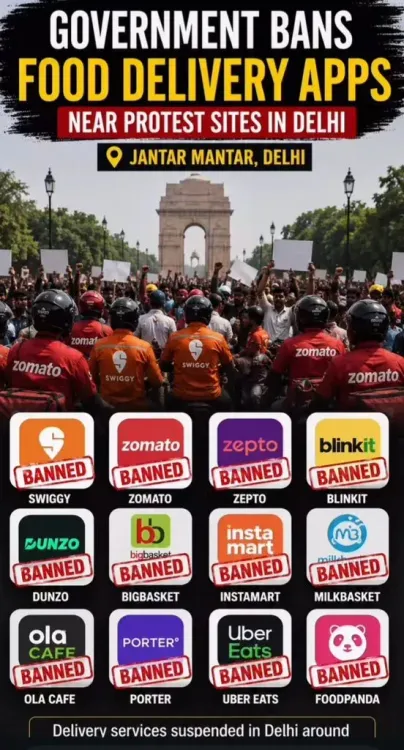
Akhilesh Yadav coins 'Foodbandi', slams Centre on food prices
Synopsis
Samajwadi Party president Akhilesh Yadav on 24 July 2026 coined the term 'Foodbandi' to link the 2016 demonetisation to current food-access hardships, urging the government with 'Do not snatch away our bread' — extending a long-running opposition critique of central economic policy.
Key Takeaways
Akhilesh Yadav posted on 24 July 2026 coining the term 'Foodbandi' to describe what he called a new assault on food access for ordinary citizens.
His post used the phrase 'रोटी मत छीनो!' — 'Do not snatch away our bread!' — as its central message.
The hashtag #Notebandi_to_Foodbandi explicitly links the November 2016 demonetisation to present-day food affordability concerns.
The Samajwadi Party's critique targets the impact on low-income households and informal sector workers — groups most vulnerable to food price shocks.
Parliamentary debates on PDS reforms and food security schemes are expected to be a key battleground in the coming legislative session.
Samajwadi Party president Akhilesh Yadav on Friday, 24 July 2026, took a sharp swipe at the central government over rising food prices, coining the term 'Foodbandi' — a portmanteau linking the 2016 demonetisation to what he described as an assault on the food security of ordinary citizens.
In a terse but pointed post on X, Yadav wrote: 'रोटी मत छीनो!' — 'Do not snatch away our bread!' — and used the hashtag #Notebandi_to_Foodbandi to draw a direct line between the November 2016 demonetisation and what he characterised as a new wave of economic hardship hitting low-income households.
Context
The term 'Notebandi' (note ban) has been the opposition's shorthand for Prime Minister Narendra Modi's demonetisation decision of 8 November 2016, which invalidated Rs 500 and Rs 1,000 currency notes overnight. The move triggered acute cash shortages across the informal economy, with daily-wage workers, small traders, and rural households bearing the heaviest burden.
Yadav's latest coinage — 'Foodbandi' — extends that critique into the domain of food affordability and access. The Samajwadi Party has long argued that demonetisation caused structural damage to cash-reliant livelihoods that was never fully repaired, and that subsequent policy choices have compounded the distress.
Policy Backdrop
Opposition parties in India have repeatedly returned to demonetisation as a reference point when attacking the central government on economic management. The rhetorical strategy — framing each new hardship as a continuation of the 2016 shock — has been especially prominent during periods of elevated food inflation and debates over the Public Distribution System (PDS).
Food price volatility has been a recurring concern in Uttar Pradesh, where Yadav's Samajwadi Party is the principal opposition force. Welfare delivery, ration entitlements, and the reach of food security schemes remain live political issues in the state, which sends the largest bloc of members to the Lok Sabha.
Stakeholders and Impact
The communities most directly invoked by Yadav's post are low-income households and informal sector workers — the same groups identified as the hardest hit by demonetisation nearly a decade ago. For these populations, food expenditure constitutes the largest share of household spending, making any squeeze on food access or affordability acutely felt.
The post carries political weight beyond Uttar Pradesh: the 'Notebandi-to-Foodbandi' framing is designed to resonate nationally, positioning the Samajwadi Party as a voice for economic grievances ahead of any upcoming legislative or electoral cycle.
What's Next
Parliamentary discussions on food security scheme reforms and PDS restructuring are expected to intensify in the coming session, providing a formal arena where opposition parties can press the government on the concerns Yadav has flagged. State-level responses from the Uttar Pradesh government and the central administration on food price management will be closely watched. Whether the 'Foodbandi' framing gains traction as a wider opposition rallying cry will depend on how food inflation data and welfare delivery metrics evolve in the weeks ahead.
Point of View
Memorable hashtag. By anchoring a present-day food grievance to the viscerally remembered disruption of demonetisation, the Samajwadi Party attempts to sustain a narrative of cumulative harm to India's most economically vulnerable. The move also signals an intent to fight the next political cycle on welfare and livelihood terrain, where the SP believes it holds an advantage in Uttar Pradesh. Whether the coinage lands beyond social media will depend on whether concrete policy developments give it factual ballast in the weeks ahead.
NationPress
22 Oct 2026
Frequently Asked Questions
What does 'Foodbandi' mean in Akhilesh Yadav's post?
'Foodbandi' is a term coined by Akhilesh Yadav to suggest that, just as 'Notebandi' (demonetisation) disrupted access to cash in 2016, a new set of economic conditions is now disrupting access to affordable food for low-income Indians.
What is the connection between Notebandi and Foodbandi?
Akhilesh Yadav's hashtag #Notebandi_to_Foodbandi draws a rhetorical line from the November 2016 demonetisation — which caused severe hardship for informal-sector workers and rural households — to what he describes as ongoing food-access hardships under the current central government.
What did Akhilesh Yadav say about food prices on 24 July 2026?
He posted 'रोटी मत छीनो!' (Do not snatch away our bread!) on X, accusing the government of causing a 'Foodbandi' that harms ordinary citizens, particularly low-income households.
Why does the Samajwadi Party keep referring to demonetisation?
Opposition parties, including the Samajwadi Party, have consistently used demonetisation as a reference point to argue that the central government's economic decisions disproportionately hurt cash-reliant and low-income communities, and the 2016 decision remains politically salient in states like Uttar Pradesh.
What is the Public Distribution System (PDS) and why is it relevant here?
The PDS is India's government-run food subsidy programme that provides subsidised grain and essentials to eligible low-income families; debates over its reform and reach are central to food security politics, making it a likely flashpoint in the parliamentary session following Yadav's post.