Akhilesh targets UP bureaucracy after HC censures CM's 'favourite officer'

Synopsis
Samajwadi Party president Akhilesh Yadav cited an Allahabad High Court order penalising a senior UP official close to CM Yogi Adityanath, and demanded that administrative officers face the same periodic competency tests now being imposed on state school teachers.
Key Takeaways
The Allahabad High Court reportedly penalised a senior Uttar Pradesh official for inappropriate administrative conduct and referred the matter to the Department of Personnel and Training and the Cabinet Appointments Committee .
Akhilesh Yadav described the officer as Chief Minister Yogi Adityanath 's 'most-favoured' official, attributing the misconduct to the culture at the top of the administration.
The court expressed doubt over the officer's suitability for any future assignment, a significant judicial censure that can affect career progression.
Yadav drew a direct parallel with the UP government 's policy of requiring school teachers to re-sit eligibility examinations, calling for the same standard to be applied to administrative officers.
The post was directed at both the UP bureaucracy and the state's large teaching community, positioning the Samajwadi Party as a champion of equal accountability.
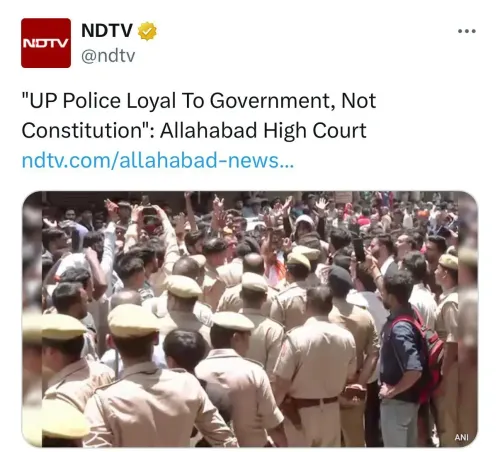
Samajwadi Party president Akhilesh Yadav on Friday, June 5, 2026, targeted the Uttar Pradesh government after the Allahabad High Court reportedly penalised a senior official described by Yadav as a 'most-favoured officer' of the Chief Minister, and referred the matter to the Department of Personnel and Training as well as the Cabinet Appointments Committee, casting doubt on the officer's suitability for future responsibilities.
Context
In his post, Yadav wrote: 'Suna hai ki mukhyamantri ji ke ati priya adhikari ke anupayukt prashasanik vyavhar ko mananiya Allahabad Uchch Nyayalay dwara dandit kiya gaya hai' ['I have heard that the inappropriate administrative conduct of the Chief Minister's most-favoured officer has been penalised by the honourable Allahabad High Court']. He added that the court has expressed doubt over the officer's fitness for any future assignment and referred the misconduct matter to the relevant personnel bodies.
Yadav framed the officer not as the root cause but as a symptom, writing: 'Vo to khatte phal hain, dosh to us vriksh ki jad mein hai jiske saaye mein vo karyarat hain' ['He is merely the sour fruit — the fault lies in the roots of the tree under whose shade he works']. The remark is a direct indictment of Chief Minister Yogi Adityanath's administration.
Policy Backdrop
The Allahabad High Court, which has jurisdiction over Uttar Pradesh, has a long record of issuing adverse observations against state officials found to have acted in excess of their authority or in contempt of judicial directions. Referral of such matters to the Department of Personnel and Training (DoPT) and the Cabinet Appointments Committee is a procedural mechanism that can restrict an officer's future postings and promotions.
Yadav drew a pointed parallel with the Uttar Pradesh government's ongoing drive requiring school teachers to re-sit eligibility examinations to prove their qualifications — a policy that has sparked protests from the teaching community. He argued that if teachers are being made to re-establish their credentials, the same standard of periodic competency assessment should apply to Indian Administrative Service and other administrative officers.
Stakeholders and Impact
The post touches three distinct constituencies: the UP bureaucracy, whose institutional culture Yadav accuses of breeding arrogance; public school teachers across the state, who have been vocal against re-examination mandates; and the broader electorate in Uttar Pradesh, where administrative accountability is a recurring political flashpoint between the Samajwadi Party and the ruling Bharatiya Janata Party.
By asking, 'We are asking the teachers: did we say anything wrong?', Yadav explicitly sought to align the SP with aggrieved teachers while simultaneously attacking the government's selective accountability — strict on educators, lenient on favoured officials. The framing is designed to consolidate support among the state's large teaching workforce and their families ahead of future electoral cycles.
What's Next
Attention will now turn to whether the Uttar Pradesh government issues any formal response to the court's observations, and whether the DoPT or Cabinet Appointments Committee takes any visible action against the unnamed officer. A legislative or executive proposal mandating periodic performance assessments for IAS and PCS officers — as Yadav has suggested — would require significant political will and is unlikely without broader consensus, but the demand adds pressure on the ruling establishment. Further hearings at the Allahabad High Court on the underlying matter could keep the issue in the public domain.
Point of View
While simultaneously co-opting teacher grievances over re-examination demands to broaden the SP's coalition. The 'sour fruit, rotten root' metaphor is designed to shift culpability from a single unnamed officer to the Chief Minister personally. This fits a well-established opposition playbook in Uttar Pradesh, where adverse High Court observations on serving officials are routinely weaponised to question ruling-party governance. The demand for periodic IAS assessments, however improbable in the short term, plants a policy marker that the SP can invoke in the run-up to the next state elections.
NationPress
19 Sept 2026
Frequently Asked Questions
What did the Allahabad High Court do to the UP officer mentioned by Akhilesh Yadav?
According to Akhilesh Yadav's post, the Allahabad High Court penalised the officer for inappropriate administrative conduct, expressed doubt over his suitability for future responsibilities, and referred his misconduct to the Department of Personnel and Training and the Cabinet Appointments Committee. The specific name of the officer and the exact order have not been independently verified.
Why is Akhilesh Yadav comparing bureaucrats to UP teachers in this post?
Yadav pointed out that the Uttar Pradesh government has been requiring school teachers to re-sit eligibility examinations to prove their qualifications. He argued it is inconsistent to impose such scrutiny on teachers while allowing administrative officers to escape similar periodic competency checks, especially when a court has found one such officer unfit.
Who is the officer Akhilesh Yadav is referring to?
Yadav did not name the officer in his post. He described the individual as the 'most-favoured officer' of Chief Minister Yogi Adityanath. The identity of the officer remains unverified.
What is the Cabinet Appointments Committee and why does it matter here?
The Cabinet Appointments Committee is a body that approves senior bureaucratic postings at the state or central level. A referral to this committee following a court's adverse observation can restrict an officer's eligibility for sensitive or senior future assignments.
What is the Samajwadi Party's broader stance on UP bureaucratic accountability?
The Samajwadi Party, led by Akhilesh Yadav, has consistently accused the Yogi Adityanath government of fostering a bureaucratic culture where officials act with impunity due to political patronage. The party has used multiple instances of High Court strictures against UP officials to argue that the ruling establishment prioritises loyalty over competence and rule of law.