Akhilesh Yadav: BJP's 'Ayodhya Express' will end its rule
Synopsis
SP president Akhilesh Yadav declared on 30 July 2026 that the BJP, which rose to power on Ayodhya's religious symbolism, will fall by the same sword — after SP MPs staged a danpatra protest outside Parliament over alleged temple-donation theft by BJP-linked individuals.
Key Takeaways
Akhilesh Yadav posted on 30 July 2026 predicting BJP's electoral defeat, framing it as the 'Ayodhya Express' reversing the 'Awadh Express' that brought the party to power.
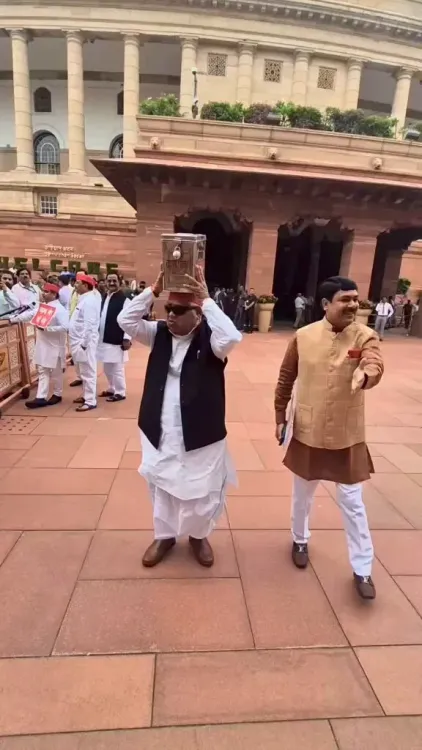
Samajwadi Party MPs staged a symbolic protest outside Parliament carrying a danpatra (donation box), targeting BJP-linked individuals accused of stealing from temple donations.
Yadav quoted public sentiment that stealing 'money meant for religion' is an unforgivable mahapap (mortal sin), even for voters otherwise tolerant of political misdeeds.
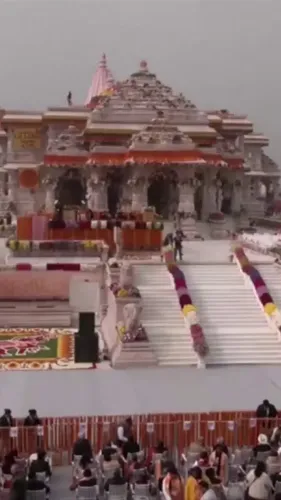
The protest inverts the BJP's core identity — its decades-long association with the Ram Janmabhoomi movement and the Ayodhya Ram Temple consecrated in January 2024 .
Yadav coined the phrase 'Jo Bhajpa ka saathi, wo Ramghati-mahapapi' — positioning any BJP ally as a betrayer of Ram — as a potential campaign slogan.
The exact nature and timing of the alleged danpatra incident have not been independently confirmed.
A donation box carried to the steps of Parliament. Samajwadi Party MPs staging a symbolic protest outside the House on 30 July 2026, wielding the very danpatra (donation box) that has become the centre of a political firestorm. Samajwadi Party president Akhilesh Yadav used the moment to launch one of his sharpest attacks yet on the Bharatiya Janata Party, tying alleged temple-donation theft to a sweeping electoral prophecy.
Posting in Hindi, Yadav declared: 'Bhajpa 'Awadh Express' se satta mein aayi thi, 'Ayodhya Express' se uski wapsi tay hai' — 'The BJP came to power on the Awadh Express; its departure is sealed on the Ayodhya Express.' The metaphor is deliberate and pointed: the party that rode the Ram Janmabhoomi wave out of Ayodhya in the 1990s will, he argues, be swept out by the same current it has now allegedly desecrated.
The danpatra protest and what sparked it
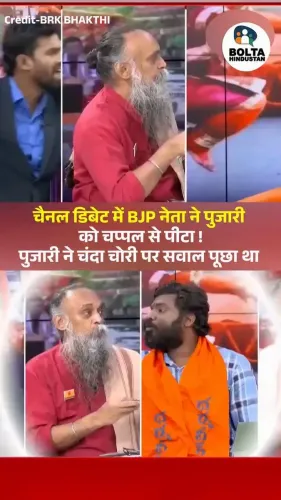
The immediate trigger is an allegation that BJP-linked individuals dipped into temple donation boxes — the danpatra — meant for religious offerings. SP MPs brought a donation box to Parliament as a prop, staging what Yadav described as a 'symbolic demonstration' against those accused. He wrote that BJP members, visibly embarrassed, were seen 'slipping past with eyes averted, avoiding everyone's gaze.' The exact details of the alleged incident are still emerging and have not been independently confirmed.
The religious-betrayal argument Akhilesh is making
Yadav's political case rests on a moral inversion: the BJP built its national identity on Hindu devotion, and stealing from a temple is therefore not just a crime but an act of supreme hypocrisy. He quoted what he called the public's verdict — 'Hum udar hriday Bharatiya log, Bhajpaiyon ki sau kya hazaar chori bhi maaf kar dete, lekin dharm ke paise churane ka mahapap hum kabhi maaf nahin karenge' — 'We generous-hearted Indians could forgive a hundred, even a thousand thefts by BJP men, but the mortal sin of stealing money meant for religion we will never forgive.'
The second line lands even harder: 'Jo Bhagwan ke nahin hue, wo hamare kya honge' — 'Those who were not faithful to God, how will they be faithful to us?' And then the couplet that doubles as a campaign slogan: 'Jo Bhajpa ka saathi, wo Ramghati-mahapapi!' — 'Whoever stands with the BJP is a destroyer of Ram, a great sinner.'
Ayodhya as political boomerang
The BJP's electoral history in Uttar Pradesh and nationally is inseparable from Ayodhya. The Ram Janmabhoomi agitation of the 1990s propelled the party from the margins to the mainstream; the consecration of the Ram Temple in January 2024 was positioned as the fulfilment of a decades-long promise. Yadav is now attempting to weaponise that same symbol — arguing that the BJP's alleged profanity against temple funds transforms its greatest electoral asset into its greatest liability.
Opposition parties in Uttar Pradesh have long accused the BJP of treating religious sentiment as electoral currency. What is new here is the specificity: a physical danpatra, MPs on Parliament's doorstep, and a leader willing to call the act a mahapap — a mortal sin — in the vocabulary the BJP itself has always owned.
Whether the courts, Parliament, or the ballot box delivers the next verdict, Akhilesh Yadav has placed a very clear bet: in a state where faith is politics, the accusation of stealing from God may prove impossible to shake.
Point of View
Where religious transgression carries greater moral weight than most political charges. If the allegation is substantiated, the SP will have found a rare wedge that cuts through the BJP's Hindu-nationalist armour; if it is not, the attack risks looking opportunistic against a party that still commands deep devotional loyalty in the state. Either way, the episode signals that the 2027 UP assembly election narrative is already being written — and Akhilesh Yadav intends to write it in the language of faith.
NationPress
30 Jul 2026
Frequently Asked Questions
What is the danpatra controversy Akhilesh Yadav is referring to?
Akhilesh Yadav is alleging that BJP-linked individuals stole money from temple donation boxes ( danpatra ). SP MPs staged a symbolic protest outside Parliament on 30 July 2026 carrying a donation box to highlight the allegation. The exact details of the incident have not been independently confirmed.
What does 'Ayodhya Express' mean in Akhilesh Yadav's post?
Yadav used 'Awadh Express' to refer to the BJP's rise to power driven by the Ram Janmabhoomi movement centred in Ayodhya, and 'Ayodhya Express' to predict that the same religious symbolism — now allegedly betrayed by BJP leaders — will drive the party out of power.
What did SP MPs do outside Parliament on 30 July 2026?
Samajwadi Party MPs held a symbolic demonstration outside Parliament on 30 July 2026 , carrying a danpatra (temple donation box) to protest against BJP-linked individuals accused of stealing from religious donation collections.
What is the meaning of 'Jo Bhajpa ka saathi, wo Ramghati-mahapapi'?
The Hindi phrase, coined by Akhilesh Yadav, translates to 'Whoever stands with the BJP is a destroyer of Ram and a great sinner.' It is designed to frame any political alliance with the BJP as a religious betrayal, using the vocabulary of Hindu devotion against the party itself.
How does the Ayodhya Ram Temple connect to BJP's electoral history?
The BJP 's national rise in the 1990s was powered by the Ram Janmabhoomi agitation demanding a temple at Ayodhya . The party fulfilled that promise with the consecration of the Ram Temple in January 2024 . Yadav is now arguing that alleged financial misconduct around temple funds undermines the very foundation of the BJP's Hindu-nationalist identity.