Amit Shah: NAFED launches scholarships for farmers' children
Synopsis
Union Home Minister Amit Shah announced on 23 June 2026 that NAFED has launched a scholarship programme for farmers' children's higher education, with a share of the federation's profits to be redirected toward farmer families — a step that deepens the government's cooperative-sector welfare agenda since 2021.
Key Takeaways
NAFED has launched a scholarship programme specifically for the higher education and career development of farmers' children .
A share of NAFED's profits will be directed toward farmer families, embedding welfare in the federation's commercial operations.
The initiative is overseen by the Ministry of Cooperation , formed in July 2021 under Amit Shah's charge.
The programme builds on the government's broader strategy of using cooperative surpluses — not just budgetary funds — to support rural welfare.
Operational details including eligibility norms, funding quantum, and the first disbursement cycle are yet to be publicly notified.
The model could potentially be extended to other national cooperatives beyond NAFED.
Union Home Minister Amit Shah announced on Tuesday, 23 June 2026 that NAFED — the National Agricultural Cooperative Marketing Federation of India — has launched a scholarship programme for the higher education and career development of farmers' children, with a share of the federation's profits to be directed toward farmer families.
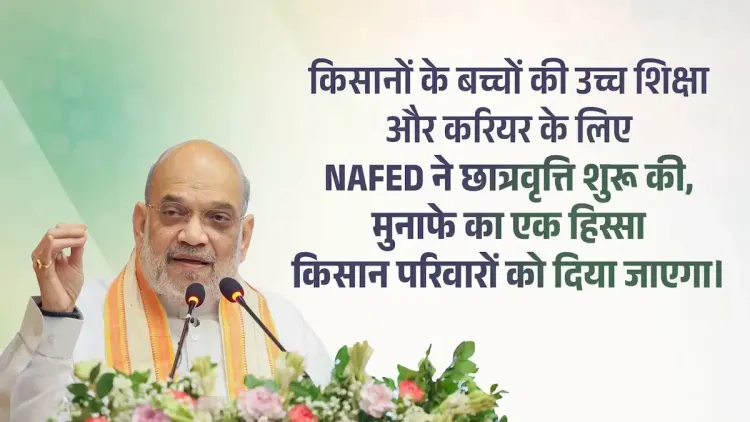
Posting on X, Shah wrote: 'किसानों के बच्चों की उच्च शिक्षा और करियर के लिए NAFED ने छात्रवृत्ति शुरू की, मुनाफे का एक हिस्सा किसान परिवारों को दिया जाएगा।' ('NAFED has launched scholarships for the higher education and career of farmers' children; a share of profits will be given to farmer families.')
Context
NAFED, the apex body for agricultural cooperative marketing in India, has historically channelled its operations toward procurement and price stabilisation for farm produce. This scholarship initiative marks a shift toward deploying a portion of the federation's commercial surpluses directly for human-capital development within member farmer households. The announcement positions cooperative profits not merely as institutional reserves but as a welfare instrument for the next generation of rural families.
Policy Backdrop
The move is rooted in the structural overhaul of India's cooperative sector that began with the creation of the Ministry of Cooperation in July 2021 — a ministry headed by Shah himself. The ministry was established with the explicit mandate to strengthen cooperative institutions and make them more farmer-centric. Since then, the government has pursued reforms aimed at improving the profitability of federations like NAFED and redirecting those surpluses toward member welfare, rather than relying solely on budgetary outlays.
The education scholarship channel represents a new layer in this strategy — linking the business performance of a national cooperative directly to higher-education access for rural youth. It complements existing farmer-income support schemes by adding an education-funding mechanism that is self-sustaining in design, drawing from cooperative earnings.
Stakeholders and Impact
The primary beneficiaries are children of NAFED member farmers and cooperative members across the country, who stand to gain financial support for undergraduate and higher education or vocational career pathways. For rural households where agricultural income is seasonal and uncertain, scholarship support funded by cooperative profits could meaningfully reduce the financial barrier to higher education.
The broader cooperative ecosystem — encompassing millions of farmers affiliated with primary agricultural cooperatives that feed into NAFED — could see this model as a template for linking institutional performance with community welfare. Eligibility norms, the selection process, and the quantum of funding per beneficiary are yet to be detailed in official operational guidelines.
What's Next
Attention will now turn to the operational guidelines that NAFED is expected to release, including eligibility criteria, application procedures, and the first disbursement cycle for scholarship recipients. Policymakers and cooperative sector observers will also watch whether the model is extended to other national cooperatives beyond NAFED. If the profit-linked scholarship framework proves administratively viable, it could set a precedent for cooperative welfare programmes across India's wider network of apex federations.
Point of View
The government is attempting to make farmer welfare self-financing and institutionally durable, a politically attractive proposition ahead of state election cycles in agrarian states. Shah's personal stewardship of both the Home Ministry and the Cooperation Ministry gives this announcement unusual bureaucratic momentum, as he can align NAFED's operational priorities with the ministry's reform agenda without inter-ministerial friction. The key test will be whether the operational framework delivers timely disbursements, since cooperative-sector schemes have historically struggled with implementation gaps between announcement and ground-level execution.
NationPress
23 Jun 2026
Frequently Asked Questions
What is the NAFED scholarship for farmers' children?
NAFED — the National Agricultural Cooperative Marketing Federation of India — has launched a scholarship programme to support the higher education and career development of farmers' children, funded from a share of the federation's profits.
Who announced the NAFED scholarship scheme?
Union Home Minister and Minister of Cooperation Amit Shah announced the scheme on 23 June 2026 via a post on X.
How will the NAFED scholarship be funded?
The scholarship will be funded from a portion of NAFED's own profits, meaning the cooperative's commercial earnings will be partially redirected toward farmer family welfare rather than relying entirely on government budget allocations.
What is the Ministry of Cooperation and what does it do?
The Ministry of Cooperation was created in July 2021 to give focused policy attention to India's cooperative sector, strengthening apex bodies like NAFED and promoting farmer-centric reforms within the cooperative ecosystem.
Who is eligible for the NAFED scholarship?
The scholarship targets children of farmers and cooperative members associated with NAFED. Detailed eligibility norms and the selection process are yet to be officially notified by the federation.