CM Conrad Sangma Reviews Shillong Traffic Plan Ahead of National Games
Synopsis
Meghalaya CM Conrad Sangma chaired a review with the Indian Army, NHIDCL, PWD and district officials on 23 June 2026 to tackle traffic congestion on Shillong's Rilbong–Anjalee–Barik Point corridor. The meeting covered road widening, junction fixes and long-term options, with the National Games serving as the key deadline for early action.
Key Takeaways
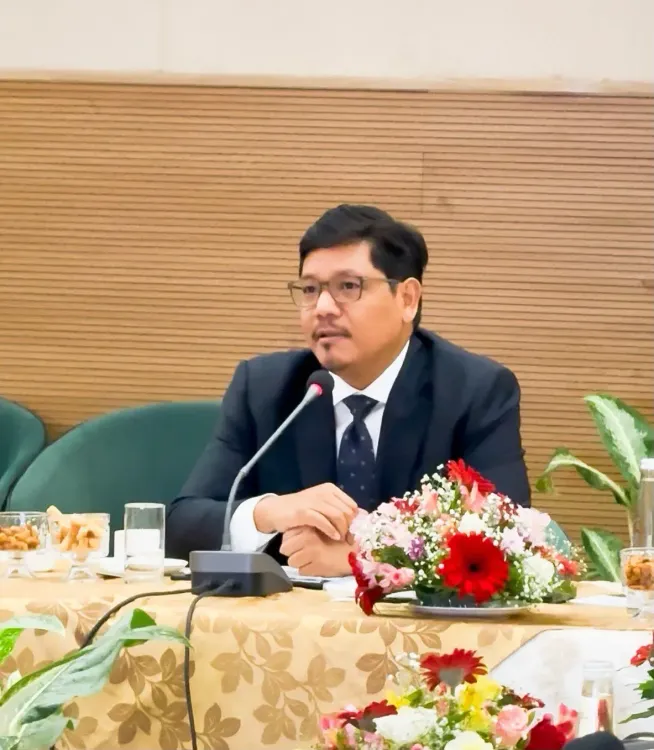
CM Conrad Sangma chaired a multi-agency review meeting on 23 June 2026 focused on traffic congestion along the Rilbong–Anjalee–Barik Point road in Shillong .
Participants included the Indian Army , NHIDCL , PWD Meghalaya , and district officials — a layered multi-agency configuration reflecting the jurisdictional complexity of hill-city infrastructure.
The meeting reviewed road widening proposals, junction improvements, traffic management measures, and long-term infrastructure options.
The approaching National Games is the stated deadline driving the push for immediate, implementable measures alongside sustainable long-term solutions.
The Indian Army 's cooperation was specifically acknowledged, indicating its potential role in on-ground execution beyond planning.
NHIDCL has been active in Meghalaya under national programmes such as Bharatmala Pariyojana and SARDP-NE since 2015 .
Meghalaya Chief Minister Conrad Sangma on Tuesday, 23 June 2026, chaired a multi-agency review meeting to address chronic traffic congestion along the Rilbong–Anjalee–Barik Point corridor in Shillong, bringing together the Indian Army, NHIDCL, PWD Meghalaya, and district officials to identify near-term and long-term road solutions with the National Games as the immediate deadline.
Context
Shillong, the hilly capital of Meghalaya, has long grappled with traffic bottlenecks caused by narrow colonial-era roads, steep gradients, and rapid urban growth. The Rilbong–Anjalee–Barik Point stretch is among the most congested arterials in the city, serving as a key link between residential neighbourhoods and the commercial core. The review meeting signals a shift toward structured, multi-stakeholder planning rather than ad hoc interventions.
Sangma noted that the meeting covered 'road widening proposals, junction improvements, traffic management measures, and long-term infrastructure options to improve traffic flow in Shillong,' underscoring the dual-track approach of immediate relief alongside durable upgrades.
Policy Backdrop
The Indian Army has a long tradition of partnering with northeastern state governments on civic infrastructure, particularly in terrain where conventional construction is difficult. NHIDCL, the central public-sector undertaking mandated to build and maintain highways across the Northeast, has been active in Meghalaya under national programmes such as Bharatmala Pariyojana and SARDP-NE, which have funded several highway stretches around Shillong since 2015.
State PWD Meghalaya is the nodal agency for the road network within the city limits, and its presence alongside NHIDCL and the Army in a single review room reflects the layered jurisdictional complexity that often slows infrastructure delivery in hill capitals. The multi-agency model being deployed here mirrors approaches adopted by other northeastern cities ahead of regional or national sporting events.
Stakeholders and Impact
The most immediate beneficiaries of any improvement on the Rilbong–Anjalee–Barik Point corridor will be daily commuters — office-goers, students, and traders — who currently lose significant time to gridlock. Local businesses along the stretch are also expected to benefit from smoother vehicular movement and better access.
With the National Games approaching, the stakes are higher: host states have historically used the event as a catalyst to accelerate urban mobility upgrades, and Shillong will be under national scrutiny for its infrastructure readiness. Athletes, support staff, officials, and visitors travelling across the city will depend on the same road network that currently strains under everyday demand.
CM Sangma specifically acknowledged 'the support and cooperation of the Indian Army and all stakeholders,' signalling that the Army's logistical and engineering capacity may be tapped for on-ground execution, not just planning.
What's Next
The immediate focus, as stated by the Chief Minister, is on 'implementing immediate measures' — likely to include junction redesigns and traffic-management protocols that can be deployed without lengthy tendering cycles. Longer-term proposals, including possible road widening, will require procurement processes and land-related clearances that typically take more time in hilly urban settings.
The key milestones to watch are the tendering and physical progress on the Rilbong–Anjalee–Barik widening, any follow-up review meetings announced by the state government, and whether the National Games deadline drives the pace of approvals. If the multi-agency model delivers visible results before the Games, it could become a template for other congestion hotspots across Shillong and the broader Northeast.
Point of View
Not merely a departmental one. The inclusion of the Indian Army alongside NHIDCL and PWD is a pragmatic acknowledgement that no single agency can resolve the city's topographic and jurisdictional constraints alone. The National Games deadline is doing real policy work here: it is compressing timelines that would otherwise stretch across multiple budget cycles. If the immediate measures deliver visible relief before the Games, Sangma's NPP government stands to gain a tangible governance credential in a state where infrastructure delivery is a perennial electoral issue.
NationPress
22 Sept 2026
Frequently Asked Questions
Why is there traffic congestion in Shillong?
Shillong faces chronic traffic congestion because its road network consists largely of narrow, colonial-era roads built for far lower traffic volumes, compounded by steep hilly terrain, limited parking, and rapid urban growth in recent decades.
What is the Rilbong–Anjalee–Barik Point road?
The Rilbong–Anjalee–Barik Point corridor is one of the key arterial stretches in Shillong, connecting residential areas to the commercial core, and is among the most congested routes in the city.
What is NHIDCL and what does it do in Meghalaya?
NHIDCL, or the National Highways and Infrastructure Development Corporation Ltd, is a central government public-sector undertaking mandated to build and maintain highways across India's Northeast, and has been funding road projects in and around Shillong under programmes like Bharatmala Pariyojana and SARDP-NE since 2015.
When are the National Games being held in Meghalaya?
The exact dates of the National Games in Meghalaya have not been officially confirmed in verified public records, but the state government has cited the approaching event as the deadline driving its push to implement immediate traffic solutions in Shillong.
What role is the Indian Army playing in Shillong's road projects?
The Indian Army has been involved in the multi-agency review chaired by CM Conrad Sangma and has a broader tradition of partnering with northeastern state governments on civic infrastructure, particularly in hilly terrain where conventional construction is challenging.