Amit Shah: NCB Brings Back Drug Fugitive Basoya from UAE

Synopsis
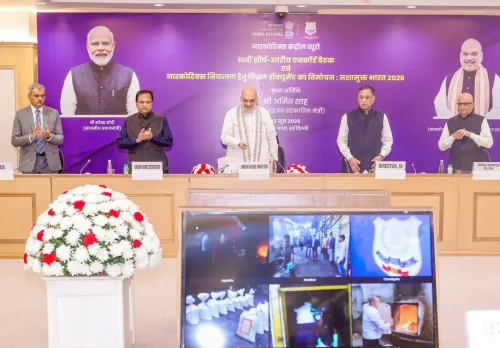
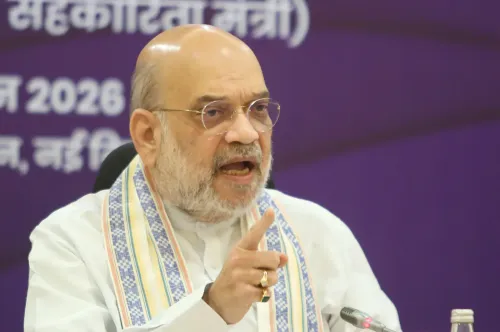
Union Home Minister Amit Shah announced on August 14, 2026 that the NCB secured the return of fugitive drug kingpin Virender Singh Basoya from the UAE, calling it a milestone in the Modi government's zero-tolerance narcotics policy and its expanding use of bilateral mechanisms to pursue traffickers abroad.
Key Takeaways
The NCB secured the extradition of fugitive drug kingpin Virender Singh Basoya from the UAE .
Union Home Minister Amit Shah announced the development on August 14, 2026 .
Investigators used a dual 'top-to-bottom and bottom-to-top' method to trace and build the case against Basoya.
The operation reflects India's growing use of bilateral security cooperation with Gulf countries to close safe havens for drug fugitives.
Prosecution will proceed under the Narcotic Drugs and Psychotropic Substances Act, 1985 .
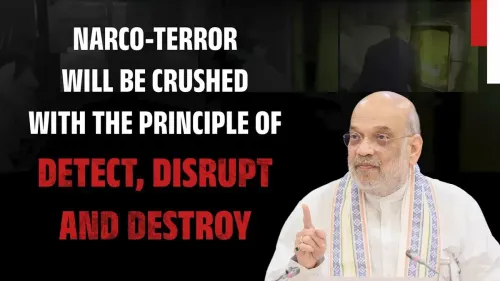
Shah described the extradition as a 'new milestone' in the government's zero-tolerance policy on narcotics.
A fugitive drug kingpin who thought distance could buy him safety just ran out of places to hide. Union Home Minister Amit Shah announced on Friday, August 14, 2026 that the Narcotics Control Bureau (NCB) has secured the return of Virender Singh Basoya from the United Arab Emirates — the latest strike in India's expanding campaign to dismantle transnational drug networks from the outside in.
The 'Top-to-Bottom, Bottom-to-Top' Hunt That Caught Basoya
Shah described the operation as a product of a dual-track investigative method — tracing criminal networks simultaneously from kingpins downward and from street-level operatives upward. This approach, he said, allowed agencies to pinpoint Basoya's location abroad and build the legal and diplomatic case for his return. The NCB, India's nodal drug-enforcement body established in 1986 under the Ministry of Home Affairs, coordinated the operation through bilateral mechanisms with the UAE.
Shah framed the extradition as a 'new milestone' in the Modi government's zero-tolerance policy on narcotics, adding that 'no matter where drug traffickers hide, they cannot escape the long arm of Indian law.'
India-UAE Security Cooperation Closing the Gulf Safe Haven
The UAE has emerged as a critical partner in India's pursuit of fugitives wanted for economic and criminal offences. For transnational drug networks — many of which route supply chains through the Golden Crescent region spanning Afghanistan, Iran, and Pakistan — Gulf destinations have historically offered a degree of operational cover. India has been systematically closing that window through mutual legal assistance treaties and agency-to-agency coordination.
The legal backbone for domestic prosecution remains the Narcotic Drugs and Psychotropic Substances (NDPS) Act of 1985, under which Basoya is expected to face charges following his return. The Act carries stringent provisions including mandatory minimum sentences for commercial-quantity trafficking.
A Pattern, Not a One-Off
Shah's announcement positions the Basoya extradition not as an isolated win but as part of a deliberate, escalating strategy. India has processed an increasing number of extradition requests through Gulf-country channels in recent years, targeting both the financial architects and the logistics operators of drug supply chains. The intelligence-led model — combining diplomatic pressure with granular network mapping — is the template the NCB is now replicating across multiple active cases.
With Independence Day falling the day after the announcement, the timing underscores a deliberate message: India's enforcement reach is no longer bounded by its borders.
Point of View
And each successful extradition strengthens the diplomatic case for faster processing of future requests. Shah's framing of the operation as a 'milestone' also signals that the NCB's intelligence-led, network-mapping model is being institutionalised rather than used selectively. The announcement on the eve of Independence Day carries an unmistakable political subtext: sovereignty now extends to the pursuit of criminals across borders.
NationPress
14 Aug 2026
Frequently Asked Questions
Who is Virender Singh Basoya?
Virender Singh Basoya is described by the NCB and Union Home Minister Amit Shah as a fugitive drug kingpin who had been hiding in the UAE before being returned to India in 2026.
What is the NCB and what does it do?
The Narcotics Control Bureau (NCB) is India's apex drug-enforcement agency, established in 1986 under the Ministry of Home Affairs. It coordinates anti-narcotics operations domestically and works with foreign agencies on transnational drug cases.
How did India secure Basoya's return from the UAE?
The NCB used a dual investigative approach — tracing the network from the top down and from the bottom up — combined with bilateral security cooperation and mutual legal assistance mechanisms between India and the UAE.
Under which law will Basoya be prosecuted?
Basoya is expected to face charges under the Narcotic Drugs and Psychotropic Substances (NDPS) Act of 1985, which carries stringent mandatory minimum sentences for commercial-quantity drug trafficking.
What is India's policy on drug trafficking fugitives abroad?
The Modi government has adopted a zero-tolerance policy that combines domestic enforcement with diplomatic pressure and bilateral treaties to pursue drug traffickers who flee to foreign countries, particularly in the Gulf region.