Amit Shah unveils four-sided security grid for borders

Synopsis
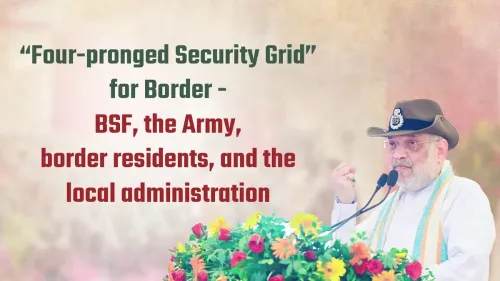
Union Home Minister Amit Shah on 29 May 2026 announced a 'four-sided security grid' integrating people, civil administration, police, military and the BSF at India's borders — reframing the national security doctrine from border security to full territorial security.
Key Takeaways
Union Home Minister Amit Shah announced a four-sided security grid on 29 May 2026 to make India's borders foolproof.
The grid integrates five layers: people, civil administration, police, military and the BSF .
Shah declared the new standard will be 'territorial security' , not just border security.
The BSF , under the Ministry of Home Affairs , currently guards the India-Pakistan and India-Bangladesh borders.
The announcement builds on the Comprehensive Integrated Border Management System (CIBMS) launched since 2016-17 .
Pilot sectors, budget allocations and formal civil-military coordination mechanisms are yet to be announced.
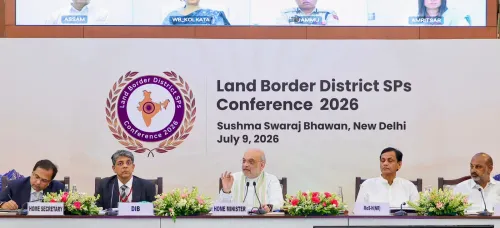
Union Home Minister Amit Shah on Friday, 29 May 2026 announced a new integrated security architecture for India's borders, describing a 'four-sided security grid' that will bring together people, civil administration, police, military and the Border Security Force (BSF) to make frontier zones impenetrable. The announcement marks a significant doctrinal shift — from conventional border security to what Shah termed complete 'territorial security'.
Context
In his post, Shah stated: 'People, civil administration, police, military and BSF will make borders foolproof with a four-sided security grid. Now there will be complete territorial security and not just border security.' The statement signals that frontier protection will no longer rest solely on physical fencing or paramilitary deployment, but will draw on every layer of governance and community presence in border districts.
The BSF, which operates under the Ministry of Home Affairs, currently guards the India-Pakistan and India-Bangladesh borders and has been the centrepiece of India's frontier defence posture for decades. Shah, as Home Minister, holds direct supervisory authority over the BSF and all Central Armed Police Forces.
Policy Backdrop
India has progressively upgraded its border infrastructure since 2016-17, when the Comprehensive Integrated Border Management System (CIBMS) and smart-fencing projects were launched along the Pakistan and Bangladesh frontiers. These initiatives introduced sensors, cameras, fibre-optic cables and command-and-control centres to supplement physical barriers.
However, critics and security planners have long argued that technology and paramilitary forces alone cannot address threats such as infiltration, cross-border smuggling, and demographic pressure in sensitive frontier districts. Shah's articulation of a 'four-sided grid' — encompassing civilian populations, district administration, state police, the Army and the BSF — reflects a doctrine that has been taking shape over several years but now appears to be receiving formal political endorsement at the highest level.
Persistent tensions along the Line of Control and the Line of Actual Control have accelerated the push for a more holistic model, one that denies adversaries any gap between the fence line and the nearest town or administrative unit.
Stakeholders and Impact
The most direct beneficiaries of the proposed framework are the millions of residents in India's border villages, who have historically lived in a security vacuum — too far from urban centres to receive routine administrative attention, yet on the front line of cross-border threats. Integrating civil administration and local communities into the security grid could mean faster intelligence sharing, better infrastructure, and greater economic inclusion in frontier zones.
For the BSF, the Army, and state police forces in border states, the grid implies new coordination protocols and potentially formalised joint command structures at the district level. Security analysts note that civil-military coordination at sub-divisional levels has historically been ad hoc, and any move to institutionalise it would represent a structural change in how India manages its frontiers.
What's Next
Attention will now turn to the operational details of the four-sided grid — specifically, which border sectors will see pilot implementation first, and whether the framework will be backed by dedicated funding in the next Union Budget or formalised through new guidelines in the Ministry of Home Affairs annual report. Any legislative or regulatory changes required to enable civil-military coordination at the district level will also be closely watched.
Shah's framing of 'territorial security' as the new standard suggests that the MHA is preparing a comprehensive policy document or operational directive that goes beyond existing CIBMS mandates. If implemented at scale, the four-sided grid could redefine India's border governance model for the next decade.
Point of View
Including its civilian population and district administration, as an active security layer rather than a passive buffer zone. This move follows years of incremental upgrades under CIBMS and smart fencing, and reflects the MHA's recognition that physical barriers alone cannot address modern hybrid threats. By publicly framing the grid as a five-actor system, Shah is also setting a political benchmark against which any future border incident will be measured. The announcement is likely to accelerate inter-ministerial coordination between Home, Defence and state governments in border states ahead of the next Union Budget cycle.
NationPress
12 Oct 2026
Frequently Asked Questions
What is the four-sided security grid announced by Amit Shah?
The four-sided security grid is an integrated border-security framework announced by Union Home Minister Amit Shah on 29 May 2026, combining people, civil administration, police, military and the BSF to create what he called complete 'territorial security' at India's borders.
What is the difference between border security and territorial security?
Border security traditionally focuses on physical barriers and paramilitary deployment at the frontier line. Territorial security, as described by Amit Shah, extends protection inward by integrating civil administration, local communities, state police and the military alongside the BSF, leaving no governance or security gap in frontier zones.
What is the BSF and who controls it?
The Border Security Force (BSF) is India's primary border-guarding paramilitary force, responsible for the India-Pakistan and India-Bangladesh frontiers. It operates under the Ministry of Home Affairs, which is headed by Union Home Minister Amit Shah.
What is CIBMS and how does it relate to the new grid?
The Comprehensive Integrated Border Management System (CIBMS) is a technology-driven border surveillance initiative launched from 2016-17, using sensors, cameras and command centres. The four-sided security grid builds on CIBMS by adding civil administration and community participation to the existing technological and paramilitary framework.
Which borders will the four-sided security grid cover?
While Amit Shah did not specify particular sectors in his announcement, the framework is broadly applicable to all of India's land borders. The BSF currently guards the India-Pakistan and India-Bangladesh borders, which are considered the most sensitive frontier zones under MHA jurisdiction.