Amit Shah Defines Border Security as Four-Pronged Grid
Synopsis
Union Home Minister Amit Shah has articulated a 'Four-pronged Security Grid' for India's borders, placing the BSF, the Indian Army, border residents, and local administration on equal footing as co-guardians of territorial security — a formulation that elevates civilian actors in the national border-defence architecture.
Key Takeaways
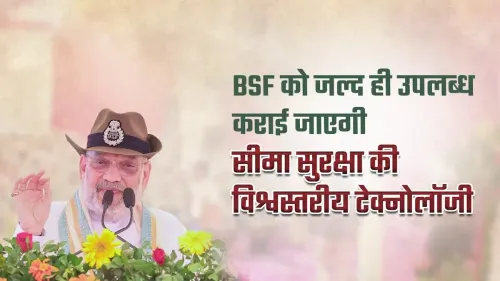
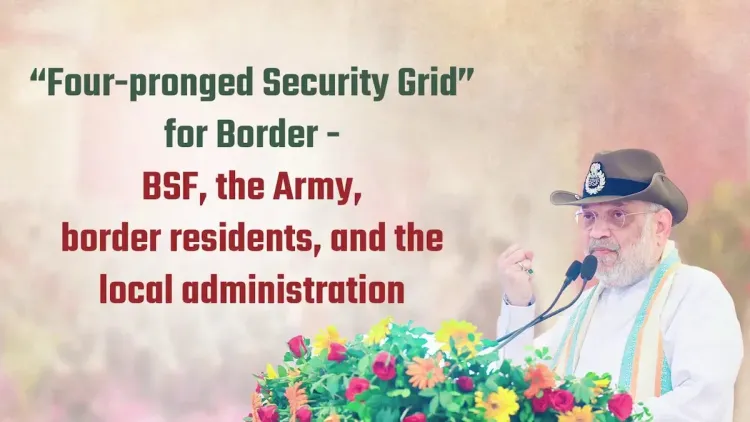
Amit Shah on 26 May 2026 described India's border security as a 'Four-pronged Security Grid' comprising the BSF , the Indian Army , border residents, and local administration.
The formulation explicitly includes civilian actors — border communities and district administration — alongside paramilitary and military forces.
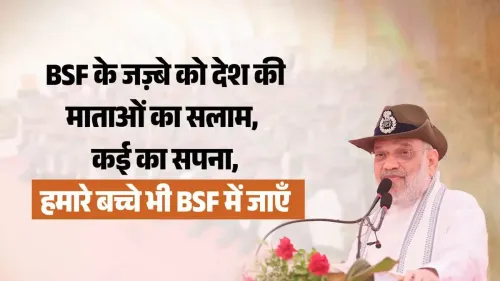
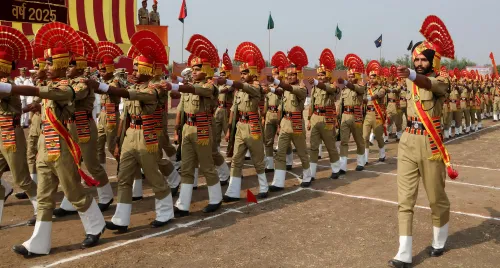
The BSF was raised in December 1965 to relieve the Army of routine border duties and operates under the Ministry of Home Affairs .
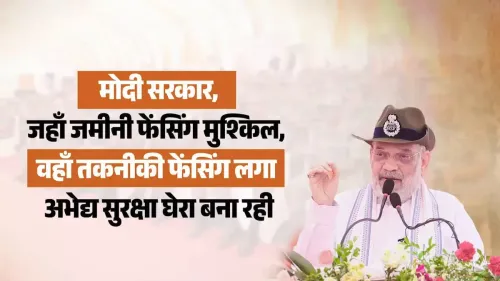
Since 2017 , the MHA has deployed smart fencing, floodlighting, and integrated check-posts on western and eastern borders as part of layered security.
The statement signals a whole-of-society approach to border management, potentially influencing future coordination between the MHA and the Ministry of Defence .
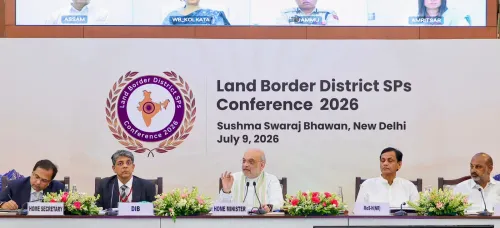
Union Home Minister Amit Shah on Tuesday, 26 May 2026, articulated a layered vision of India's border security, describing the BSF, the Indian Army, border residents, and the local administration as a collective 'Four-pronged Security Grid' — framing border protection not as a single agency's mandate but as a shared territorial responsibility.
Context
In his post, Shah stated: 'The BSF, the Army, border residents, and the local administration together constitute the 'Four-pronged Security Grid' for borders. Securing borders is not an isolated duty, but a territorial responsibility.' The formulation is notable for explicitly including civilian actors — border residents and district administration — alongside the two principal security forces, signalling that border security is conceived as a whole-of-society enterprise rather than a purely military or paramilitary function.
The Border Security Force was raised in December 1965 following the Indo-Pak war, specifically to relieve the Army of routine border-guarding duties along the western and eastern frontiers. It operates under the Ministry of Home Affairs, which Shah has headed since 2019.
Policy Backdrop
The idea of layered, multi-agency border management has evolved over successive governments. Since 2017, the Ministry of Home Affairs has rolled out smart fencing, floodlighting, and integrated check-posts along both the western border with Pakistan and the eastern border with Bangladesh, moving well beyond a single-force model.
Village defence committees and local community engagement programmes along sensitive frontiers have long been a complementary tool, particularly in Jammu and Kashmir and the Northeast. Shah's framing elevates these community-level actors to a formally articulated tier within the security architecture, giving political weight to what has largely been an operational practice.
The Indian Army retains operational responsibility for the Line of Actual Control and certain international borders, while the BSF holds primary jurisdiction over the Indo-Pakistan and Indo-Bangladesh borders. Coordination between the Ministry of Home Affairs and the Ministry of Defence on border infrastructure and force deployment has been a recurring theme in national security planning.
Stakeholders and Impact
For border residents — often the first to detect infiltration, smuggling, or unusual movement — the Home Minister's statement is a formal acknowledgement of their role as partners in national security. In many border districts, civilian alertness has historically fed into early-warning systems for the BSF and Army.
Local administration, including district collectors and state police, forms the fourth prong in Shah's formulation. Their role spans intelligence sharing, management of border-area populations, and coordination during crises. The explicit inclusion of civil administration underscores the MHA's integrated approach, where law enforcement, governance, and military readiness are treated as inseparable.
What's Next
The articulation of a 'Four-pronged Security Grid' is likely to inform further coordination mechanisms between the Ministry of Home Affairs and the Ministry of Defence, and could surface in upcoming border infrastructure budget allocations. Analysts will watch whether the framework is institutionalised through formal joint protocols or reflected in the next iteration of the Comprehensive Integrated Border Management System. The statement also sets a rhetorical baseline for policy discussions ahead of any parliamentary or cabinet-level review of border security architecture.
Point of View
Giving political authority to the integration of civilian and military actors in border management. By naming border residents and local administration as co-equal pillars alongside the BSF and Army, the Home Ministry is signalling a shift from a force-centric to a governance-centric security model. This aligns with the MHA's broader push since 2017 to use infrastructure, technology, and community engagement as force multipliers on sensitive frontiers. The statement is likely a precursor to either a formal policy document or a budget push for deeper civil-military coordination at the border district level.
NationPress
10 Oct 2026
Frequently Asked Questions
What is the 'Four-pronged Security Grid' mentioned by Amit Shah?
According to Union Home Minister Amit Shah, the 'Four-pronged Security Grid' refers to the four pillars of India's border security: the BSF, the Indian Army, border residents, and local administration, all working together as a unified territorial defence system.
What is the role of the BSF in India's border security?
The Border Security Force, raised in December 1965, is India's primary border-guarding force under the Ministry of Home Affairs, responsible for the Indo-Pakistan and Indo-Bangladesh borders and routine border management duties.
Why are border residents included in India's border security framework?
Border residents are often the first to detect infiltration, smuggling, or unusual activity, making them a critical early-warning layer. Amit Shah's statement formally acknowledges their role as partners in national security alongside armed forces.
How does the Indian Army coordinate with the BSF on borders?
The Indian Army holds operational responsibility for the Line of Actual Control and certain international borders, while the BSF manages the western and eastern frontiers. Coordination between the Ministry of Home Affairs and Ministry of Defence governs joint operations and infrastructure planning.
What border security infrastructure has India built in recent years?
Since 2017, the Ministry of Home Affairs has deployed smart fencing, floodlighting, and integrated check-posts along the western border with Pakistan and the eastern border with Bangladesh as part of a layered border management strategy.