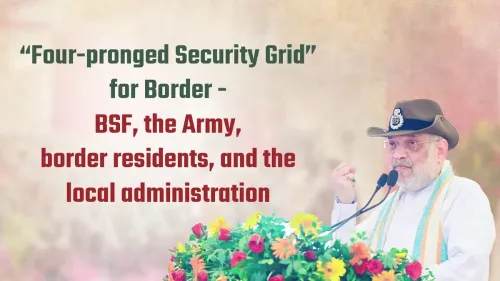
Amit Shah: Modi Govt Building Leak-Proof Border Security Grid

Synopsis
Union Home Minister Amit Shah declared on 29 May 2026 that the Modi government is building a 'leak-proof security grid' along India's borders, deploying technology-driven fencing in terrain where physical barriers are not feasible, as part of a layered border management strategy.
Key Takeaways
Union Home Minister Amit Shah stated on 29 May 2026 that the Modi government is building a 'leak-proof security grid' across India's borders.
Where physical ground fencing is not feasible due to difficult terrain, the government is installing technical fencing to create an impenetrable security cordon.
The Comprehensive Integrated Border Management System (CIBMS) , piloted from 2012 and expanded post- 2014 , integrates sensors, radars, and cameras in hard-to-fence stretches.
The Border Security Force (BSF) is the primary operational agency responsible for deploying and managing both physical and technology-based border barriers.
Physical fencing along the India-Pakistan border has been progressively installed since the 1980s , with significant acceleration under the current government.
Future Union Budget allocations and parliamentary committee reports will indicate the pace of further smart-fencing expansion.
Union Home Minister Amit Shah on Friday, 29 May 2026 declared that the Modi government is constructing a 'leak-proof security grid' along India's borders, combining physical fencing where feasible with technology-driven barriers in terrain that makes conventional fencing impossible.
In his post, Shah stated: 'मोदी सरकार हर दृष्टि से लीक-प्रूफ सुरक्षा ग्रिड बना रही, जहाँ जमीनी फेंसिंग मुश्किल, वहाँ तकनीकी फेंसिंग लगा अभेद्य सुरक्षा घेरा बना रही।' — translated: 'The Modi government is building a leak-proof security grid from every angle; where ground fencing is difficult, it is installing technical fencing to create an impenetrable security cordon.'
Context
The statement reflects the government's long-standing position that India's border security cannot rely solely on physical barriers. Stretches of the India-Pakistan and India-Bangladesh borders pass through rivers, marshes, and mountainous terrain where erecting conventional fencing is either impractical or prohibitively expensive. Shah's framing of a 'leak-proof grid' signals that both physical and technological layers are being treated as complementary, not alternatives.
The Border Security Force (BSF), the central paramilitary unit responsible for guarding these frontiers, has been the primary operational agency for fencing and surveillance deployment. Successive expansions of its mandate have brought more difficult terrain under active monitoring.
Policy Backdrop
Physical fencing along the India-Pakistan border has been progressively installed since the 1980s, with significant acceleration after 2014 when the Modi government prioritised completion of remaining unfenced stretches. Alongside this, the Comprehensive Integrated Border Management System (CIBMS) was piloted from 2012 onward and expanded after 2014 to integrate sensors, radars, and cameras in difficult terrain.
In 2017, the Ministry of Home Affairs rolled out CIBMS on a pilot basis in the Jammu sector, combining thermal sensors, underground sensors, and high-resolution cameras to create a surveillance layer independent of physical barriers. This model has since been cited as a template for extending coverage to other challenging stretches.
The broader policy direction — layered border security combining physical and electronic components — has been a consistent theme across Union Budgets, with allocations for smart-fencing projects appearing in successive years.
Stakeholders and Impact
The primary operational stakeholders are the BSF and other border-guarding forces whose personnel rely on real-time surveillance data to respond to infiltration attempts. Improved situational awareness reduces the risk to troops deployed in difficult, isolated terrain.
Frontier communities living along the India-Pakistan and India-Bangladesh borders are directly affected, as reduced infiltration has implications for local security, cross-border smuggling, and the movement of armed groups. Technology-based fencing also reduces the need for dense physical infrastructure that can disrupt local livelihoods and agriculture near border villages.
What's Next
Parliamentary committee reports on border infrastructure spending and forthcoming Union Budget allocations will be closely watched for details on the scale and pace of smart-fencing rollout. Any formal announcements expanding CIBMS coverage to new sectors — particularly along the India-Bangladesh border following recent security concerns — would mark the next concrete step in the grid the Home Minister described.
The government's emphasis on an 'impenetrable cordon' through technology suggests that future policy statements and budget lines will continue to prioritise integrated, multi-domain border management as a core national-security deliverable.
Point of View
A shift with significant procurement and policy implications. The statement also reinforces the government's broader pattern of linking internal-security outcomes directly to the Prime Minister's governance brand.
NationPress
12 Oct 2026
Frequently Asked Questions
What is the 'leak-proof security grid' Amit Shah mentioned?
It refers to a layered border security system combining physical fencing where terrain permits and technology-driven surveillance — sensors, radars, cameras — where conventional fencing is not feasible, creating an integrated, impenetrable cordon along India's borders.
What is the Comprehensive Integrated Border Management System (CIBMS)?
CIBMS is a technology-driven border surveillance project piloted from 2012 and expanded after 2014 that integrates thermal sensors, underground sensors, radars, and high-resolution cameras to monitor border stretches where physical fencing is difficult to install.
Which borders does India's smart fencing cover?
Smart fencing and technology-based surveillance have been deployed primarily along the India-Pakistan and India-Bangladesh borders, particularly in sectors with rivers, marshes, or mountainous terrain that make conventional fencing impractical.
What is the role of the BSF in India's border fencing?
The Border Security Force (BSF) is the central paramilitary organisation responsible for guarding the India-Pakistan and India-Bangladesh borders, and it operates and responds to alerts generated by both physical fencing and electronic surveillance systems.
Why can't India fence its entire border physically?
Large stretches of India's borders pass through rivers, wetlands, and mountainous terrain where erecting and maintaining physical fencing is either structurally impossible or prohibitively expensive, making technology-based surveillance the practical alternative.