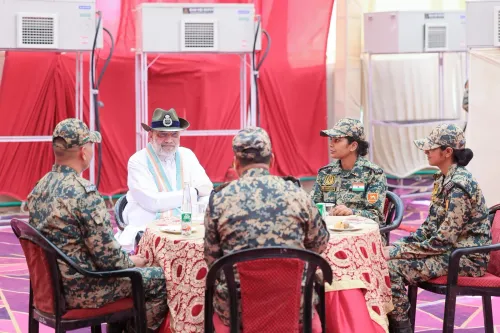
Amit Shah Inspects India-Pakistan Border at Sir Creek

Synopsis
Union Home Minister Amit Shah inspected the India-Pakistan border at the Sir Creek sector in Gujarat on 30 May 2026, reaffirming 'Smart Borders' and 'Zero Infiltration' as the Modi government's top priorities for the western frontier.
Key Takeaways
Amit Shah conducted an on-ground inspection of the India-Pakistan border in the Sir Creek area of Gujarat on 30 May 2026 . 'Smart Borders' and 'Zero Infiltration' were reaffirmed as the Modi government's top border-security priorities.
The Sir Creek sector is a 96-km tidal estuary in the Rann of Kutch and remains one of the few largely unfenced stretches of the western border due to marshy terrain.
The Border Security Force (BSF) is the primary force guarding the Gujarat sector of the India-Pakistan border .
India's Comprehensive Integrated Border Management System (CIBMS) , piloted from 2016 , uses sensors, cameras, and drones to monitor high-risk border stretches.
Analysts will watch for follow-up announcements on CIBMS expansion in Gujarat and Rajasthan , and border infrastructure allocations in the next Union Budget .
Union Home Minister Amit Shah on Saturday, 30 May 2026, inspected the India-Pakistan border in the Sir Creek area of Gujarat, reaffirming that 'Smart Borders' and 'Zero Infiltration' remain the Modi government's top security priorities along the western frontier.
Context
The Sir Creek is a 96-kilometre tidal estuary in the Rann of Kutch that forms a disputed segment of the India-Pakistan maritime boundary. Unlike most stretches of the western border, the sector remains largely unfenced due to its marshy and tidal character, making it a persistent focus of security reviews and infrastructure planning. Shah's on-ground inspection signals continued high-level attention to this vulnerable stretch.
The visit comes amid a broader government push to modernise border infrastructure across both the International Border and the Line of Control. The Border Security Force (BSF), which guards the Gujarat sector, is the primary operational force on the ground in this region.
Policy Backdrop
India's border modernisation drive gained momentum after the 1999 Kargil conflict, which prompted accelerated fencing and surveillance upgrades along the India-Pakistan border. The Comprehensive Integrated Border Management System (CIBMS), piloted from 2016 onward, brought sensors, cameras, and command infrastructure to high-risk stretches.
Under the current administration, the emphasis has shifted to integrated surveillance using drones and real-time monitoring. The twin goals of 'Smart Borders' — deploying technology to compensate for terrain where physical fencing is impractical — and 'Zero Infiltration' have been repeatedly articulated as non-negotiable security benchmarks. The Sir Creek sector's unique geography makes it a test case for how these ambitions translate into operational reality.
Stakeholders and Impact
BSF personnel deployed in the Gujarat sector are the most directly affected by any policy or infrastructure decisions that follow from such inspections. Border villagers in the region, who live in proximity to the tidal wetlands, also have a direct stake in the stability and security of the area.
A senior ministerial inspection of this nature typically precedes or accompanies fresh infrastructure allocations, operational directives, or a public statement on border readiness. The presence of video documentation of the visit, shared via Shah's official social media, underscores the government's intent to publicly signal its commitment to western border security.
What's Next
Analysts and security watchers will track whether the inspection is followed by announcements on additional CIBMS phases in the Gujarat and Rajasthan sectors, or earmarked allocations in the next Union Budget for border infrastructure. The Sir Creek sector's unfenced character means that any technological upgrade announced here will be closely watched as a template for similarly difficult terrain along India's western border.
Frequently Asked Questions
What is Sir Creek and why is it significant for India-Pakistan border security?
Sir Creek is a 96-kilometre tidal estuary in the Rann of Kutch forming a disputed segment of the India-Pakistan maritime boundary. Its marshy and tidal character makes physical fencing impractical, making it one of the most challenging and frequently reviewed stretches of the western border.
What did Amit Shah do at the Sir Creek border on 30 May 2026?
Union Home Minister Amit Shah inspected the India-Pakistan border in the Sir Creek area of Gujarat on 30 May 2026, reiterating that 'Smart Borders' and 'Zero Infiltration' are the Modi government's top priorities.
What is the 'Smart Borders' policy of the Modi government?
'Smart Borders' refers to the government's push to use technology — including sensors, drones, cameras, and integrated command systems — to secure border stretches where physical fencing is difficult, particularly under the Comprehensive Integrated Border Management System (CIBMS) framework.
Which force guards the India-Pakistan border in Gujarat?
The Border Security Force (BSF) is the central armed police force responsible for guarding the India-Pakistan border, including the Gujarat sector covering the Sir Creek area.
What is CIBMS and when was it introduced?
The Comprehensive Integrated Border Management System (CIBMS) was piloted from 2016 onward to equip high-risk border stretches with sensors, cameras, drones, and real-time command infrastructure as part of India's border modernisation effort.