Amit Shah calls for zero infiltration via four-cornered security grid

Synopsis
Union Home Minister Amit Shah on 26 May 2026 declared that ensuring zero infiltration is the government's responsibility, achievable only through a 'four-cornered security grid'. The statement reinforces the Home Ministry's long-standing push for integrated, technology-backed border management along India's sensitive borders.
Key Takeaways
Amit Shah on 26 May 2026 publicly committed to achieving zero cross-border infiltration as a government responsibility.
He identified the 'four-cornered security grid' as the sole mechanism capable of delivering this objective.
The statement builds on a policy lineage dating to 2014 that prioritises multi-layered, technology-integrated border management.
The Comprehensive Integrated Border Management System (CIBMS) , launched in 2016-17 , forms part of the existing infrastructure underpinning this approach.
The Border Security Force (BSF) and border communities in Jammu and Kashmir , Punjab , and West Bengal are the primary stakeholders of any expanded grid deployment.
Formal articulation of the grid's architecture and any related budgetary proposals in Parliament will be the key indicators to watch.
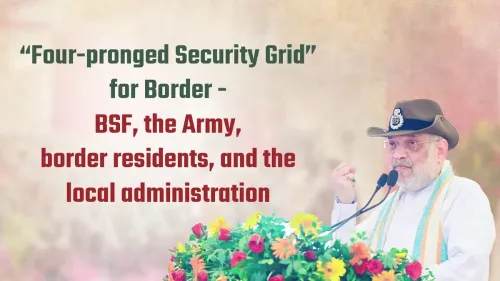
Union Home Minister Amit Shah on Tuesday, 26 May 2026 declared that ensuring zero infiltration is the government's responsibility and that it can be achieved only through what he termed a चार कोणीय सुरक्षा ग्रिड (four-cornered security grid), underscoring the Union Home Ministry's continued emphasis on integrated, technology-backed border management.
Context
In his post on X, Shah stated: 'शून्य घुसपैठ सुनिश्चित करना हमारी जिम्मेदारी, जो चार कोणीय सुरक्षा ग्रिड से ही संभव है' — 'Ensuring zero infiltration is our responsibility, and it is possible only through the four-cornered security grid.' The statement signals a firm policy position from the country's top internal security authority on cross-border infiltration, a challenge that has persisted particularly along sensitive border sectors.
The phrase 'four-cornered security grid' suggests a multi-dimensional framework combining physical barriers, surveillance technology, intelligence coordination, and rapid response — though the precise operational contours of this specific formulation have not yet been formally detailed in public documents.
Policy Backdrop
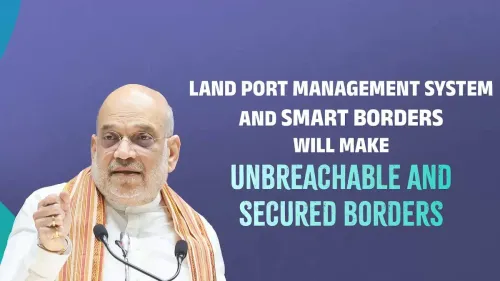
Since 2014, the Union Home Ministry has pursued a doctrine of layered border security, investing in multi-tier fencing, floodlighting, and force deployment along the India-Pakistan and India-Bangladesh borders. The Comprehensive Integrated Border Management System (CIBMS), introduced in 2016-17, sought to fuse technology — including sensors, cameras, and communication networks — with physical infrastructure to plug gaps in vulnerable sectors.
The Border Security Force (BSF), the primary central armed police force responsible for anti-infiltration duties along these borders, has been at the centre of these efforts. Successive Home Ministry statements have consistently framed zero-infiltration as a non-negotiable national security objective, with multi-agency coordination and real-time intelligence sharing positioned as the key enablers.
Jammu and Kashmir, where infiltration across the Line of Control has remained an enduring challenge, has been a focal point of these deployments. Enhanced grid-based patrolling and technology integration in the region have been recurring themes in the government's border security narrative.
Stakeholders and Impact
The most direct stakeholders of any strengthened security grid are the BSF, the Indian Army, state police forces in border districts, and the communities residing in border areas who bear the immediate consequences of infiltration-linked violence and instability. A robust, coordinated grid framework would directly affect the operational tempo and inter-agency communication protocols of these forces.
Border residents in states such as Jammu and Kashmir, Punjab, and West Bengal stand to benefit most from reduced infiltration. At the same time, any major expansion of border infrastructure carries implications for land use, local livelihoods, and civil liberties that policymakers will need to address.
What's Next
Attention will now turn to whether the Union Home Ministry formally articulates the architecture of the 'four-cornered security grid' — including its technological components, budgetary requirements, and geographic scope — in parliamentary statements or policy announcements. Any related allocations in supplementary demands for grants or legislative proposals in Parliament will be closely watched by security analysts and border-state administrations alike. Shah's statement sets the rhetorical and policy benchmark; the operational rollout will determine its real-world impact on infiltration numbers.
Point of View
Integrated threat denial — a doctrine that has become a signature of the current government's internal security posture. By framing zero infiltration as a 'responsibility' rather than an aspiration, Shah is setting a political accountability standard ahead of what may be a formal policy rollout. The statement also signals continued institutional investment in the BSF and allied agencies at a time when border tensions remain elevated on multiple fronts. Whether the four-cornered grid represents a genuinely new operational framework or a rebranding of existing CIBMS-era architecture will be the critical question for security analysts to resolve.
NationPress
9 Oct 2026
Frequently Asked Questions
What is the four-cornered security grid mentioned by Amit Shah?
The 'four-cornered security grid' is a term used by Union Home Minister Amit Shah to describe an integrated border security framework aimed at achieving zero infiltration. Its precise components have not yet been formally detailed in public documents, but the concept aligns with existing multi-layered approaches combining physical barriers, surveillance technology, intelligence sharing, and rapid response.
What is Amit Shah's role in India's border security?
As Union Home Minister, Amit Shah oversees India's internal security apparatus, including the Border Security Force (BSF) and all central armed police forces responsible for anti-infiltration operations along the India-Pakistan and India-Bangladesh borders.
What is the Comprehensive Integrated Border Management System (CIBMS)?
CIBMS is a government initiative launched in 2016-17 that integrates sensors, cameras, communication networks, and physical barriers to create a technology-enabled border surveillance system in vulnerable sectors along India's international borders.
Which borders are most affected by infiltration in India?
The Line of Control in Jammu and Kashmir along the India-Pakistan border and sections of the India-Bangladesh border in West Bengal and other northeastern states are the most persistently affected by cross-border infiltration.
What should we watch for after Amit Shah's zero infiltration statement?
Key developments to watch include formal government announcements detailing the architecture of the four-cornered security grid, any related budgetary allocations in Parliament, and operational deployment updates from the BSF in high-infiltration sectors.