Amit Shah warns infiltrators will be purged from voter rolls
Synopsis
Union Home Minister Amit Shah challenged Congress leader Rahul Gandhi in a sharp post on X, declaring that the BJP will identify illegal infiltrators, delete them from electoral rolls, and deport them from India — reigniting the NRC-CAA debate ahead of state elections.
Key Takeaways
Amit Shah posted on 5 November 2026 challenging Rahul Gandhi to defend illegal infiltrators while declaring BJP will find, disenfranchise, and deport them.
The post invokes the BJP's long-standing 'detect, delete, deport' approach to illegal immigration rooted in the Assam Accord of 1985 .
The National Register of Citizens (NRC) completed in Assam in 2019 excluded nearly 1.9 million residents from the citizenship register.
Shah signalled between 2019 and 2020 that a nationwide NRC was the BJP's goal — a commitment now being refreshed as election season approaches.
Border states West Bengal, Assam, and Tripura are the primary focus, where voter-roll verification drives could begin with fresh administrative directives.
The BJP frames the Congress opposition as protecting infiltrators for electoral gain; Congress argues the NRC-CAA framework is discriminatory.
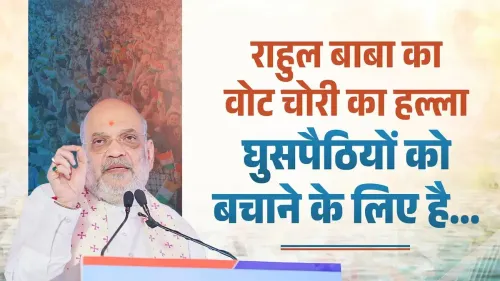
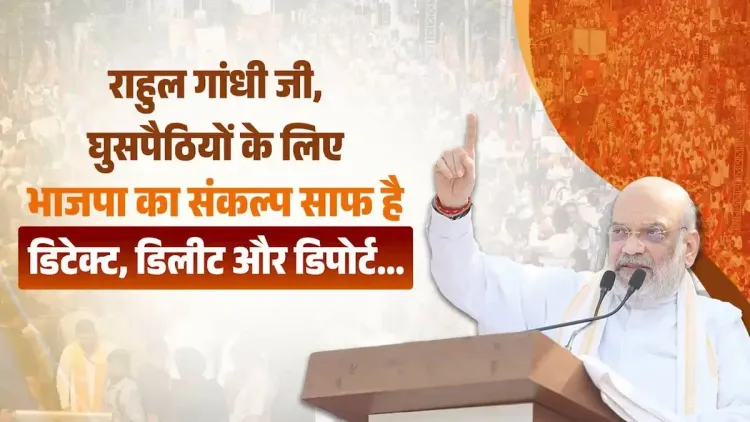
A direct challenge — aimed squarely at Rahul Gandhi — landed on Thursday evening when Union Home Minister Amit Shah declared that the BJP will hunt down illegal infiltrators, strip them from voter lists, and deport them from the country, daring the Congress leader to keep defending them.
Shah's post in Hindi reads: 'Rahul ji, ghuspaiThiyon ke liye jitni chhaati peetni hai peet lijiye' — 'Rahul ji, beat your chest for infiltrators as much as you like; the BJP will find them, remove them from the voter list, and throw them out of the country too.' The message is unambiguous: the ruling party frames illegal immigration not merely as a law-and-order issue but as an electoral integrity crisis that demands active, aggressive resolution.
The long road from Assam NRC to a national promise
The ideological roots of this confrontation run deep. The Assam Accord of 1985 first drew a line in the sand, setting 24 March 1971 as the cut-off date for identifying post-partition illegal immigrants from Bangladesh. Decades later, the National Register of Citizens (NRC) exercise in Assam — concluded in 2019 — attempted to operationalise that accord, producing a list that excluded nearly 1.9 million residents from the citizenship register. Simultaneously, the Citizenship Amendment Act (CAA) was enacted to offer a parallel fast-track for non-Muslim minorities from Pakistan, Bangladesh, and Afghanistan — completing what the BJP described as a 'detect, delete, deport' architecture.
Shah himself, in statements between 2019 and 2020, signalled that a nationwide NRC was the logical next step — a commitment the party has periodically revived as a campaign anchor, particularly ahead of elections in border states.
Shah vs Gandhi: a recurring battle over who infiltrators 'belong' to
The Congress, led in opposition by Rahul Gandhi, has consistently argued that the NRC-CAA combination is discriminatory and targets minorities rather than genuine security threats. The BJP's counter-narrative — sharpened in Thursday's post — accuses the opposition of shielding illegal immigrants for electoral arithmetic, particularly in densely settled districts of West Bengal, Assam, and Tripura where the demographic stakes are highest.
Shah's choice of the phrase 'chhaati peeto' — literally 'beat your chest', meaning to mourn or wail theatrically — is a deliberately combative rhetorical device, casting Gandhi's criticism as performance rather than principle. It signals that the BJP intends to make voter-roll purification a live, visible campaign in the months ahead.
What the voter-list threat means on the ground
Removing names from electoral rolls requires coordination between the Election Commission of India and state governments, involving intensive door-to-door verification drives and legal challenges that can take months or years to resolve. Border states like West Bengal — which has not undergone an NRC exercise — would be the primary theatre. Any fresh directive to state chief electoral officers or district administrations would signal that the political rhetoric is converting into administrative action.
With assembly polls looming across several states, Shah's post is both a policy signal and a political marker: the BJP is staking its identity, once again, on being the party that acts where others, it claims, only talk.
Point of View
He forces the Congress into a defensive posture: either defend immigration scrutiny as harsh or be painted as sympathisers of illegal entrants. The post also serves as a public pressure signal to state administrations and the Election Commission to accelerate voter-roll verification, lending bureaucratic urgency to political rhetoric. The broader arc is clear: since 2019 the BJP has incrementally built an NRC-CAA framework, and each election cycle sees that framework weaponised as proof of decisiveness against a 'soft' opposition.
NationPress
6 Nov 2026
Frequently Asked Questions
What did Amit Shah say about illegal infiltrators?
On 5 November 2026 , Amit Shah posted on X challenging Rahul Gandhi, stating that the BJP will identify illegal infiltrators, remove them from India's voter lists, and deport them from the country.
What is the NRC and how does it relate to infiltrators?
The National Register of Citizens (NRC) is an Assam-specific exercise completed in 2019 to identify genuine citizens and exclude suspected illegal immigrants, primarily from Bangladesh. It excluded nearly 1.9 million residents and forms the basis of the BJP's broader 'detect, delete, deport' policy.
What is Rahul Gandhi's position on illegal immigration and NRC?
Congress leader Rahul Gandhi has consistently opposed the NRC-CAA framework, arguing it is discriminatory and targets minorities rather than addressing genuine national security concerns.
Could illegal immigrants actually be removed from Indian voter rolls?
Yes, but it requires a legally intensive process involving door-to-door verification by state governments and the Election Commission of India , which can take months or years and is subject to judicial challenge.
Which states are most affected by the illegal immigration debate?
Assam, West Bengal, and Tripura are the primary focus states, sharing borders with Bangladesh and housing large populations whose citizenship documentation has historically been disputed.