CM Mann's Punjab rolls out e-Challan in Amritsar, 4th city covered
Synopsis
Amritsar has become the fourth Punjab city to adopt the automated e-Challan traffic enforcement system, joining SAS Nagar, Jalandhar, and Ludhiana. The CM Bhagwant Mann-led government announced the move on June 1, 2026, as part of its technology-driven policing agenda aimed at greater transparency and improved road safety.
Key Takeaways
Amritsar is now the fourth city in Punjab to implement the automated e-Challan System for traffic enforcement.
The city joins SAS Nagar (Mohali) , Jalandhar , and Ludhiana in the phased rollout.
The system uses camera-linked automation to detect violations and generate electronic fines, reducing manual intervention.
The initiative is part of CM Bhagwant Mann 's broader technology-in-policing agenda launched after the 2022 Punjab elections.
Punjab's approach mirrors automated enforcement models adopted in Delhi , Maharashtra , and Karnataka following the 2019 Motor Vehicles Act amendments.
Official enforcement statistics from the four operational cities have not yet been publicly released.
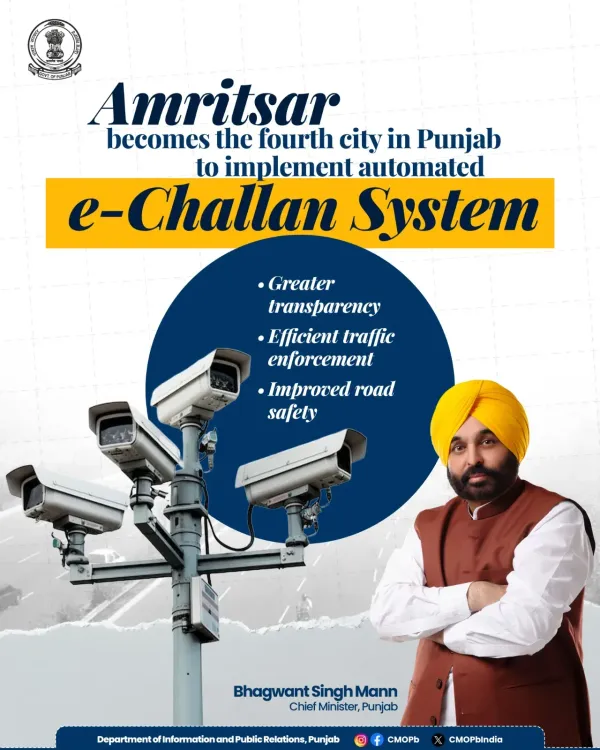
The Chief Minister's Office of Punjab announced on Monday, June 1, 2026, that Amritsar has become the fourth city in the state to implement the automated e-Challan System for traffic enforcement, continuing the Bhagwant Mann-led government's push for technology-driven policing.
Context
The official announcement confirmed that Amritsar now joins SAS Nagar (Mohali), Jalandhar, and Ludhiana in adopting the camera-linked automated enforcement platform. The system detects traffic violations, generates electronic fines, and is designed to reduce manual intervention by traffic personnel. According to the post, the initiative aims to promote 'greater transparency, efficient traffic enforcement, and improved road safety' across the city.
Policy Backdrop
The e-Challan rollout is part of a broader technology-in-policing agenda the Aam Aadmi Party government in Punjab committed to after winning the March 2022 state elections. The approach links enforcement data with central vehicle databases, bringing Punjab in line with states such as Delhi, Maharashtra, and Karnataka that introduced similar camera-based systems following amendments to the Motor Vehicles Act in 2019. Those amendments significantly raised penalties for traffic violations and pushed state governments to modernise enforcement infrastructure.
The phased, city-by-city deployment model allows authorities to calibrate the system before a wider statewide rollout. SAS Nagar and Ludhiana — a major industrial hub — were among the earlier adopters, providing an operational template for subsequent cities including Amritsar, which carries additional significance as Punjab's largest religious and commercial centre.
Stakeholders and Impact
Urban motorists in Amritsar will be the most immediately affected, as the system removes the discretion that typically accompanies manual challan issuance, reducing the scope for on-the-spot settlements. Punjab Traffic Police personnel in the city are expected to shift toward a monitoring and response role rather than direct enforcement at intersections. Civil society groups and road-safety advocates have broadly welcomed automated enforcement as a tool to improve compliance on high-density corridors.
For the state government, the expansion represents a visible deliverable on its digital-governance agenda. Amritsar's inclusion is particularly notable given the city's heavy tourist and pilgrimage footfall around the Golden Temple, where traffic management has historically been a persistent challenge.
What's Next
With four cities now covered, attention will turn to whether the Punjab government announces a timeline for extending the e-Challan network to smaller district headquarters and towns. Official enforcement statistics — including violation counts and fine recovery figures — from the four operational cities have not yet been made public, and their release would offer the first measurable gauge of the system's impact. Any statewide expansion plan, if announced, would mark a significant step in CM Bhagwant Mann's stated goal of making Punjab's policing infrastructure fully technology-backed.
Point of View
Low-risk expansion strategy that allows the AAP government to showcase governance deliverables while managing implementation risk. Choosing Amritsar — Punjab's most symbolically prominent city — as the fourth node signals confidence in the system's operational readiness and maximises political visibility. The move fits a wider national pattern where state governments use automated traffic enforcement to demonstrate tech-forward governance without requiring large capital outlays. The missing piece remains public data: without published enforcement and compliance figures from the earlier three cities, independent assessment of the system's actual impact on road safety is not yet possible.
NationPress
16 Oct 2026
Frequently Asked Questions
What is the e-Challan System in Punjab?
The e-Challan System is a camera-linked automated platform that detects traffic violations and generates electronic fines without manual intervention by traffic police. It is part of the Punjab government's technology-driven policing initiative under CM Bhagwant Mann.
Which cities in Punjab have the e-Challan System?
As of June 1, 2026, four Punjab cities have implemented the e-Challan System: SAS Nagar (Mohali), Jalandhar, Ludhiana, and Amritsar, with Amritsar being the most recent addition.
When did Amritsar get the automated e-Challan System?
Amritsar's adoption of the automated e-Challan System was announced on June 1, 2026, by the Chief Minister's Office of Punjab.
How does the Punjab e-Challan System improve road safety?
By automating the detection of traffic violations through cameras and issuing fines electronically, the system removes manual discretion from enforcement, reduces the scope for informal settlements, and aims to improve compliance among motorists.
Will the e-Challan System expand to more Punjab cities?
No official timeline has been announced yet, but the phased rollout across four cities suggests further expansion to smaller district headquarters is likely as the government's digital policing agenda progresses.