Anurag Thakur Addresses EPF-ESI Camp for Contract Workers
Synopsis
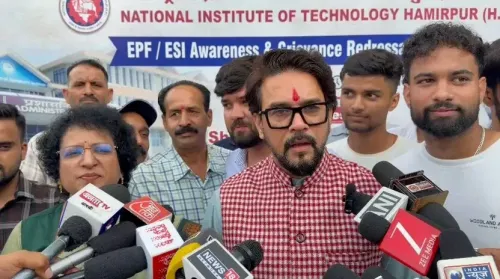
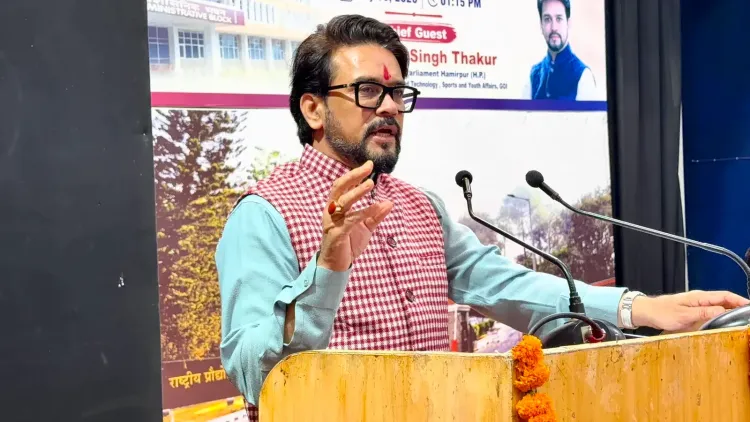
BJP MP Anurag Thakur addressed a one-day EPF and ESI awareness and grievance camp at NIET Hamirpur on 8 July 2026, underlining the Modi government's consolidation of 29 central labour laws into four codes as a constitutional guarantee for India's contract workforce.
Key Takeaways
BJP MP Anurag Thakur addressed an EPF and ESI awareness and grievance-redressal camp at NIET Hamirpur on 8 July 2026 .
The Modi government consolidated 29 central labour laws into four Labour Codes : Code on Wages 2019, Industrial Relations Code 2020, Code on Social Security 2020, and OSH Code 2020.
Thakur described the four codes as 'your constitution' for contract workers, asserting they protect workers' rights the way the Constitution protects citizens.
EPF provides retirement security while ESI covers medical care and cash benefits for eligible contract and organised-sector workers.
Implementation of the four codes depends on state-level rule-making, which remains at varying stages across India.
The camp aimed to bridge the gap between statutory entitlements and actual enrolment among contract workers in Hamirpur constituency.
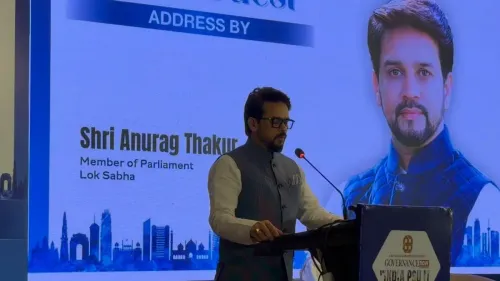
BJP MP Anurag Thakur addressed a one-day EPF and ESI awareness and grievance-redressal camp for contract workers at NIET Hamirpur, Himachal Pradesh, on 8 July 2026, highlighting the Modi government's labour welfare initiatives over the past twelve years.
Context
Thakur, speaking at the camp, stated that the welfare, social security, and financial protection of contract workers — संविदा श्रमिक — is a stated priority of the Modi government. He noted that over twelve years, the government has enacted several laws to safeguard the rights and benefits of contract workers, many of whom previously had neither present-day security nor future protection under the older statutory regime.
Addressing attendees, he described the Four Labour Codes as 'your constitution' — आपका संविधान — saying they protect workers' interests in the same way the Constitution of India protects citizens' fundamental rights.
Policy Backdrop
India's labour law landscape was historically fragmented across 29 central labour statutes, many of which were enacted in the decades immediately after independence and were seen as poorly suited to the modern workforce, particularly informal and contract workers. The Modi government consolidated these into four codes: the Code on Wages 2019, the Industrial Relations Code 2020, the Code on Social Security 2020, and the Occupational Safety, Health and Working Conditions (OSH) Code 2020.
The Code on Wages was the first to be passed by Parliament in 2019, followed by the remaining three during the 2020 monsoon session. The consolidation is considered the most sweeping overhaul of India's labour framework since independence, shifting the emphasis from inspector-driven enforcement to self-certification while mandating social security registration for a wider category of workers, including those in contract and gig arrangements.
EPF and ESI: What the Camp Covered
The Employees' Provident Fund (EPF) is a statutory scheme that provides retirement savings and financial security to workers in the organised and contract sectors. The Employees' State Insurance (ESI) is a contributory health insurance programme covering medical care and cash benefits in the event of sickness, maternity, or workplace injury.
Awareness camps of this kind are designed to bridge the information gap between statutory entitlements and actual enrolment, particularly in semi-urban and rural constituencies where contract workers may be unaware of their eligibility. Hamirpur, the constituency Thakur has represented in the Lok Sabha, served as the venue, underlining the local outreach dimension of the initiative.
Stakeholders and Impact
Contract workers — spread across construction, manufacturing, hospitality, and the informal services sector — represent one of India's largest and most economically vulnerable labour categories. Historically excluded from or under-served by social security frameworks, they stand to benefit most directly from the expanded coverage envisaged under the Code on Social Security 2020.
Implementation, however, has been uneven. The four codes require individual states to frame their own rules before provisions can be notified and enforced. Several states are at varying stages of this process, meaning that the full protective architecture of the codes has yet to reach workers on the ground uniformly across India.
What's Next
The pace of state-level rule-making will determine when and how comprehensively the four codes translate into on-the-ground protections for contract workers. Camps such as the one held at NIET Hamirpur represent an interim measure — using existing EPF and ESI machinery to extend awareness and resolve grievances while the broader legislative architecture awaits full notification. Further Ministry of Labour and Employment notifications expanding EPF and ESI eligibility to new worker categories, including platform and gig workers, remain a key policy watch-point in the months ahead.
Point of View
Seeking to invest technocratic consolidation with the moral weight of fundamental rights. Yet the gap between legislative intent and ground-level implementation — contingent on state rule-making that remains incomplete — is the central tension this kind of awareness drive cannot by itself resolve. The Modi government's ability to point to enacted codes while actual worker coverage lags will likely remain a contested political space as the 2026-27 electoral cycle approaches in several states.
NationPress
8 Jul 2026
Frequently Asked Questions
What are the four Labour Codes introduced by the Modi government?
The four Labour Codes are the Code on Wages 2019, the Industrial Relations Code 2020, the Code on Social Security 2020, and the Occupational Safety, Health and Working Conditions Code 2020. Together they replace 29 earlier central labour statutes.
What is EPF and who is eligible for it?
EPF stands for Employees' Provident Fund, a statutory retirement savings scheme. It covers workers in the organised sector and, increasingly, contract workers as coverage has been expanded under successive government notifications.
What is ESI and what benefits does it provide?
ESI stands for Employees' State Insurance, a contributory health insurance scheme. It provides medical care, sickness cash benefits, maternity benefits, and coverage for workplace injuries to eligible workers and their dependants.
What did Anurag Thakur do at the NIET Hamirpur camp on 8 July 2026?
Anurag Thakur addressed a one-day EPF and ESI awareness and grievance-redressal camp for contract workers at NIET Hamirpur, explaining government labour welfare schemes and the protections offered by the four Labour Codes.
Have the four Labour Codes been implemented across all states in India?
Not uniformly. The four codes require each state to frame its own rules before provisions can be enforced. Implementation is at varying stages across states, meaning full coverage has not yet reached all workers.