Anurag Thakur chairs Steel QCO review at Parliamentary panel

Synopsis
BJP MP Anurag Thakur chaired the Parliamentary Standing Committee on Coal, Mines and Steel on November 5, 2026, to review Quality Control Orders in the steel sector, with officials from the Ministry of Steel, BIS, and SAIL attending discussions on quality standards, domestic competitiveness, and Aatmanirbhar Bharat goals.
Key Takeaways
Anurag Thakur chaired the Standing Committee on Coal, Mines and Steel on November 5, 2026 to review steel-sector Quality Control Orders.
Officials from the Ministry of Steel , Bureau of Indian Standards , Jago Grahak Jago , and SAIL participated in the discussions.
The review focused on strengthening quality standards, boosting domestic steel competitiveness, and advancing Aatmanirbhar Bharat self-reliance goals.
Quality Control Orders in steel have been progressively introduced since the mid-2010s to curb sub-standard imports and enforce Indian Standards certification.
Formal committee recommendations, if any, would be acted upon by the Ministry of Steel through revised QCO notifications.
Steel remains central to India's infrastructure, defence, and manufacturing ambitions under both Make in India and Aatmanirbhar Bharat .
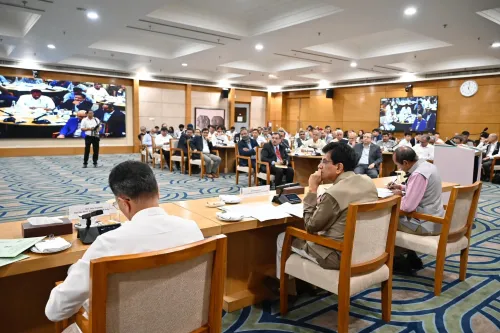
Steel is the skeleton of every road, bridge, and factory India is racing to build — and on Thursday, November 5, 2026, BJP MP Anurag Thakur put the quality of that skeleton under the microscope. Thakur chaired a meeting of the Standing Committee on Coal, Mines and Steel focused on reviewing Quality Control Orders (QCOs) in the steel sector, bringing together officials from the Ministry of Steel, the Bureau of Indian Standards (BIS), consumer affairs body Jago Grahak Jago, and the Steel Authority of India Limited (SAIL).
What QCOs do — and why the review matters now
Quality Control Orders are legally binding instruments that mandate Indian Standards certification for specified products, effectively barring sub-standard or uncertified steel — including cheap imports — from the domestic market. India began introducing QCOs for steel products from the mid-2010s onward, progressively tightening the standards regime as domestic capacity expanded. The periodic review process ensures those orders keep pace with evolving production technologies and industrial demand.
The standing committee's session, according to Thakur's post, zeroed in on three linked priorities: strengthening quality standards, enhancing the competitiveness of domestic producers, and advancing self-reliance under the Aatmanirbhar Bharat framework. All three are interconnected — a tighter QCO regime raises the floor for every tonne of steel that enters the market, domestic or imported, pushing producers to invest in quality while simultaneously making it harder for underpriced, below-standard foreign material to undercut them.
Steel's place in the Aatmanirbhar and Make in India architecture
Make in India, launched in September 2014, identified steel as a foundational input for every sector it aimed to promote — from defence platforms to metro rail to affordable housing. Aatmanirbhar Bharat, announced in May 2020, doubled down on that logic by explicitly linking quality standards enforcement with reducing import dependence in strategic materials.
SAIL, the country's largest public-sector steel producer, is both a direct stakeholder in QCO outcomes and a benchmark setter: its product quality and pricing influence how the broader market responds to tightened standards. The presence of BIS officials signals that any revised or new QCO notifications would flow through the national standards body before reaching the Ministry of Steel for implementation.
What industry is watching next
The standing committee's review is a precursor to formal recommendations. If the panel proposes expanding the list of steel products covered by QCOs, or tightening certification timelines, the Ministry of Steel would need to issue revised notifications — a process that directly affects domestic steel producers, industrial consumers, and importers alike. The pace at which those recommendations are translated into policy will be the real indicator of whether Thursday's meeting moves the needle or remains a deliberative exercise.
India's infrastructure ambitions — National Infrastructure Pipeline projects, defence manufacturing corridors, and the ongoing housing push — all depend on a steady supply of certified, quality steel. Getting the QCO framework right is not a paperwork exercise. It is industrial policy in action.
Point of View
Steering this review signals a continued stake in economic-nationalist policy architecture even from the legislature rather than the executive. The outcome will test whether parliamentary committees can generate actionable standards reform, or whether the momentum stalls in the gap between recommendation and Ministry notification.
NationPress
5 Nov 2026
Frequently Asked Questions
What are Quality Control Orders in the steel sector?
Quality Control Orders (QCOs) are government-issued directives that make it mandatory for specific steel products to conform to Indian Standards and carry BIS certification before they can be sold in India — covering both domestically produced and imported material.
Why did the Parliamentary committee review steel QCOs?
The Standing Committee on Coal, Mines and Steel conducts periodic reviews to assess whether existing quality standards remain effective, identify gaps that allow sub-standard imports, and recommend updates aligned with India's self-reliance and manufacturing competitiveness goals.
What is SAIL's role in the steel QCO framework?
Steel Authority of India Limited (SAIL) is India's largest public-sector steel producer and participates in QCO consultations as a key industry stakeholder, with its product standards often serving as a benchmark for the broader domestic market.
How do QCOs support Aatmanirbhar Bharat in the steel sector?
By mandating BIS certification and Indian Standards compliance, QCOs make it difficult for cheaper, sub-standard foreign steel to undercut domestic producers, directly reinforcing the import-substitution and quality-upgrade goals of the Aatmanirbhar Bharat initiative.
What happens after the Standing Committee reviews steel QCOs?
The committee can submit formal recommendations to the Ministry of Steel, which may then issue revised or new QCO notifications specifying updated product categories, certification timelines, and enforcement mechanisms.